


An actor resignation letter is a formal notice. It tells an employer that an actor is leaving their job. This letter officially ends the actor’s employment.
Crafting the perfect resignation can be tricky. Don’t worry, we’ve got you covered. We’ll provide a selection of templates and examples. These samples will guide you.
Use these to create your own letter. Need a specific tone? Want to be brief? We have options. Find the perfect fit for your situation.
Actor Resignation Letter
Below is a sample of a Actor Resignation Letter:
[Your Name]
[Your Address]
[Your Phone Number]
[Your Email Address]
[Date]
[Recipient Name/Company Name]
[Recipient Title]
[Company Address]
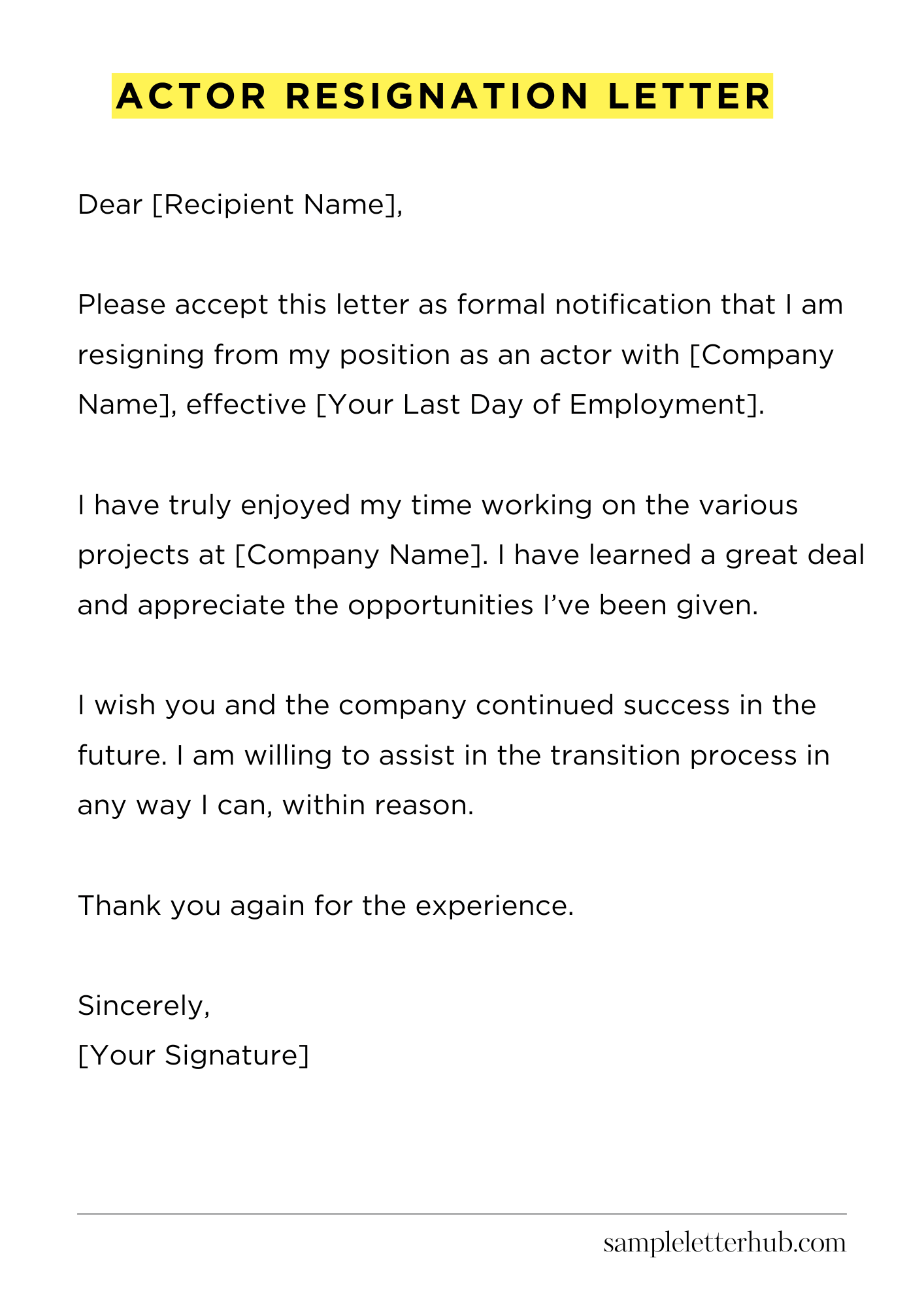
Dear [Recipient Name],
Please accept this letter as formal notification that I am resigning from my position as an actor with [Company Name], effective [Your Last Day of Employment].
I have truly enjoyed my time working on the various projects at [Company Name]. I have learned a great deal and appreciate the opportunities I’ve been given.
I wish you and the company continued success in the future. I am willing to assist in the transition process in any way I can, within reason.
Thank you again for the experience.
Sincerely,
[Your Signature]
How to Write an Actor Resignation Letter
So, you’ve decided to hang up your acting boots. Whether it’s to pursue a new passion, move to a different city, or simply because you’re ready for a change, resigning from an acting role requires a professional and thoughtful approach.
This is not just about quitting; it’s about maintaining relationships and leaving a positive impression, even as you move on. Let’s break down how to craft a resignation letter that does just that.
1. Formalities: The Essential Elements
Your resignation letter is a formal document. Make sure it looks the part. Begin with your full name, address, and contact information. Then, add the date, followed by the recipient’s name, title (e.g., Casting Director, Agent), and the company’s address. Use a formal salutation like “Dear Mr./Ms. [Last Name].” This is the standard for any professional letter, and it sets the tone.
Now, to the core of the matter! Start by clearly stating your intention to resign. Keep it straightforward: “Please accept this letter as formal notification that I am resigning from my role as [Your Role] effective [Your Last Day of Employment].” This is the meat and potatoes; get straight to the point. Be sure to confirm the specific date of your final day of employment.
2. Expressing Gratitude: The Power of Thank You
Acting is a collaborative industry. Even if things haven’t always been perfect, taking the time to express gratitude is crucial. This shows respect for the opportunity you were given.
Thank the individual or company for the experience and the opportunities provided. You could write something like: “I am grateful for the opportunity to have worked on [Project Name] and for the experiences I gained during my time here.”
Consider mentioning specific positive aspects of your experience. Did you enjoy working with a particular director? Did you learn valuable skills? Highlighting these positives not only makes your letter more genuine but also helps maintain a positive relationship. Remember, the acting world is often small; keeping doors open is key.
3. Providing a Reason (Optional, But Sometimes Helpful)
You don’t *have* to provide a reason for resigning. However, in certain situations, it might be beneficial. If you are leaving for a better opportunity, you can briefly and professionally mention it. For instance: “I have accepted a new role that will allow me to further develop my skills.”
If you’re leaving for personal reasons, you can keep it vague: “I am pursuing personal interests at this time.” Avoid negativity or complaints. The goal is to maintain a positive relationship. The less drama the better, always.
4. Offering Assistance: Show You Care
Offering your assistance during the transition shows professionalism and consideration. Suggest you will assist in finding a replacement or completing ongoing tasks. This adds a level of courtesy that will be appreciated. “I am happy to assist in the transition process, including the handover of any unfinished tasks.”
Be available for a phone call if needed. This may be of great help to the person that is going to be assigned on your role. This is your chance to shine and go the extra mile. Offering help is a sign of a good team member.
5. Closing and Signature: Making it Official
End your letter with a professional closing, such as “Sincerely,” or “Respectfully,” followed by your signature above your typed name. If you are sending a digital letter, consider adding your name, contact information, and signature in an image at the end. Proofread carefully before sending.
And there you have it! By following these steps, you can craft a resignation letter that is professional, respectful, and leaves a positive lasting impression. Good luck with your next chapter.
FAQs about Actor Resignation Letter
What is the primary purpose of an actor resignation letter?
The primary purpose of an actor’s resignation letter is to formally notify their employer (e.g., agent, casting director, theatre company, production house) of their decision to terminate their employment or representation. It serves as an official record of the resignation, clarifies the last day of work or representation, and often expresses gratitude or provides reasons for leaving.
What key information should be included in an actor’s resignation letter?
A well-crafted actor resignation letter typically includes the actor’s full name, the date of the letter, the name of the employer or agent, a clear statement of resignation, the effective date of resignation (last day of employment or representation), any handover details or outstanding commitments, a statement of gratitude (optional but recommended), and the actor’s signature.
Contact information for future correspondence is also usually included.
How far in advance should an actor submit their resignation letter?
The notice period for an actor’s resignation letter depends on the terms of the contract or agreement in place. It’s crucial to review the contract for clauses pertaining to termination and notice periods.
In the absence of specific contractual agreements, a standard notice of two to four weeks is generally considered professional. However, for significant roles, longer notice periods might be expected.
Should an actor provide a reason for resigning in their letter?
Providing a reason for resigning in an actor’s letter is optional. While it’s not always necessary, including a brief and professional explanation, such as pursuing other opportunities or a change in career direction, can be helpful. Avoid negative comments or personal grievances. Keeping the explanation concise and positive is advisable to maintain a professional tone.
What are the common mistakes to avoid when writing an actor’s resignation letter?
Common mistakes to avoid include: not adhering to contractual obligations for notice; using unprofessional or overly emotional language; including excessive details about the reasons for leaving; failing to express gratitude; and neglecting to proofread the letter carefully for errors in grammar, spelling, or punctuation.
It is best to avoid burning bridges by making disparaging remarks about the employer or colleagues.
Related:
Resignation letter due to rude boss
Resignation letter moving to another state
Resignation letter due to illness of family member
Resignation letter due to study