

An Assistant Manager HR resignation letter is a formal document. Its purpose is to officially announce your departure from the company. It notifies your employer about your last working day. This letter helps to ensure a smooth transition.
Preparing to leave a job can be overwhelming. Writing the resignation letter might feel like a big hurdle. Don’t worry, we’re here to help. We’ll share several templates and examples.
You’ll find various sample letters. These cover different scenarios. Whether you’re moving on for a new opportunity or personal reasons, we have you covered. Use these to craft your own perfect letter.
Assistant Manager Hr Resignation Letter
Below is a sample of a Assistant Manager Hr Resignation Letter:
[Your Name]
[Your Address]
[Your Phone Number]
[Your Email Address]
[Date]
[Manager’s Name] (or HR Department)
[Company Name]
[Company Address]
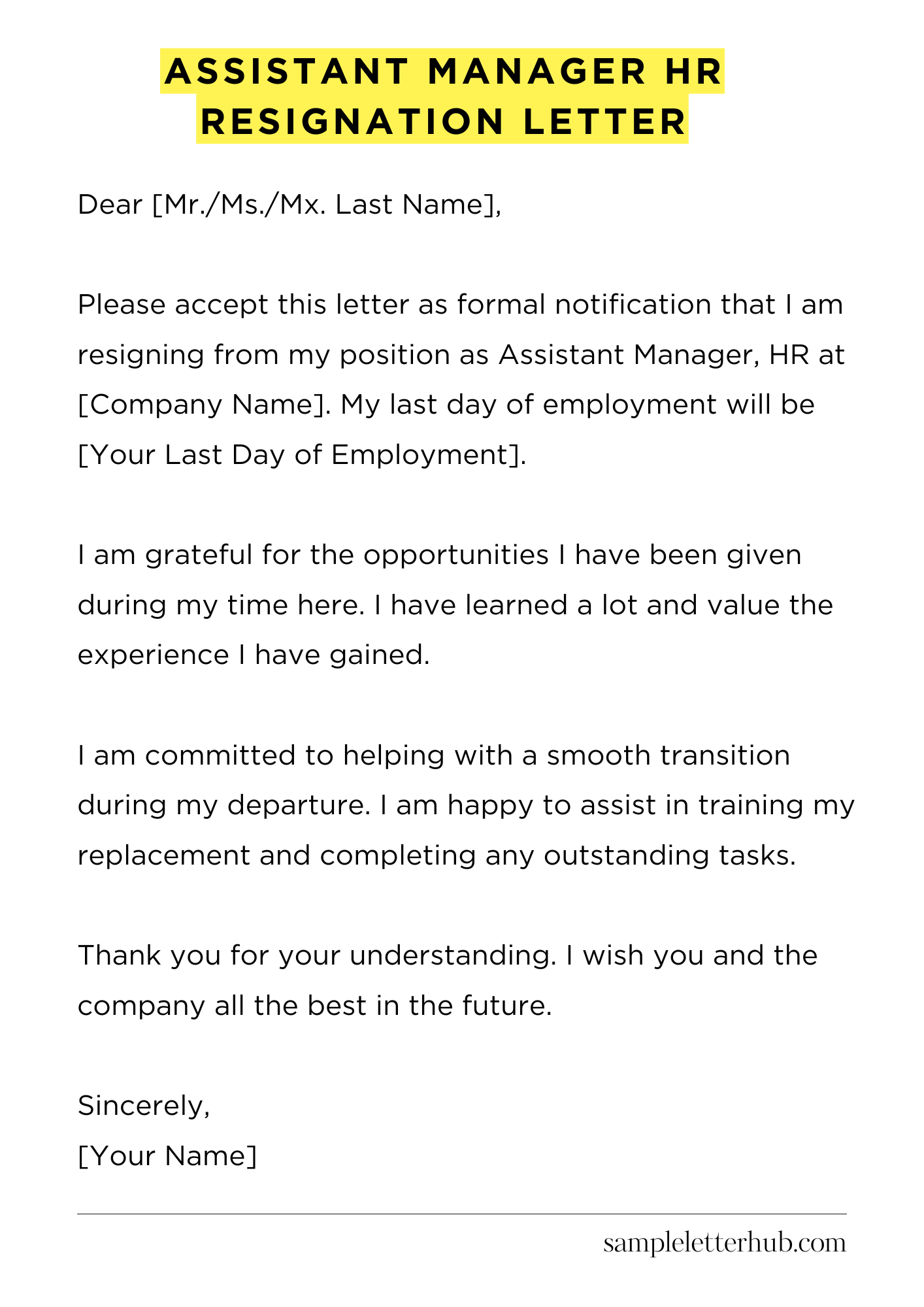
Dear [Mr./Ms./Mx. Last Name],
Please accept this letter as formal notification that I am resigning from my position as Assistant Manager, HR at [Company Name]. My last day of employment will be [Your Last Day of Employment].
I am grateful for the opportunities I have been given during my time here. I have learned a lot and value the experience I have gained.
I am committed to helping with a smooth transition during my departure. I am happy to assist in training my replacement and completing any outstanding tasks.
Thank you for your understanding. I wish you and the company all the best in the future.
Sincerely,
[Your Name]
How to Write Assistant Manager HR Resignation Letter
1. Grasp the Basics: What’s Essential?
Resigning from any job can be tricky. However, when it’s an Assistant Manager HR role, things are slightly different. You’ll be dealing with personnel files, company policies, and perhaps, even legal considerations. So, let’s start with the basics. Your letter is a formal document. Therefore, it needs to be professional in tone and formatting. Be clear and concise. Keep it straightforward.
Always include the date, your name, job title, and the name of your superior. Then, state your intention to resign. Specify your last day of employment. This is critical. You might have to refer to your employment contract. Double-check your company’s policy regarding notice periods. These vary. Don’t forget to express your gratitude for the opportunity. It’s simply good practice.
2. Structure for Success: Crafting the Perfect Letter
The structure of your resignation letter is key. This is how you organize your thoughts for maximum impact. Begin with a clear and direct statement of your resignation. After the date and basic information, start with a simple sentence like, “Please accept this letter as formal notification that I am resigning from my position as Assistant Manager HR, effective [Date].” Straight to the point.
Next, offer a brief, positive statement about your experience. Consider, “I have greatly valued my time at [Company Name] and have appreciated the opportunities I’ve been given.” Keep it short.
This is not the place for lengthy complaints or overly detailed explanations. You do not need to provide a reason for your resignation. However, if you’re comfortable, you can include one brief, professional reason. Something like, “I am pursuing other career opportunities.”
Finally, end with a note of thanks. This is often overlooked. But it is very important. Offer to assist with the transition.
It can be something like, “I am committed to ensuring a smooth handover of my responsibilities and am available to assist in training my replacement.” Conclude with a polite closing, such as “Sincerely” or “Respectfully,” followed by your signature and printed name.
3. What to Include: The Crucial Elements
Certain elements are non-negotiable in your letter. As mentioned, the date is crucial, followed by your name and title. Clearly state your intention to resign. Provide your last day of employment. This is essential for HR purposes. It helps with payroll and other administrative tasks.
Also, express gratitude. A simple “Thank you for the opportunity” can make a world of difference. Offer to help with the transition. This showcases professionalism and a commitment to your previous employer. Always include your contact information. This can be important for any final communication or paperwork.
4. What to Avoid: Common Mistakes
There are some things you should avoid in your resignation letter. Stay away from negative comments about the company or your colleagues. This is not the time to air grievances. Keep it positive. Or at least neutral. Don’t include personal attacks. These will not serve your long-term goals. They can burn bridges.
Avoid excessive detail about your reasons for leaving. Unless you have a good relationship with your superior, it’s best to keep the reasons vague. Do not make demands or threats.
This is not the place to negotiate. Finally, proofread your letter carefully. Spelling and grammatical errors make a bad impression. They lack professionalism. Ask a friend to read it over, too.
5. Sample Letter: A Practical Example
Here is a sample resignation letter. Feel free to adapt this to your situation. Remember to customize it with your specific details.
[Your Name]
[Your Address]
[Your Phone Number]
[Your Email Address]
[Date]
[Manager’s Name]
[Manager’s Title]
[Company Name]
[Company Address]
Dear [Manager’s Name],
Please accept this letter as formal notification that I am resigning from my position as Assistant Manager HR at [Company Name], effective [Your Last Day of Employment].
I have greatly valued my time at [Company Name] and appreciate the opportunities I have been given during my employment. I will be pursuing other opportunities.
I am committed to ensuring a smooth handover of my responsibilities and am available to assist in training my replacement. Please let me know how I can be of assistance during this transition.
Thank you again for the opportunity.
Sincerely,
[Your Signature]
[Your Typed Name]
FAQs about Assistant Manager HR Resignation Letter
What is the primary purpose of an Assistant Manager HR resignation letter?
The primary purpose of an Assistant Manager HR resignation letter is to formally notify the employer of the employee’s intention to leave the position. It serves as an official record of the resignation, the last day of employment, and often includes a brief statement of gratitude or explanation for leaving.
What key elements should be included in an Assistant Manager HR resignation letter?
An effective Assistant Manager HR resignation letter should include: a clear and concise statement of resignation, the specific date of resignation, the employee’s name and job title, the recipient’s name and title (usually the direct supervisor or HR department), and a professional tone.
It may optionally include a brief statement of appreciation or a reason for leaving, though this is not always required.
How much notice should an Assistant Manager HR give when resigning?
The amount of notice required typically depends on the company’s policy and any employment contracts. Standard practice is often two weeks’ notice, but it’s important to consult the employee’s contract or company handbook to ensure compliance with the required notice period. Some positions may require longer notice.
Should I provide a reason for resigning in my Assistant Manager HR resignation letter?
Providing a reason for resigning is optional. While it’s generally acceptable to offer a brief, neutral explanation (e.g., “to pursue another opportunity” or “for personal reasons”), you are not obligated to disclose detailed reasons. Keep the tone positive and professional, regardless of the reasons.
What should I do after submitting my Assistant Manager HR resignation letter?
After submitting the resignation letter, follow up with your supervisor or HR representative to confirm receipt and discuss the next steps, such as exit interviews, return of company property, and final paycheck arrangements. Continue to perform your duties diligently during the notice period and maintain a professional demeanor throughout the transition process.
Related:
Resignation letter due to rude boss
Resignation letter moving to another state
Resignation letter due to illness of family member
Resignation letter due to study