

A stagehand resignation letter is a formal document. It informs your employer of your intention to leave your job. It marks the official end of your employment. This letter serves several purposes.
This article simplifies the process. We will explore different letter options. You will find templates and examples. These samples cover various scenarios. They are designed to assist you.
We aim to make it easy. Writing a resignation letter is crucial. It ensures a smooth transition. Our resources will help you craft your own letter.
Stagehand Resignation Letter
Below is a sample of a Stagehand Resignation Letter:
[Your Name]
[Your Address]
[Your Phone Number]
[Your Email Address]
[Date]
[Hiring Manager Name] (If known, otherwise use title)
[Hiring Manager Title]
[Theatre/Company Name]
[Theatre/Company Address]
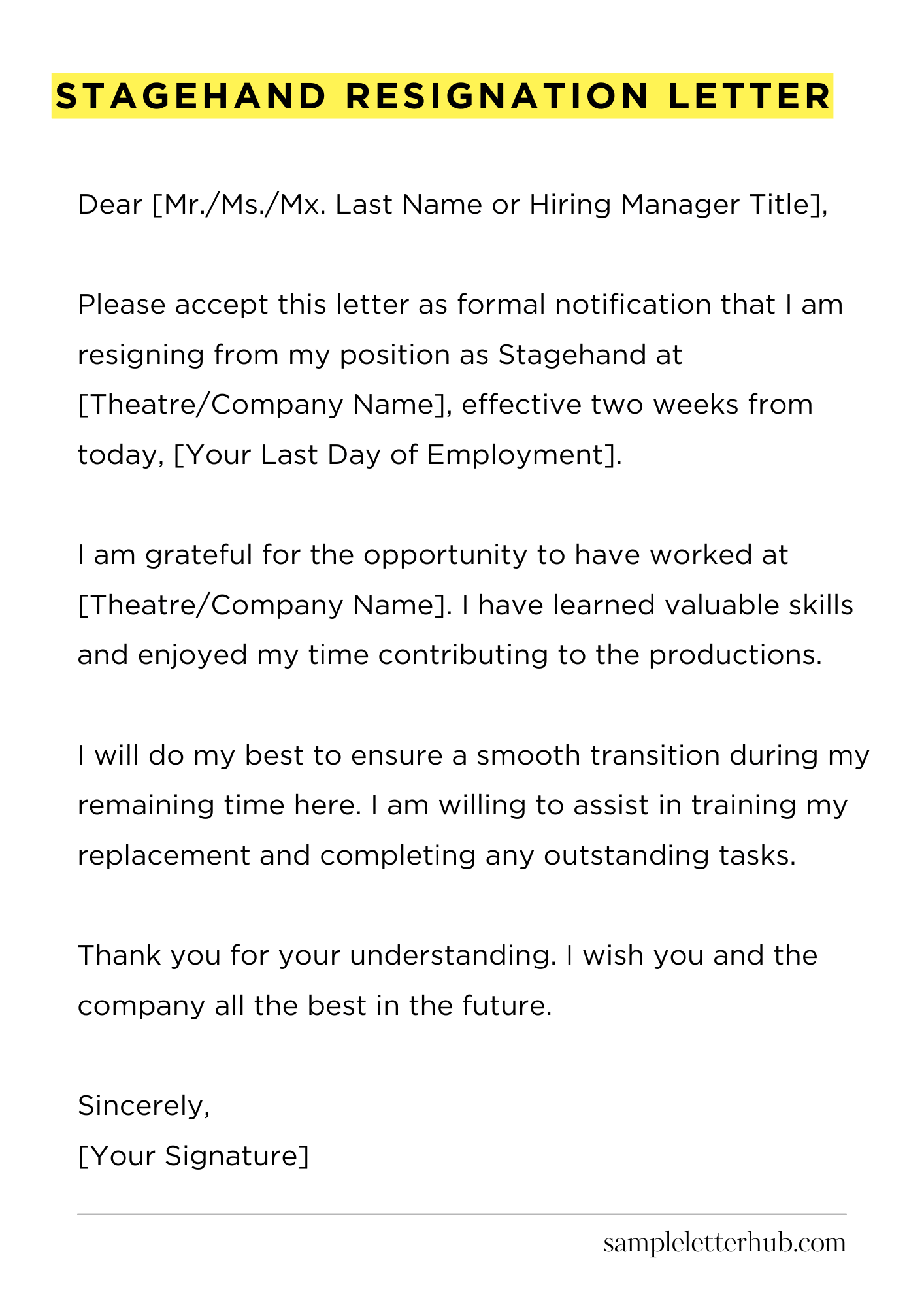
Dear [Mr./Ms./Mx. Last Name or Hiring Manager Title],
Please accept this letter as formal notification that I am resigning from my position as Stagehand at [Theatre/Company Name], effective two weeks from today, [Your Last Day of Employment].
I am grateful for the opportunity to have worked at [Theatre/Company Name]. I have learned valuable skills and enjoyed my time contributing to the productions.
I will do my best to ensure a smooth transition during my remaining time here. I am willing to assist in training my replacement and completing any outstanding tasks.
Thank you for your understanding. I wish you and the company all the best in the future.
Sincerely,
[Your Signature]
How to Write a Stagehand Resignation Letter
So, you’re moving on from the world of stagecraft? Congratulations on your next adventure! Resigning from a job can feel like a big step, and it’s essential to do it professionally. This is especially true in the close-knit world of theatre and live events, where you want to leave a good impression. Your resignation letter is a crucial document that can impact your future opportunities.
Step 1: Get the Basics Right
First things first, your letter needs a professional layout. Start with your name and contact information at the top, followed by the date. Then, address the letter to your immediate supervisor or the person you directly report to. Keep the tone formal but friendly.
Example:
Your Name
Your Address
Your Phone Number
Your Email Address
Date
Supervisor’s Name
Supervisor’s Title
Company Name
Company Address
Step 2: State Your Intent Clearly
This is the core of your letter. It should be concise and direct. Immediately state that you are resigning from your position. Don’t beat around the bush. Mention the date of your last day of employment. This is crucial for their planning. State the date of your last working day.
Example:
“Please accept this letter as formal notification that I am resigning from my position as a Stagehand at [Company Name]. My last day of employment will be [Your Last Day of Employment].”
Step 3: Show Gratitude and a Positive Outlook
Even if the job wasn’t perfect, it’s always a good idea to express gratitude for the opportunities you’ve been given. Briefly mention any positive experiences you’ve had.
This makes you look good. Consider thanking your supervisor or the company for the experience and what you learned. Keep it brief. Showing a positive attitude goes a long way. After all, you might run into these people again in the future.
Example:
“I am grateful for the opportunities I’ve had during my time at [Company Name]. I appreciate the experience I’ve gained and the people I’ve worked with.”
Step 4: Offer to Help with the Transition
A great employee always leaves on good terms. Offer to assist with the transition process. This shows professionalism and a willingness to help. This may involve training a replacement or completing ongoing projects. This offer can make all the difference. Offer your help with any handover tasks. Be willing to make the transition as smooth as possible.
Example:
“I am committed to making this transition as smooth as possible. I am happy to assist in training my replacement and completing any outstanding projects before my departure.”
Step 5: Close with Professionalism
End your letter with a formal closing and your signature. Thank them again for the experience. Then, include your typed name below your signature. Proofread your letter carefully before sending it. Double-check for typos and grammatical errors. Make sure everything is correct. This is the last impression you’ll leave with them, so make it a good one.
Example:
“Sincerely,
[Your Signature]
[Your Typed Name]”
Following these steps will help you write a professional and effective stagehand resignation letter. You will be leaving with your reputation intact and setting yourself up for future success.
FAQs about Stagehand resignation letter
What is the primary purpose of a stagehand resignation letter?
The primary purpose of a stagehand resignation letter is to formally notify an employer of an employee’s intent to leave their position. It serves as an official record of the resignation, the last day of employment, and often, a brief expression of gratitude or future intentions.
This document ensures a clear understanding between the employee and employer, helping to avoid misunderstandings and set a professional tone for the departure.
What key elements should be included in a stagehand resignation letter?
A well-crafted stagehand resignation letter should include: a clear statement of resignation (I am writing to resign from my position as…), the job title held, the effective date of resignation (your last day of employment), a formal salutation and closing (e.g., Dear [Manager’s Name], Sincerely), and optionally, a brief expression of gratitude for the employment experience.
It may also include an offer to assist with the transition, such as training a replacement or completing ongoing projects.
How much notice should a stagehand give when resigning?
The amount of notice a stagehand should give when resigning varies depending on the employment contract, company policy, and local labor laws. However, a general rule of thumb is to provide at least two weeks’ notice.
This allows the employer sufficient time to find a replacement and complete any necessary handoffs. Reviewing the employment contract is crucial to determine the specific notice period required.
Should a stagehand resignation letter include a reason for leaving?
While not mandatory, including a reason for leaving in a stagehand resignation letter is optional. It is generally acceptable to offer a brief, neutral reason, such as “to pursue other opportunities” or “for personal reasons.”
Providing excessive detail about the reasons for leaving is not necessary. If the employee wishes to provide feedback, they may consider doing so in a separate conversation or exit interview.
How should a stagehand handle delivering their resignation letter?
A stagehand should deliver their resignation letter in writing to their direct supervisor or the appropriate person designated by the company. It’s best to hand-deliver the letter in person if possible, or send it via email with a “read receipt” requested.
Keeping a copy of the letter for personal records is also a good practice. After submitting the letter, the stagehand should be prepared to discuss their departure with their supervisor and assist with any necessary transition tasks.
Related:
Resignation letter due to rude boss
Resignation letter moving to another state
Resignation letter due to illness of family member
Resignation letter due to study