

A Branch Sales Manager resignation letter is a formal document. It announces your departure from the company. Its primary purpose is to inform your employer of your intention to resign. It also sets the official date of your last day of employment.
Thinking of moving on? Drafting this letter can feel tricky. We understand it’s a big step. We’re here to help you navigate this process.
This article offers several helpful templates. You’ll find different examples. These samples will guide you. They’ll make writing your own letter easier.
Branch Sales Manager Resignation Letter
Below is a sample of a Branch Sales Manager Resignation Letter:
[Your Name]
[Your Address]
[Your Phone Number]
[Your Email Address]
[Date]
[Recipient Name] (If known, otherwise use title)
[Recipient Title]
[Company Name]
[Company Address]
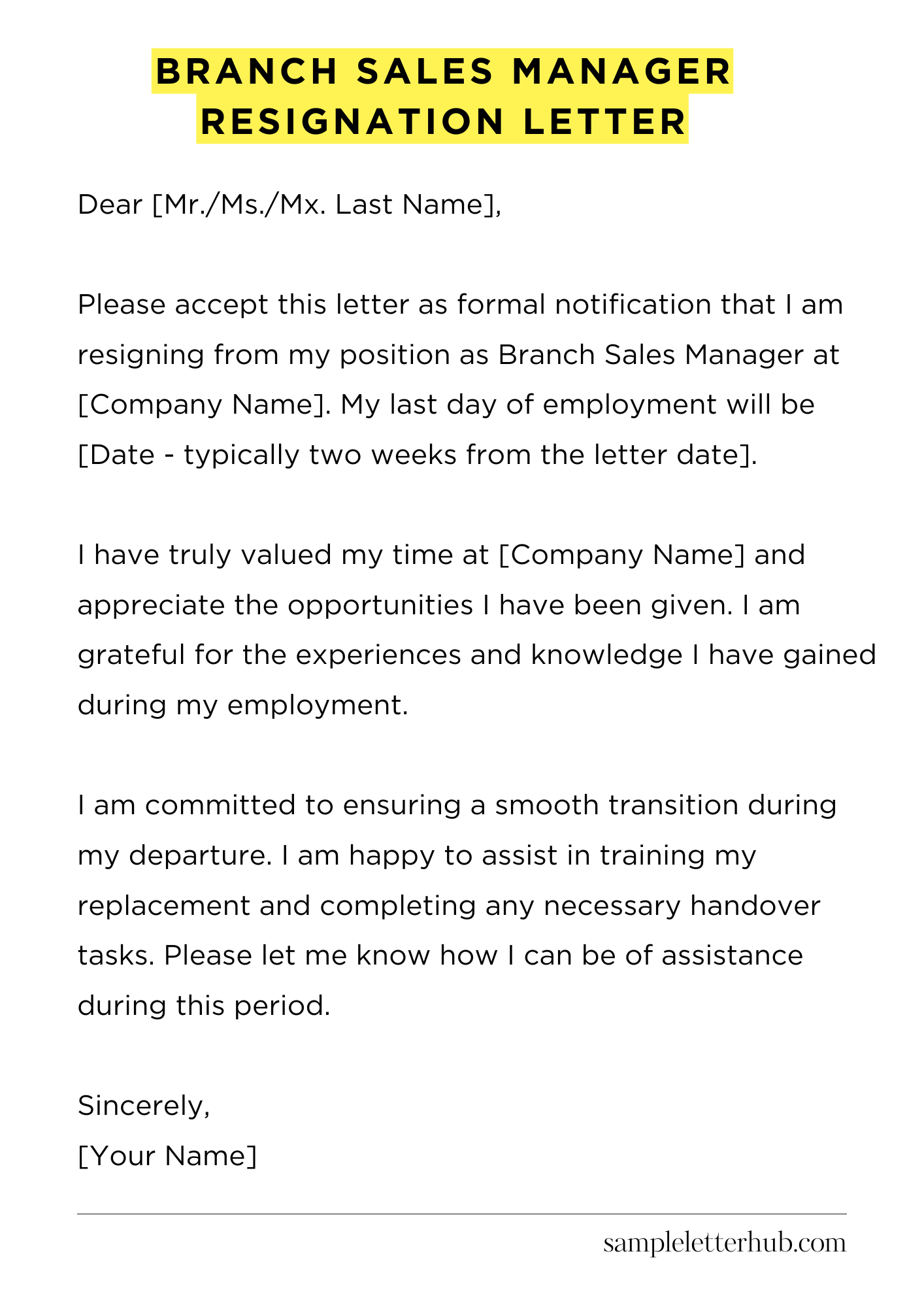
Dear [Mr./Ms./Mx. Last Name],
Please accept this letter as formal notification that I am resigning from my position as Branch Sales Manager at [Company Name]. My last day of employment will be [Date – typically two weeks from the letter date].
I have truly valued my time at [Company Name] and appreciate the opportunities I have been given. I am grateful for the experiences and knowledge I have gained during my employment.
I am committed to ensuring a smooth transition during my departure. I am happy to assist in training my replacement and completing any necessary handover tasks. Please let me know how I can be of assistance during this period.
I wish [Company Name] continued success in the future.
Sincerely,
[Your Name]
How to Write a Branch Sales Manager Resignation Letter
So, you’ve decided to move on. That’s perfectly okay. Life takes us in different directions. One of the most important things to do, when departing a company, is to write a solid resignation letter. Specifically, if you’re a Branch Sales Manager, this letter needs to be both professional and considerate. This guide will help you craft that perfect document.
1. Start with the Basics: The Essentials
First things first. You need to include the essential information. Your letter should clearly state your intention to resign. You should also clearly mention your name. Use the date you are writing the letter.
Always include the name of the company, and the name of your direct supervisor. Next, state your last day of employment. This is crucial for a smooth transition. Be direct and unambiguous. Keep it simple and clear.
2. Express Your Gratitude: Show Appreciation
Even if the job wasn’t perfect, expressing gratitude is key. A few well-chosen words can go a long way. Thank the company for the opportunity. Mention any specific experiences or learning opportunities you value.
This positive gesture leaves a good impression. Consider briefly acknowledging any positive relationships you’ve built. Remember, you might need a reference later! A little kindness goes a long way. Consider using a standard phrase like, “I am grateful for the opportunities I have been given during my time here.”
3. Provide a Reason (If You Choose): Transparency
You’re not obligated to give a detailed reason for leaving. However, you can offer a brief explanation if you feel comfortable. Perhaps you’re pursuing another opportunity, relocating, or simply seeking a career change. Keep it brief and positive.
Avoid negativity. Do not go into deep details. No one wants to hear a long list of complaints. A simple statement such as, “I am pursuing a new opportunity that aligns with my long-term career goals,” is fine.
4. Offer Assistance with Transition: Be Helpful
This is where you show you’re a team player. Offer to assist with the transition. Offer to help train your replacement. Offer to complete pending tasks. Be willing to answer any questions.
This shows professionalism and respect. This will make your departure even smoother. This also means you are leaving on good terms. Being helpful demonstrates your commitment to a smooth handover.
5. Finalize and Proofread: Polish it Up
Before you send it, proofread, proofread, and proofread again! Check for any spelling errors or grammatical mistakes. Ensure the formatting is professional. Make sure the tone is appropriate for a formal business letter.
Use a standard business letter format. If possible, have someone else review it as a fresh set of eyes can often catch errors that you might miss. Ensure you have the correct name and title of the person you are submitting the resignation letter.
Writing a resignation letter, especially as a Branch Sales Manager, requires careful consideration. Following these steps ensures you leave on a positive note, maintaining your professional reputation. Best of luck in your next endeavor.
FAQs about Branch Sales Manager Resignation Letter
What is the primary purpose of a Branch Sales Manager resignation letter?
The primary purpose of a Branch Sales Manager resignation letter is to formally notify an employer of an employee’s intent to leave their position. It serves as an official record of the resignation, the effective date of departure, and provides an opportunity for the employee to express gratitude and outline transition plans, if applicable.
What key elements should be included in a Branch Sales Manager resignation letter?
A comprehensive resignation letter should include: a clear statement of resignation, the date of resignation, the last day of employment, a brief statement of gratitude for the opportunity, and any relevant details regarding the handover of responsibilities. It’s also often customary to offer assistance in the transition process.
How much notice should a Branch Sales Manager give when resigning?
The amount of notice required typically depends on company policy and the terms of the employment contract. However, a standard practice is to provide at least two weeks’ notice. In some senior roles or for key personnel like a Branch Sales Manager, a longer notice period of four weeks or more might be considered professional.
Should I provide a reason for resigning in my resignation letter?
While not mandatory, it’s generally acceptable to briefly state your reason for leaving. You can keep it concise, focusing on career advancement or personal reasons if you prefer not to delve into specifics. Avoid negative comments about the company or colleagues, maintaining a professional tone. If the reason is a conflict, only mention it if you can do so in a concise and neutral way.
How should a Branch Sales Manager handle the handover of responsibilities after resigning?
A Branch Sales Manager should facilitate a smooth transition by: preparing a detailed handover document outlining current projects, client relationships, and ongoing tasks; training their replacement; providing support and guidance during the transition period; and ensuring all company property is returned. This helps minimize disruption and demonstrates professionalism.
Related:
Resignation letter due to rude boss
Resignation letter moving to another state
Resignation letter due to illness of family member
Resignation letter due to study