

A Support Analyst resignation letter is a formal document. It informs your employer you are leaving. It officially ends your employment. It’s a crucial step when moving on.
Need to resign from your Support Analyst role? We can help. We’ve got you covered. We’ll provide you with templates. Find various examples. Use these to craft your perfect letter.
Our goal is to make it easy. We offer a variety of letter samples. These will help you express your decision. Make it clear and professional. Make your resignation a smooth process.
Support Analyst Resignation Letter
Below is a sample of a Support Analyst Resignation Letter:
[Your Name]
[Your Address]
[Your Phone Number]
[Your Email Address]
[Date]
[Recipient’s Name]
[Recipient’s Title]
[Company Name]
[Company Address]
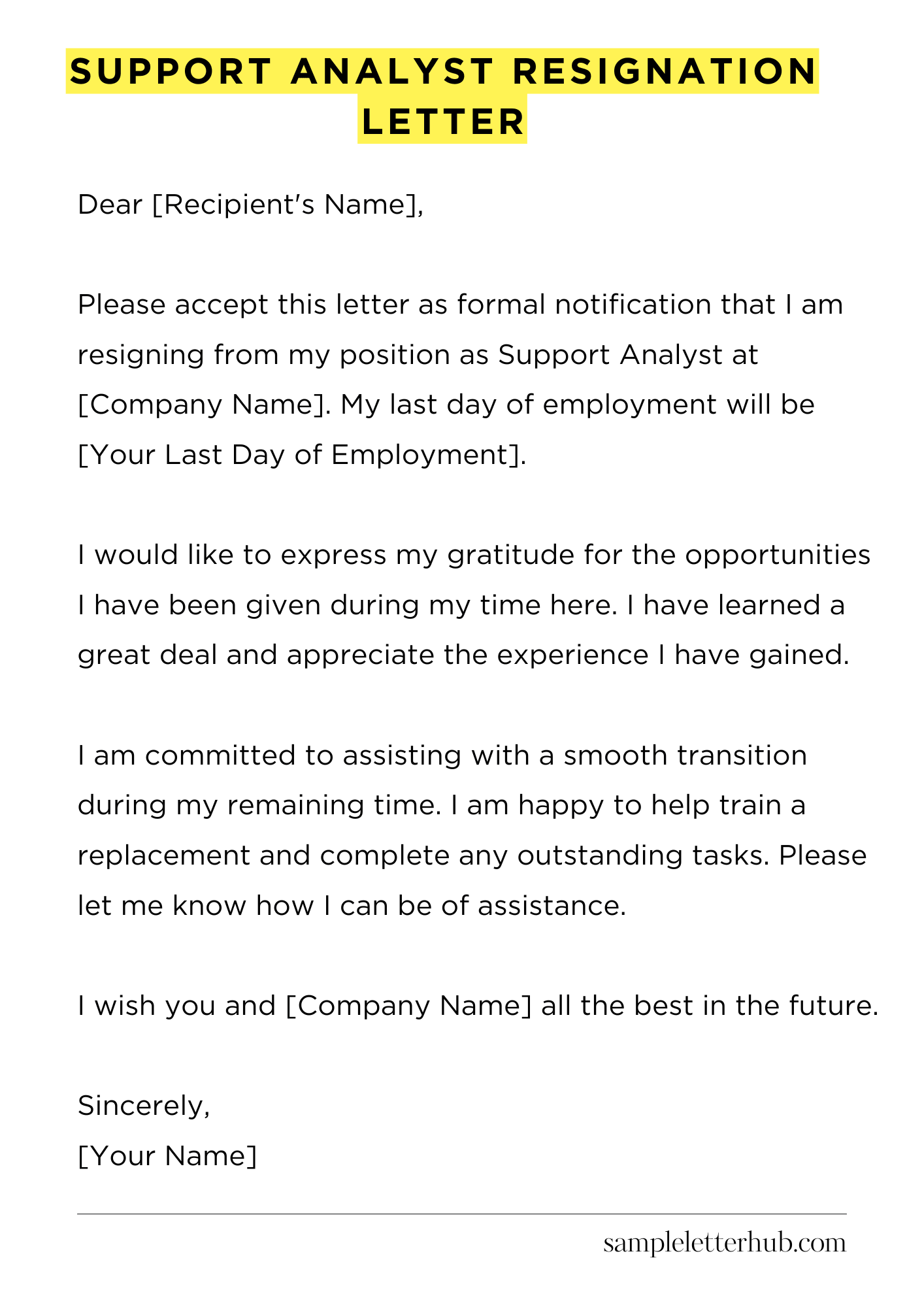
Dear [Recipient’s Name],
Please accept this letter as formal notification that I am resigning from my position as Support Analyst at [Company Name]. My last day of employment will be [Your Last Day of Employment].
I would like to express my gratitude for the opportunities I have been given during my time here. I have learned a great deal and appreciate the experience I have gained.
I am committed to assisting with a smooth transition during my remaining time. I am happy to help train a replacement and complete any outstanding tasks. Please let me know how I can be of assistance.
I wish you and [Company Name] all the best in the future.
Sincerely,
[Your Name]
How to Write a Support Analyst Resignation Letter
So, you’ve decided to move on from your role as a Support Analyst. Congratulations! This is a big step. Now, you need to craft a resignation letter. This document is a crucial formality. It’s your official notice. It helps to ensure a smooth transition. Let’s get to the nitty-gritty of creating an effective one.
1. The Essentials: What to Include
Your Support Analyst resignation letter, while seemingly simple, should be both professional and concise. Don’t overthink this part! First, state your intention to resign clearly.
This is the whole point, after all. Mention your current role (Support Analyst) and the date your resignation takes effect. Give enough notice according to your employment contract. Two weeks is the general rule, but always double-check your contract. Be specific and avoid ambiguity.
Next, express your gratitude for the opportunity. This shows professionalism and leaves a positive impression. You can briefly mention any positive experiences. It’s a small gesture, but it matters. It’s also wise to offer assistance during the transition period. This means helping train your replacement.
Or, you can document your processes to leave things in good order. This is a crucial element. This helps to show your willingness to support the company.
2. Formatting and Tone: Keep it Professional
Formatting is important, especially when it comes to formal documents like this. Use a standard business letter format. Include your name and address.
Then add the date, and the recipient’s name and address. Keep your tone polite and professional throughout. Avoid any negative comments about your experience or employer. This is a letter of departure, not a place to air grievances.
Proofread your letter carefully! Check for grammar and spelling errors. Errors can detract from the professionalism of your resignation. Also, keep the letter brief and to the point. Long-winded letters are unnecessary and often ineffective. Focus on the core information.
3. Crafting the Core Statements
The “meat” of your letter should be straightforward. Start with a clear statement of your resignation. For example: “Please accept this letter as formal notification that I am resigning from my position as Support Analyst, effective [Date].”
Follow this up with a statement of gratitude. Something along the lines of: “I am grateful for the opportunities I have been given during my time at [Company Name].” Then, offer assistance during the transition. “I am happy to assist in training my replacement and ensuring a smooth handover of my responsibilities.”
4. Examples and Templates
Need some inspiration? Here’s a basic template you can adapt.
[Your Name]
[Your Address]
[Date]
[Recipient’s Name]
[Recipient’s Title]
[Company Name]
[Company Address]
Dear [Recipient’s Name],
Please accept this letter as formal notification that I am resigning from my position as Support Analyst, effective [Date].
I am grateful for the opportunities I have been given during my time at [Company Name].
I am happy to assist in training my replacement and ensuring a smooth handover of my responsibilities.
Sincerely,
[Your Signature]
[Your Typed Name]
Customize this template with your own details. Then, remember to personalize it slightly to fit your specific situation. This will help you to show professionalism.
5. Delivering the Letter and Next Steps
After you have written your letter, how do you deliver it? Always hand it in person to your manager if possible. If that is not possible, send it via email. Keep a copy for your records. This is just good practice, always.
Once you’ve submitted your letter, prepare for the exit interview (if applicable). Be prepared to answer questions about your experience. Also, be ready to offer constructive feedback if asked. Finally, focus on making a positive impression during your remaining time. You’ll want to leave on good terms!
FAQs about Support Analyst resignation letter
How do I start a Support Analyst resignation letter?
The standard way to begin a resignation letter includes a formal salutation (e.g., “Dear [Manager’s Name]”), followed by a clear and concise statement of your intent to resign from your position as Support Analyst. It’s crucial to specify your last day of employment.
What key information must be included in the body of a Support Analyst resignation letter?
The body of the letter should briefly state your reason for leaving (optional but often included) and express gratitude for the opportunity to work at the company. It’s also professional to offer assistance during the transition period, such as training your replacement or completing outstanding tasks. Be sure to confirm your last date of employment.
Should I provide a reason for leaving in my Support Analyst resignation letter?
While not mandatory, providing a reason for leaving is often considered professional. Keep the reason brief and focus on positive aspects, such as pursuing a new career opportunity or personal growth. Avoid negative comments about the company or colleagues. If you prefer not to disclose the reason, you can simply state your intent to resign without explanation.
How do I end a Support Analyst resignation letter professionally?
End the letter with a professional closing, such as “Sincerely,” or “Respectfully,” followed by your full name and signature. Include your contact information (phone number and email address) for future communication if desired. You may also reiterate your willingness to assist with the transition.
What should I do after submitting my Support Analyst resignation letter?
After submitting your letter, follow up with your manager to discuss the transition plan. Be prepared to answer any questions and cooperate with the company’s procedures for departing employees. Maintain a professional demeanor and focus on completing your responsibilities effectively during your remaining time at the company.
Related:
Resignation letter due to rude boss
Resignation letter moving to another state
Resignation letter due to illness of family member
Resignation letter due to study