

You’re likely looking for a way to formally end your employment as an Operations Engineer. That’s where a resignation letter comes in. It’s a professional document that notifies your employer of your departure. The primary purpose is to officially communicate your decision.
Crafting the perfect letter can feel tricky. This article simplifies the process. We’re offering various Operations Engineer resignation letter templates. Consider these your starting points. They’ll help you express your reasons effectively.
Need a template for a specific situation? We’ve got you covered. From basic notices to letters highlighting career changes, we have samples. Use these examples to draft your own personalized resignation. Make the whole thing simpler.
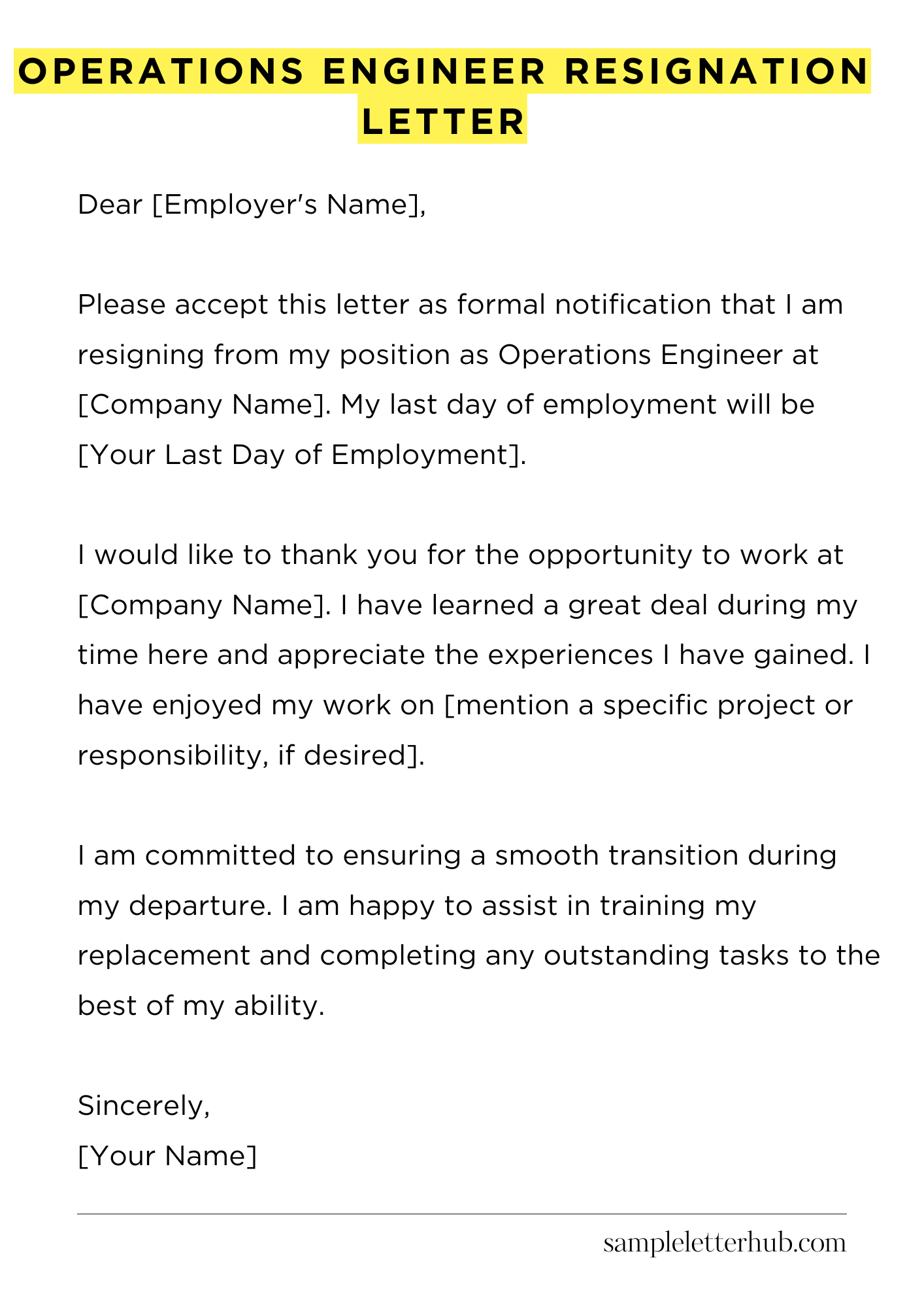
Operations Engineer Resignation Letter
Below is a sample of a Operations Engineer Resignation Letter:
[Your Name]
[Your Address]
[Your Phone Number]
[Your Email Address]
[Date]
[Employer’s Name]
[Company Name]
[Company Address]
Dear [Employer’s Name],
Please accept this letter as formal notification that I am resigning from my position as Operations Engineer at [Company Name]. My last day of employment will be [Your Last Day of Employment].
I would like to thank you for the opportunity to work at [Company Name]. I have learned a great deal during my time here and appreciate the experiences I have gained. I have enjoyed my work on [mention a specific project or responsibility, if desired].
I am committed to ensuring a smooth transition during my departure. I am happy to assist in training my replacement and completing any outstanding tasks to the best of my ability. Please let me know how I can be of assistance.
I wish you and [Company Name] all the best in the future.
Sincerely,
[Your Name]
How to Write Operations Engineer Resignation Letter
Know Your Audience and Purpose
Before you even begin typing, think about who will be reading this letter. This is important. It’s usually your direct supervisor, but it could also include HR.
Your purpose is straightforward: to formally inform your employer of your departure. Keep it professional. Avoid personal grievances or unnecessary drama. This is a business communication, after all.
Think about leaving on good terms. You never know when you might need a reference or cross paths with these people again. A clear, concise, and respectful tone is crucial. Don’t burn any bridges. Be professional.
Crafting the Core: The Body of Your Letter
The body of your resignation letter should be brief and to the point. Start with a clear statement of your intention to resign, and the date your resignation will be effective. For example, “Please accept this letter as formal notification that I am resigning from my position as Operations Engineer, effective [Date].” That’s a good start.
Next, you might offer a very brief expression of gratitude for the opportunity. Keep it short. “I am grateful for the opportunities I’ve had at [Company Name] during my time here.”
It’s a nice touch, but not absolutely mandatory. Avoid over-the-top praise or negative comments. Stick to the facts. Briefly mention any transition plans, if you have any. This shows courtesy and professionalism. If you’re willing to help train your replacement, state it explicitly.
Key Elements: What to Include and Exclude
Your letter must include several crucial elements. Definitely include your name, the date, your job title, and the effective date of your resignation. Make sure your contact information is correct. Check everything carefully before you send it! A handwritten signature is usually preferred at the end of the letter. This is very important.
Avoid any negativity. Leave out any details about your new job or its pay. It’s not necessary and could be interpreted as bragging. Don’t include a long list of complaints. This isn’t the place to air your grievances. Focus on the positive. Keep it brief. Keep it simple.
Formatting and Tone: Making It Polished
The format of your letter matters. Use a professional business letter format. This means a formal salutation (e.g., “Dear [Supervisor’s Name]”), followed by the body paragraphs. Use a professional font, like Times New Roman or Arial, and a standard font size, like 12 points. Always spellcheck! Proofread carefully for any errors in grammar and spelling.
Maintain a respectful and professional tone throughout the letter. Even if you’re leaving because of frustrating circumstances, keep your emotions in check. Your goal is to leave a positive lasting impression. Your tone impacts your reputation, so keep it positive. Always be respectful.
Final Touches and Delivery
Before submitting your resignation letter, make sure you know your company’s policy on resignations. Some companies prefer a physical copy, while others accept digital submissions. Deliver the letter to the appropriate person, as outlined in company procedure. It’s usually the direct supervisor.
Consider sending the letter via certified mail or email with a read receipt. This can provide proof that your letter was received. Keep a copy for your records. Once your resignation is accepted, start the transition process professionally and efficiently. Make the most of your remaining time! Good luck with your next chapter.
FAQs about Operations Engineer resignation letter
How do I start my Operations Engineer resignation letter?
The standard opening for a resignation letter includes a clear and direct statement of your intent to resign, along with the effective date of your departure. You should state your name, the role you’re resigning from (Operations Engineer), and the last day of your employment. Keep it professional and concise.
What should I include in the body of my Operations Engineer resignation letter?
The body of your letter should be brief and to the point. Express your gratitude for the opportunity to have worked in the role and company.
You may briefly mention any specific experiences or contributions you enjoyed or made. You are not obligated to provide detailed reasons for leaving, but if you choose to, keep it general and positive. It’s often helpful to offer assistance during the transition period.
Should I provide a reason for resigning in my Operations Engineer resignation letter?
Providing a reason for your resignation is optional. If you choose to, keep your explanation brief and professional. Focus on future opportunities or personal circumstances, rather than dwelling on any negative aspects of your current role or employer.
It’s important to maintain a positive and professional tone. A simple statement such as “I am pursuing a new opportunity” is often sufficient.
How should I end my Operations Engineer resignation letter?
The closing of your letter should reiterate your gratitude and offer assistance with the transition. Express your willingness to help train your replacement or complete any ongoing projects. End with a polite sign-off such as “Sincerely” or “Respectfully,” followed by your full name. It’s also a good idea to include your contact information for any final communication.
What should I do after submitting my Operations Engineer resignation letter?
After submitting your resignation letter, you should follow up with your manager to discuss the transition plan. Be prepared to answer any questions and assist in the handover process. Maintain a professional attitude throughout your remaining time with the company. Ensure you fulfill all your responsibilities and leave on good terms.
Related:
Resignation letter due to rude boss
Resignation letter moving to another state
Resignation letter due to illness of family member
Resignation letter due to study