

You’re moving on. Leaving a business development role requires a formal resignation letter. It officially communicates your departure to your employer. This letter is crucial for a smooth transition. It also protects your professional reputation.
Writing this letter can feel tricky. It should be clear and professional. That’s where we come in. We will offer several templates and examples. These will help you craft your own effective resignation letter.
We provide a variety of business development resignation letter samples. Choose the best fit for your situation. These samples make writing your own letter easy. Say goodbye with confidence.
Business Development Resignation Letter
Below is a sample of a Business Development Resignation Letter:
[Your Name]
[Your Address]
[Your Phone Number]
[Your Email Address]
[Date]
[Hiring Manager Name] (If known, otherwise use title)
[Hiring Manager Title]
[Company Name]
[Company Address]
Dear [Mr./Ms./Mx. Last Name],
Please accept this letter as formal notification that I am resigning from my position as Business Development Manager at [Company Name]. My last day of employment will be [Your Last Day of Employment].
I would like to thank you for the opportunity to work at [Company Name]. I have learned a great deal during my time here and appreciate the experiences I’ve gained.
I am committed to ensuring a smooth transition during my departure. I am happy to assist in training my replacement and completing any outstanding tasks. Please let me know how I can be of assistance during this period.
I wish you and [Company Name] all the best in the future.
Sincerely,
[Your Signature]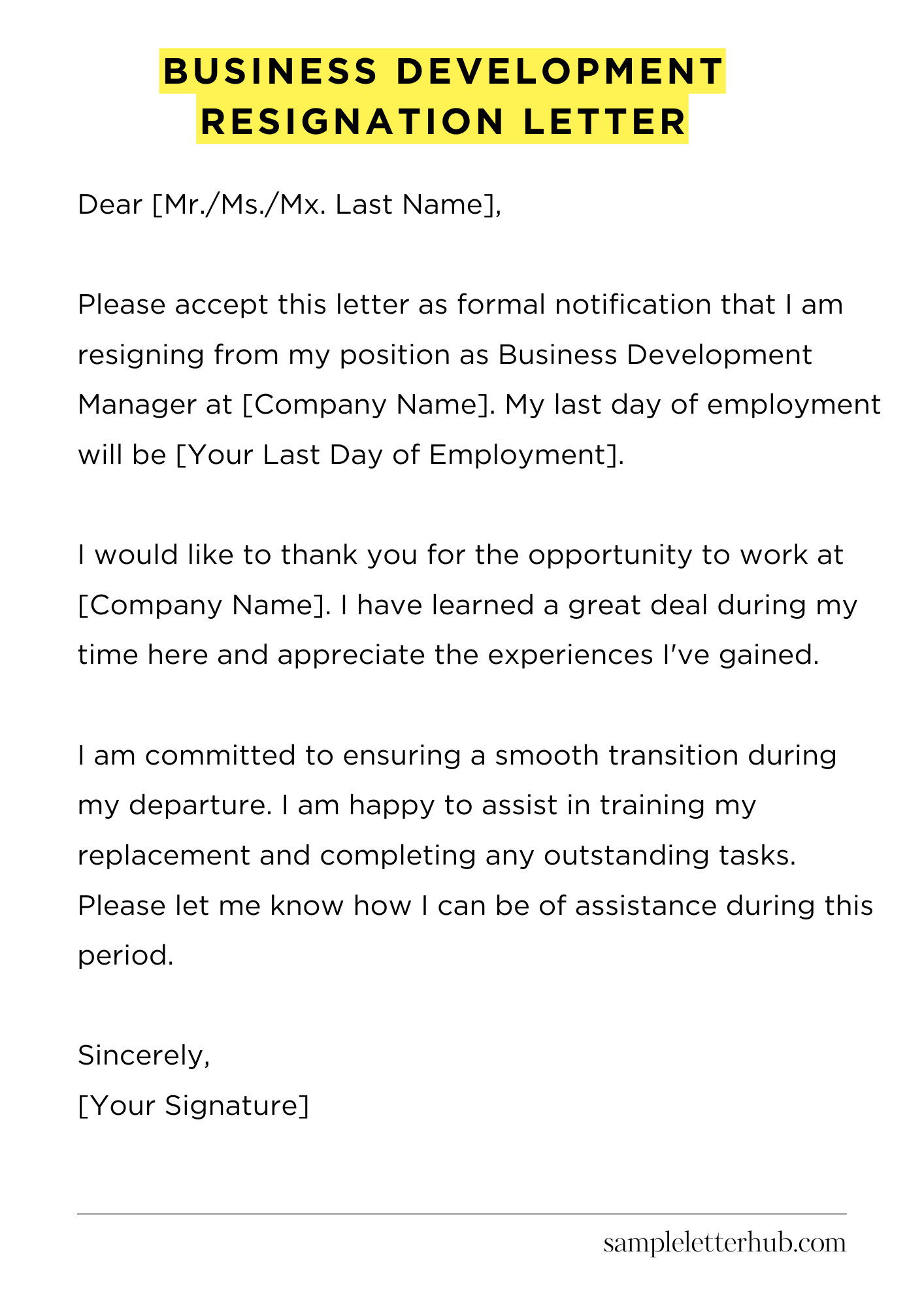
How to Write a Business Development Resignation Letter
Leaving a job is a big deal. You want to do it right, especially when it involves your career in business development. It’s about more than just saying “I quit.” A well-crafted resignation letter can protect your reputation and even help you in the future. So, let’s look at how to construct a professional and effective business development resignation letter.
1. Start with a Clear and Direct Statement
First things first. You need to clearly state your intention to resign. Keep it simple and straightforward. Avoid any ambiguity. This is crucial.
For example, you could begin with a sentence like: “Please accept this letter as formal notification that I am resigning from my position as [Your Position] at [Company Name], effective [Your Last Day of Employment].” See? Easy. Direct.
You can also use this template to start: “I am writing to inform you of my resignation from the position of [Your Job Title] at [Company Name]. My last day of employment will be [Your Last Day of Work].” Keep it professional.
2. Express Gratitude and Positivity
Even if you’re unhappy, this isn’t the time to burn bridges. Briefly express your gratitude for the opportunity to have worked at the company. Mention anything positive you learned or experienced. This shows professionalism and class.
Consider something along these lines: “I am grateful for the opportunities I’ve had during my time here. I’ve learned a great deal about [mention something specific, e.g., the sales process, client relationship management, etc.]”. Be genuine if possible. Nobody likes forced gratitude, but a simple acknowledgement goes a long way.
Another option, if it feels right: “Thank you for the experience and the skills I’ve gained at [Company Name]. I especially appreciate [specific positive experience, perhaps working on a particular project or with a colleague].” It’s all about maintaining a positive tone.
3. Provide Necessary Information and Offer Assistance
Your letter should include practical details. This usually includes your last day of employment. Also, think about offering to help with the transition. This displays a great work ethic.
Something like: “My last day of employment will be [Date]. I am happy to assist in the transition process in any way I can to ensure a smooth handover of my responsibilities.” Is very helpful.
You can also offer specific assistance: “I am available to train my replacement or complete any ongoing projects before my departure.” It’s very proactive.
4. Keep it Concise and Professional
Your letter should be brief and to the point. Don’t ramble. Focus on the essential information. This isn’t the place for lengthy explanations about why you’re leaving. Keep it businesslike. It should read well.
Stick to a few clear paragraphs. Proofread carefully for any errors in grammar or spelling before you send it. This is your professional farewell.
Remember, brevity is your friend here. Focus on the core message.
5. End with a Polished Closing and Contact Information
End your letter with a professional closing. Then include your contact information for future communication. Be sure to choose a professional email address.
Examples: “Sincerely,” or “Respectfully,” are both perfectly fine. Follow this with your full name, your phone number, and a professional email address. You want it to be easy for your former employer to reach you.
Finally, keep a copy of the letter for your records. This is a very important part of the process.
FAQs about Business Development Resignation Letter
Understanding the nuances of a business development resignation letter is crucial for a smooth transition. Here are some frequently asked questions to help you navigate this process effectively.
What essential information should I include in my business development resignation letter?
Your resignation letter should clearly state your intention to resign, the effective date of your resignation, and a brief expression of gratitude for the opportunity. While not mandatory, it’s often courteous to thank your employer for the experience and opportunities provided. Be sure to include your name, job title, and the date.
How far in advance should I submit my business development resignation letter?
The standard practice is to provide at least two weeks’ notice. However, your employment contract or company policy may specify a longer notice period. Always review your contract and adhere to the guidelines set forth by your employer to avoid any potential complications.
Should I provide a reason for leaving in my business development resignation letter?
While not always required, briefly stating your reason for leaving is acceptable. You can keep it concise, such as “pursuing other opportunities,” or “accepting a new role.” Avoid negative comments about the company or its employees. However, if you have any constructive feedback, consider offering it separately, either in a meeting or a different communication.
What is the appropriate tone for a business development resignation letter?
Maintain a professional and positive tone. Express gratitude for the opportunities you’ve been given, and avoid burning bridges. A neutral and respectful approach will leave a positive lasting impression. Remember, you might need to rely on your connections in the future.
Can I ask for a letter of recommendation in my business development resignation letter?
It’s generally not recommended to request a letter of recommendation directly within your resignation letter. Instead, after submitting your letter, once you’ve had a conversation with your manager or supervisor about your resignation, you can then ask for a letter of recommendation. This ensures the focus remains on your resignation first and demonstrates respect for the process.
Related:
Resignation letter due to rude boss
Resignation letter moving to another state
Resignation letter due to illness of family member
Resignation letter due to study