

So, you’re a Field Service Representative ready to move on. A resignation letter is your official goodbye. It formally informs your employer of your departure. It’s a crucial step in ending your employment professionally.
This article is your guide to crafting the perfect letter. We know writing can be tough. Don’t worry, we’ve got you covered. We’ll share several templates. These templates can be your starting point.
Use these samples as inspiration. Adapt them to fit your situation. We will help you write a letter that’s clear and respectful. It will make your transition smoother.
Field Service Representative Resignation Letter
Below is a sample of a Field Service Representative Resignation Letter:
[Your Name]
[Your Address]
[Your Phone Number]
[Your Email Address]
[Date]
[Recipient Name]
[Recipient Title]
[Company Name]
[Company Address]
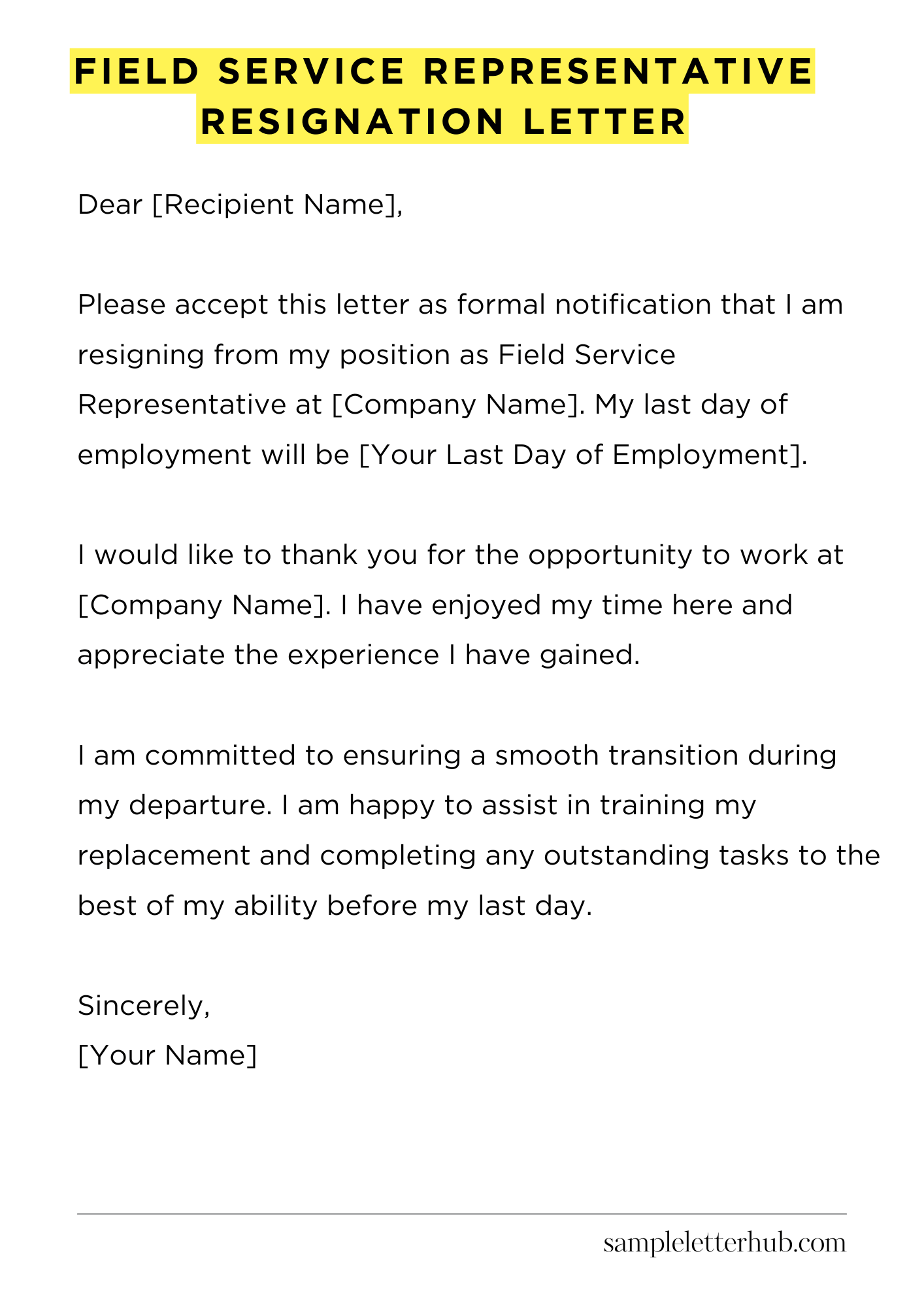
Dear [Recipient Name],
Please accept this letter as formal notification that I am resigning from my position as Field Service Representative at [Company Name]. My last day of employment will be [Your Last Day of Employment].
I would like to thank you for the opportunity to work at [Company Name]. I have enjoyed my time here and appreciate the experience I have gained.
I am committed to ensuring a smooth transition during my departure. I am happy to assist in training my replacement and completing any outstanding tasks to the best of my ability before my last day.
I wish you and the company continued success in the future.
Sincerely,
[Your Name]
How to Write a Field Service Representative Resignation Letter
So, you’ve decided to move on from your role as a Field Service Representative. Congratulations! It’s a big step. You’ve likely put in a lot of hard work, driving to different locations, fixing things, and dealing with customers. Now, it’s time to put all of that into writing: a proper resignation letter. But don’t worry; it’s easier than troubleshooting a faulty circuit board.
1. Keep It Simple and Professional
First things first: keep it simple. This isn’t the time for flowery language or long-winded explanations. Your resignation letter needs to be clear, concise, and professional. It’s a business document, after all.
Start with a clear statement of your intent to resign. State the effective date of your resignation. That’s the day you’ll officially be done with the job. You’ll want to be absolutely clear. The tone should remain respectful. This helps maintain a positive relationship with your previous company.
2. Essential Information: What to Include
Certain elements are a must-have in your letter. Begin with your name, address, and the date. Then, address the letter to your direct supervisor or the appropriate HR representative.
Next, state your intention to resign. This could be something as simple as, “Please accept this letter as formal notification that I am resigning from my position as Field Service Representative, effective [Date].”
After that, consider expressing gratitude for the opportunity. Briefly mention any key accomplishments you are proud of. Finally, sign off with your name and contact information.
3. Optional but Appreciated: Expressing Gratitude and Providing Assistance
While not mandatory, it’s always good practice to express your gratitude for the opportunity. You can say something like, “I am grateful for the experience and opportunities I’ve had during my time here.” If you’re feeling generous and want to leave on the best possible terms, offer to assist with the transition.
You could write: “I am happy to assist with the handover of my responsibilities to ensure a smooth transition.” This shows you’re a team player and demonstrates your professionalism. It will be helpful to offer assistance in training your replacement.
4. Formatting for a Polished Look
Your letter should be well-formatted for a professional appearance. Use a standard business letter format. This means single-spacing within paragraphs and double-spacing between paragraphs.
Choose a readable font like Times New Roman or Arial and a font size of 12 points. Make sure your letter is properly aligned (usually left-aligned). Proofread your letter carefully for any spelling or grammatical errors before you send it. Simple mistakes can reflect poorly.
5. Delivery and Follow-Up
Once you’ve written your letter, the next step is to deliver it. Usually, you’ll hand it to your supervisor or HR representative in person or send it via email. If you send it electronically, keep a copy for your records.
After submitting your resignation, be prepared for a response. Your employer may want to discuss your departure, conduct an exit interview, or ask about training your replacement. Be prepared to answer questions. Remember to remain professional and positive throughout this process. It’s the last impression you’ll leave.
FAQs about Field Service Representative resignation letter
Here are some frequently asked questions regarding resignation letters for Field Service Representatives. These questions will help you navigate the process effectively and professionally.
What is the proper format for a Field Service Representative resignation letter?
The proper format for a Field Service Representative resignation letter generally includes:
- Your name and contact information (address, phone, email) at the top, followed by the date.
- The recipient’s (usually your manager or HR) name and title.
- A clear and direct statement of your intent to resign.
- Your last day of employment (as per your employment agreement or standard notice period).
- A brief expression of gratitude for the opportunity.
- (Optional) A concise reason for leaving (but not required).
- A professional closing and your signature.
What should I include in my Field Service Representative resignation letter?
Your resignation letter should include:
- A clear statement of your intention to resign.
- Your last day of employment (as per your notice period).
- Gratitude for the opportunity.
- (Optional) A brief and neutral reason for leaving (e.g., “pursuing other opportunities,” “relocating”). Avoid negative comments about the company or colleagues.
- A willingness to assist with the transition.
How much notice should a Field Service Representative give when resigning?
The amount of notice a Field Service Representative should give varies based on their employment contract and local labor laws. Typically:
- 2 weeks is the standard notice period in many locations and industries.
- Check your employment contract or employee handbook for the specific notice period.
- If there’s no specified notice period, 2 weeks is still generally considered professional.
- Consider the impact of your work on projects and clients and aim to provide adequate time for the transition.
Should I provide a reason for resigning in my Field Service Representative resignation letter?
Providing a reason for resigning is optional. If you choose to include a reason:
- Keep it brief and professional.
- Avoid negativity, complaints, or criticisms.
- Common reasons include “pursuing other opportunities,” “relocating,” or “career advancement.”
- You’re not obligated to disclose a detailed explanation.
- If you have a positive reason, like a new job, briefly state it without going into excessive detail.
Can I use a template for my Field Service Representative resignation letter?
Yes, using a template is perfectly acceptable. Templates can provide a good starting point and ensure you include all the necessary information. However:
- Customize the template to fit your specific situation and add your personal details.
- Ensure the tone and language are professional and appropriate for your company culture.
- Proofread the letter carefully for any errors.
- Make sure to send the letter to the correct recipient, typically your direct manager or HR.
Related:
Resignation letter due to rude boss
Resignation letter moving to another state
Resignation letter due to illness of family member
Resignation letter due to study