

An electronic engineer resignation letter is a formal document. It informs your employer of your intention to leave. This letter initiates the official departure process. It’s a key part of ending your employment professionally.
Crafting this letter can be tricky. Don’t worry, we’re here to help. This article provides various templates. We will share examples and samples. Use these as a guide.
Writing a resignation letter is now easy. Adapt them to your specific situation. Create a polished and professional farewell. Make your transition as smooth as possible.
Electronic Engineer Resignation Letter
Below is a sample of a Electronic Engineer Resignation Letter:
[Your Name]
[Your Address]
[Your Phone Number]
[Your Email Address]
[Date]
[Employer’s Name]
[Company Name]
[Company Address]
Dear [Employer’s Name],
Please accept this letter as formal notification that I am resigning from my position as Electronic Engineer at [Company Name]. My last day of employment will be [Your Last Day of Employment].
I am grateful for the opportunities I have been given during my time here. I have learned a great deal and appreciate the experience I have gained working on [mention a specific project or two, if you wish].
I am committed to ensuring a smooth transition during my departure. I am happy to assist in training my replacement and completing any outstanding tasks to the best of my ability.
I wish you and the company all the best in the future.
Sincerely,
[Your Signature]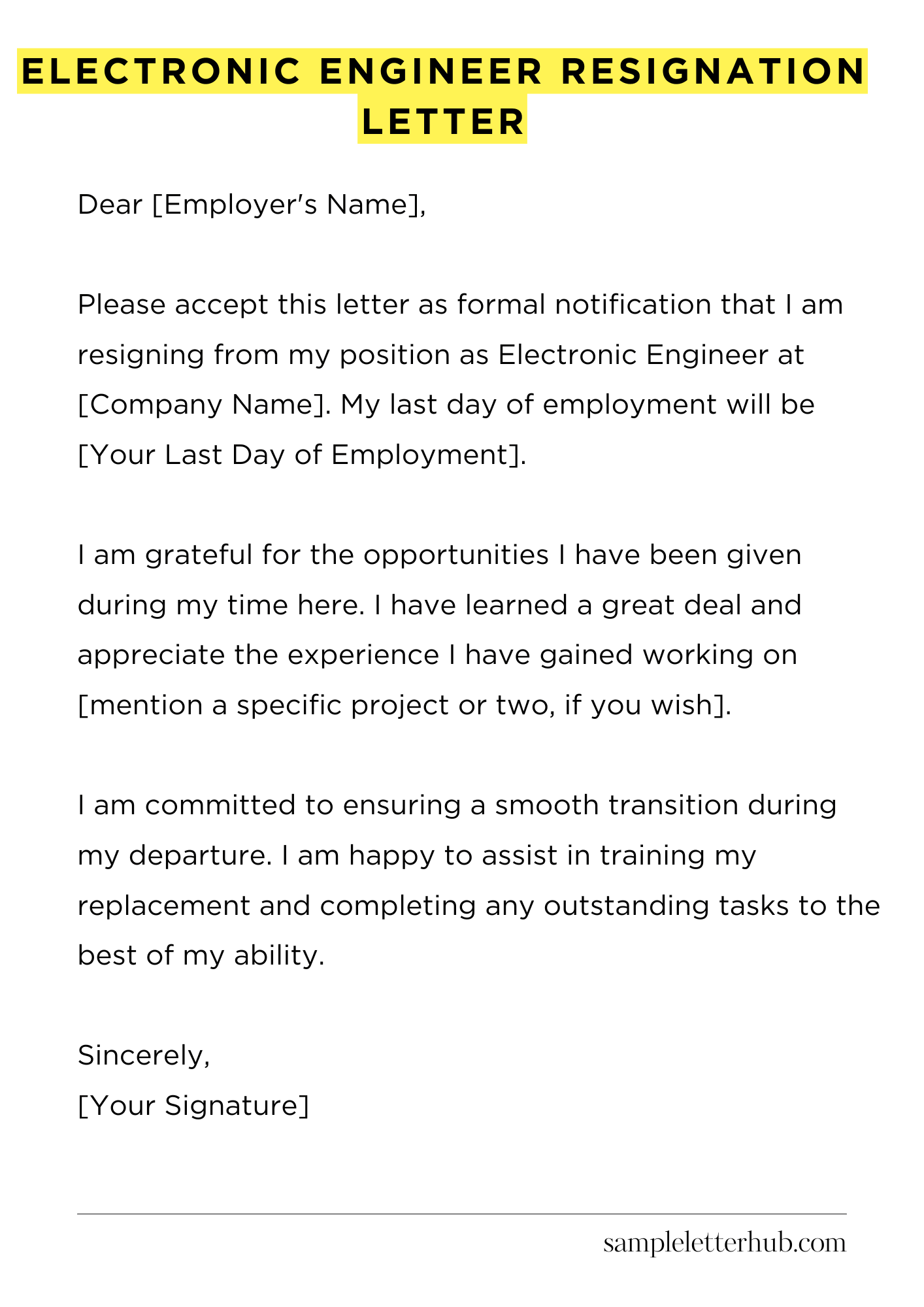
How to Write an Electronic Engineer Resignation Letter
Why Your Resignation Matters
Leaving a job is a big step. Resigning, especially from a technical field like Electronic Engineering, requires careful consideration and execution. Your resignation letter is more than just a formality; it is a vital document. It officially announces your departure, sets the tone for your final interactions, and can influence your future opportunities.
Think about it: it’s a permanent record of your employment ending. Done right, it leaves a positive lasting impression. Mess it up, and you might burn bridges. Getting it right is essential.
Key Elements of a Professional Resignation
So, what makes a strong resignation letter? First, keep it concise. Clarity is key. State your intention to resign clearly. Mention your official last day of employment. This information should be easy to find.
Express gratitude to your employer for the opportunity. This shows professionalism and respect. Briefly acknowledge the experience you’ve gained, or the value of working there. Mention a specific positive aspect or two, if possible. Always adhere to professional standards.
If appropriate, offer to assist with the transition. A willingness to help with handover tasks demonstrates responsibility and a commitment to ensuring a smooth departure. This can be as simple as offering to train your replacement or documenting your current projects.
Crafting the Perfect Letter: Step-by-Step
Let’s break down the process. Start with your contact information (name, address, phone number, email) and the date. Next, address your letter to your direct supervisor or HR department.
In the first paragraph, make your intention crystal clear. “I am writing to inform you of my resignation from my position as Electronic Engineer, effective [Your Last Day of Employment].” Then, express your gratitude in the second paragraph. For example: “I am grateful for the opportunities I have been given at [Company Name] and for the experience I have gained during my time here.”
The third paragraph allows for an offer of assistance. “I am happy to assist with the transition process and to train my replacement. Please let me know how I can be of help.” Finally, close the letter with a professional closing, such as “Sincerely” or “Best Regards,” followed by your name.
Common Mistakes to Avoid
Be careful of a few common traps. Don’t include negative comments about your employer, colleagues, or the company. Keep the tone positive and professional. Avoid offering too much detail about your reasons for leaving. Generally, this is not necessary.
Avoid any accusations or complaints; now is not the time. Refrain from burning bridges. Focus on the positive aspects of your employment, even if they were limited. Do not vent your frustrations.
Proofread carefully. Spelling and grammar errors reflect poorly on you. Always get a second pair of eyes to check your letter before sending it.
Final Thoughts: Leaving on a High Note
Your resignation letter is a crucial document. It’s your last official communication. By following these guidelines, you can ensure a smooth transition. You will leave with your reputation intact.
Always maintain a professional approach. This will help you maintain a favorable relationship with your current employer. Doing so is extremely important for your future career prospects. Good luck!
FAQs about Electronic Engineer Resignation Letter
What is the essential information to include in an Electronic Engineer resignation letter?
An Electronic Engineer’s resignation letter should include your formal resignation, the effective date of your departure, a concise and professional statement of your reason for leaving (if desired; it’s often optional), a thank-you to the employer (especially the manager) for the opportunity and experience.
How much notice should an Electronic Engineer give when resigning?
The standard notice period is typically two weeks, though this can vary depending on your employment contract, company policy, and local laws. Some senior positions or those with critical project involvement may require a longer notice period, often 30 days or more. Always refer to your employment agreement for the specific requirements.
Should I provide a reason for leaving in my resignation letter as an Electronic Engineer?
Providing a reason is often optional. While you aren’t legally or ethically obligated to state your reason, a brief and professional statement can sometimes be beneficial, especially if it relates to career advancement or personal growth. Avoid negative comments about the company or colleagues.
Examples include stating, “I am pursuing a new opportunity that aligns more closely with my career goals” or “I am seeking to develop my expertise in [specific area].”
How should an Electronic Engineer address any outstanding projects or responsibilities in their resignation letter?
Outline how you will assist with the transition of your responsibilities. Offer to aid in the handover process by documenting your current work, training a replacement, or completing critical tasks before your departure. Provide a willingness to be available for questions after your last day, if feasible.
This demonstrates professionalism and a commitment to ensuring a smooth transition.
What tone and format are most appropriate for an Electronic Engineer’s resignation letter?
Maintain a professional and polite tone. The format should be formal, with clear language, concise sentences, and a respectful closing (e.g., “Sincerely,” or “Respectfully,”).
Use standard business letter formatting: your contact information, the date, the employer’s information, a subject line (“Resignation”), the body of the letter, and your signature. Proofread carefully before submitting.
Related:
Resignation letter due to rude boss
Resignation letter moving to another state
Resignation letter due to illness of family member
Resignation letter due to study