

A Technical Support Executive resignation letter is a formal document. It informs your employer about your decision to leave your job. The letter is your official notice. It states your last day of employment.
Writing this letter can feel tricky. You want to be professional. You also want to express your reasons (if you choose to). We understand. That’s why we’ve created helpful resources.
We’ll share templates and examples here. You’ll find different formats. Choose one that fits your situation. Simplify the whole process.
Technical Support Executive Resignation Letter
Below is a sample of a Technical Support Executive Resignation Letter:
[Your Name]
[Your Address]
[Your Phone Number]
[Your Email Address]
[Date]
[Recipient Name]
[Recipient Title]
[Company Name]
[Company Address]
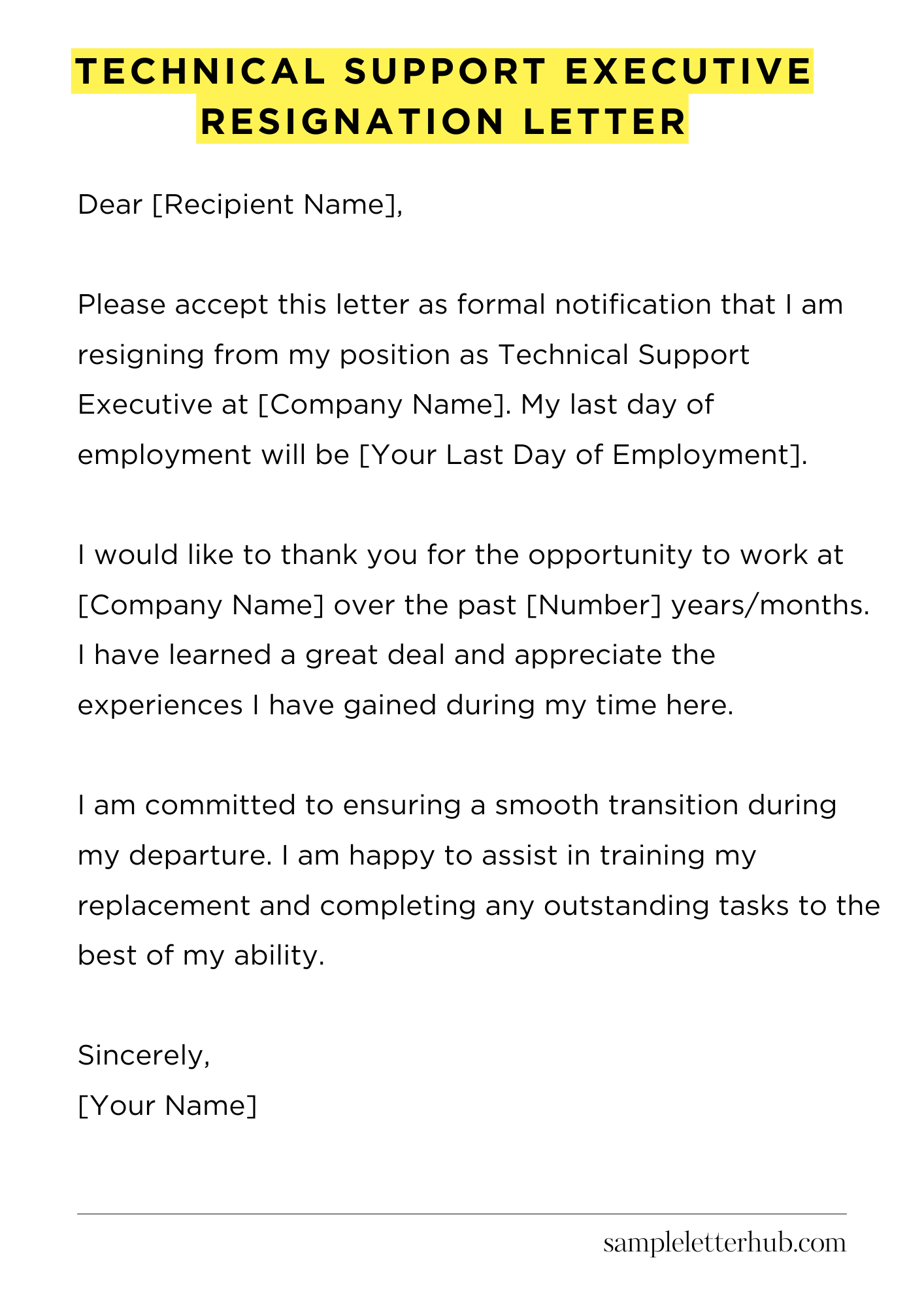
Dear [Recipient Name],
Please accept this letter as formal notification that I am resigning from my position as Technical Support Executive at [Company Name]. My last day of employment will be [Your Last Day of Employment].
I would like to thank you for the opportunity to work at [Company Name] over the past [Number] years/months. I have learned a great deal and appreciate the experiences I have gained during my time here.
I am committed to ensuring a smooth transition during my departure. I am happy to assist in training my replacement and completing any outstanding tasks to the best of my ability.
I wish you and the company all the best in the future.
Sincerely,
[Your Name]
How to Write a Technical Support Executive Resignation Letter
Leaving a job is a big decision. Especially when you’ve been in a role like Technical Support Executive, you’ve probably developed strong relationships. That’s why your resignation needs to be handled professionally and with courtesy.
It’s also crucial to ensure you leave on good terms, paving the way for future opportunities. Here’s a simple guide to crafting your resignation letter.
1. Formatting and Basics
First things first: formatting is key. Your letter should be clear, concise, and easy to read. Use standard business letter format. Your contact information goes at the top, followed by the date, and then the recipient’s information (usually your direct manager or HR). This makes it official and professional.
Keep the tone formal and respectful. The letter should be no longer than one page. Use a professional font like Times New Roman or Arial, and use a standard font size, generally 12 points. This simple format shows respect for the process.
2. The Opening: State Your Intent
The first paragraph should clearly state your intention to resign. Don’t beat around the bush. Be direct. A simple sentence works wonders. For example: “Please accept this letter as formal notification that I am resigning from my position as Technical Support Executive, effective [Your Last Day].” Make it easy to understand what you’re doing. This sets the tone for the rest of the letter.
3. Express Gratitude and Briefly Explain (Optional)
Next, express your gratitude for the opportunity to have worked there. This is a crucial step. Acknowledge the experience and opportunities you’ve gained. This demonstrates professionalism and leaves a positive impression. Here’s a sample statement: “I am grateful for the opportunities I’ve had during my time at [Company Name], especially [mention a specific skill or experience].”
You’re not obligated to give the exact reasons for leaving. However, you can briefly mention a reason if you wish, but keep it brief and positive. You could say, “I am pursuing a new opportunity that aligns more closely with my career goals,” or “This decision allows me to prioritize my personal commitments.” Avoid negativity, like complaining about your job. Keep it professional.
4. Formalities, Handover and Closing
In the subsequent paragraph, if there is a handover process or specific tasks to be done, you might mention your commitment to a smooth transition. Consider a sentence like: “I am committed to ensuring a smooth handover of my responsibilities and will be available to assist in any way possible during my remaining time here.” This highlights your commitment to the company. After that, always offer to assist with the handover process.
Close your letter with a professional and appreciative tone. Use a formal closing, such as “Sincerely,” or “Respectfully,” followed by your full name. Also, do not forget to sign the document.
5. Review and Proofread
Before submitting, review your letter carefully. Check for any grammatical errors, typos, or inconsistencies. Ask a friend or colleague to proofread it. A polished letter reflects well on you. Also, ensure all the information is accurate, especially the date and your last day. Consider printing the document and keeping a copy for your records.
By following these steps, you can craft a technical support executive resignation letter that is professional, respectful, and leaves a positive lasting impression.
FAQs about Technical Support Executive resignation letter
How should I format my Technical Support Executive resignation letter?
Your resignation letter should follow a professional business letter format. Include your contact information at the top, followed by the date, the recipient’s name and title, and their company’s address.
The body of the letter should clearly state your intention to resign, your last day of employment, a brief expression of gratitude (optional), and your signature. Keep it concise, professional, and positive.
What key information must I include in my Technical Support Executive resignation letter?
The most crucial information includes a clear statement of your resignation, your intended last day of employment, and your name. While not mandatory, it’s often courteous to express gratitude for the opportunity to work at the company.
Specifying your role (Technical Support Executive) reinforces clarity. You don’t need to provide detailed reasons for leaving, but you can if you choose, keeping it brief and constructive.
Is it necessary to provide a reason for my resignation in the letter?
While not always required, offering a brief reason can sometimes be helpful. If you’re comfortable, you can state you are pursuing other opportunities or simply mention a desire for a change.
You’re not obligated to give a detailed explanation. If you have any constructive feedback, you may offer it, but ensure it remains professional and avoids negativity. Focus on the positive aspects of your employment experience if you include any details.
How much notice should I give when resigning as a Technical Support Executive?
The standard notice period varies depending on your employment contract, company policy, and local labor laws. Typically, a minimum of two weeks’ notice is expected, but check your employment agreement or employee handbook.
For executive-level positions or those with specific responsibilities, a longer notice period (e.g., one month) might be customary. Adhering to the agreed-upon notice period is crucial for maintaining a positive professional relationship.
Should I submit my Technical Support Executive resignation letter via email or hard copy?
Generally, it’s best to submit your resignation letter both via email and as a hard copy. Sending an email ensures immediate delivery and provides a digital record. However, providing a printed copy is often considered more formal and allows your employer to keep a physical copy in your personnel file. Always check your company’s internal protocol for the preferred method of submission.
Related:
Resignation letter due to rude boss
Resignation letter moving to another state
Resignation letter due to illness of family member
Resignation letter due to study