

An interpreter resignation letter is a formal document. It informs an employer of your intent to leave your interpreting position. The letter officially ends your employment. It typically includes your last day of work.
Planning your exit can feel overwhelming. Don’t worry, you’re not alone. This article has you covered. We’ve created helpful templates for your interpreter resignation letter. We’ll share examples and samples.
Use these to craft your perfect letter. Make the process smoother. Ensure a professional and respectful departure. Find your voice and hit “send” with confidence.
Interpreter Resignation Letter
Below is a sample of a Interpreter Resignation Letter:
[Your Name]
[Your Address]
[Your Phone Number]
[Your Email Address]
[Date]
[Recipient’s Name]
[Recipient’s Title]
[Company Name]
[Company Address]
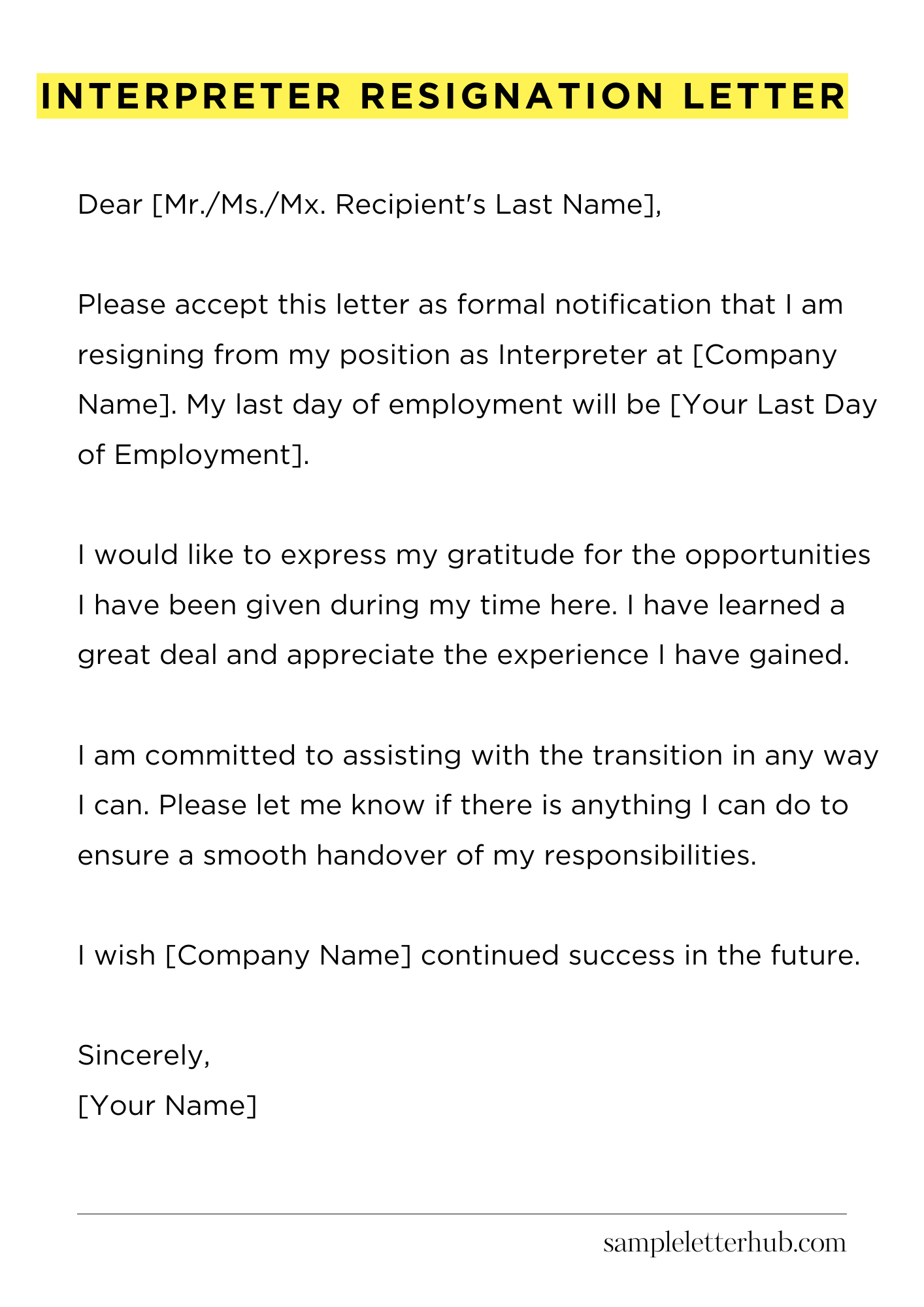
Dear [Mr./Ms./Mx. Recipient’s Last Name],
Please accept this letter as formal notification that I am resigning from my position as Interpreter at [Company Name]. My last day of employment will be [Your Last Day of Employment].
I would like to express my gratitude for the opportunities I have been given during my time here. I have learned a great deal and appreciate the experience I have gained.
I am committed to assisting with the transition in any way I can. Please let me know if there is anything I can do to ensure a smooth handover of my responsibilities.
I wish [Company Name] continued success in the future.
Sincerely,
[Your Name]
How to Write an Interpreter Resignation Letter
So, you’re ready to move on from your interpreting role? Good for you! It’s a significant step. Whether you’re chasing a new opportunity, seeking a career change, or simply need a break, the way you leave your current position matters.
A well-crafted resignation letter is crucial. It’s more than just a formality; it’s a professional courtesy and often the last impression you’ll leave. Let’s look at how to construct a strong interpreter resignation letter that keeps things positive and professional.
1. Start with the Basics: Your Contact Information and the Date
First things first. You need to include the essential information. Always begin by putting your full name, address, phone number, and email address at the top left of the letter. Below your contact information, on the right side, add the current date.
This allows your employer to easily identify who is resigning and when the letter was written. It also provides vital contact information for any future correspondence.
2. Clearly State Your Intent to Resign
Get straight to the point! The first paragraph should clearly and directly state your intention to resign from your position as an interpreter. Don’t beat around the bush. Use simple, direct language.
For example: “Please accept this letter as formal notification that I am resigning from my position as an interpreter, effective [Your Last Day of Employment].” Be clear and concise. It leaves no room for misunderstanding.
3. Express Gratitude and Highlight Your Contributions
This is where you show your appreciation. Briefly acknowledge the opportunities you’ve had while working as an interpreter. Consider the experiences you’ve gained and the skills you’ve developed. Mention any significant accomplishments or contributions you made during your time with the company.
This isn’t the time for a detailed resume, but highlighting key achievements shows professionalism. For instance: “I am grateful for the opportunities I have had to work with [Company Name] and for the experience I’ve gained in [Specific areas or specializations].” Acknowledging this will leave a positive impact. It also maintains a positive tone.
4. Offer Assistance with the Transition
Show your willingness to help during the transition period. This shows consideration for your employer and your colleagues. Offer to assist in any way you can, such as training your replacement or completing any outstanding projects. If applicable, mention that you’re available to help with a smooth handover.
It reflects well on your professionalism and leaves a lasting positive impression. Something like: “I am committed to ensuring a smooth transition. I am available to assist in training my replacement and completing any pending projects before my departure.”
5. Finalize with a Professional Closing and Signature
End the letter with a professional closing, such as “Sincerely,” or “Respectfully,” followed by your full name and your signature. If you’re sending a hard copy, sign the letter above your typed name.
If you’re sending an electronic copy, you can either sign it electronically or type your name. Your signature completes the professional look. This final step reinforces the professional tone of your resignation letter. It is polite and shows respect.
FAQs about Interpreter resignation letter
What is the primary purpose of an interpreter resignation letter?
The primary purpose of an interpreter resignation letter is to formally notify an employer of an interpreter’s intention to leave their position. It serves as an official record of the resignation, the last day of employment, and often includes a brief statement of gratitude or farewell.
What key information should be included in an interpreter resignation letter?
A well-crafted interpreter resignation letter should include: a clear statement of resignation, the interpreter’s name and job title, the effective date of resignation (last day of employment), and a professional closing. It may also include a brief reason for leaving (optional), and expressions of gratitude to the employer.
How should an interpreter address their resignation letter?
The letter should be addressed formally, typically to the direct supervisor or the human resources department. If a specific person is known, use their name and title. If not, use a generic title like “Human Resources Department.” Always maintain a professional tone.
Is it necessary to provide a reason for resigning in the letter?
While not mandatory, providing a reason for resignation is often considered a courtesy. It can be a simple statement like “to pursue other opportunities” or “for personal reasons.” You are not obligated to disclose detailed explanations, and maintaining brevity is usually best. However, always be professional.
How much notice should an interpreter provide when resigning?
The amount of notice required typically depends on the employment agreement or company policy. Two weeks’ notice is a standard practice in many industries, but it’s crucial to check your employment contract. Adhering to the agreed-upon notice period is important to maintain a positive professional relationship with the employer.
Related:
Resignation letter due to rude boss
Resignation letter moving to another state
Resignation letter due to illness of family member
Resignation letter due to study