

So, you’re an Instructional Designer ready to move on? A resignation letter is the official document. It’s your formal notice to your employer. The letter signals your departure. It’s a professional courtesy.
Writing the perfect letter can feel tricky. We’ve got you covered. We’re sharing templates and examples. These samples will make it simple. They’ll guide you through the process.
Whether you’re after a quick exit or want to leave a lasting impression, we’ve got options. Customize these examples to fit your needs. Your next career move starts here.
Instructional Designer Resignation Letter
Below is a sample of a Instructional Designer Resignation Letter:
[Your Name]
[Your Address]
[Your Phone Number]
[Your Email Address]
[Date]
[Hiring Manager Name] (If known, otherwise use title)
[Hiring Manager Title]
[Company Name]
[Company Address]
Dear [Mr./Ms./Mx. Last Name],
Please accept this letter as formal notification that I am resigning from my position as Instructional Designer at [Company Name]. My last day of employment will be [Your Last Day of Employment].
I would like to thank you for the opportunity to work at [Company Name] over the past [Duration of Employment]. I have enjoyed my time here and appreciate the experiences I have gained.
I am committed to ensuring a smooth transition during my departure. I am happy to assist in training my replacement and completing any outstanding projects. Please let me know how I can be of assistance during this time.
I wish you and [Company Name] all the best in the future.
Sincerely,
[Your Signature]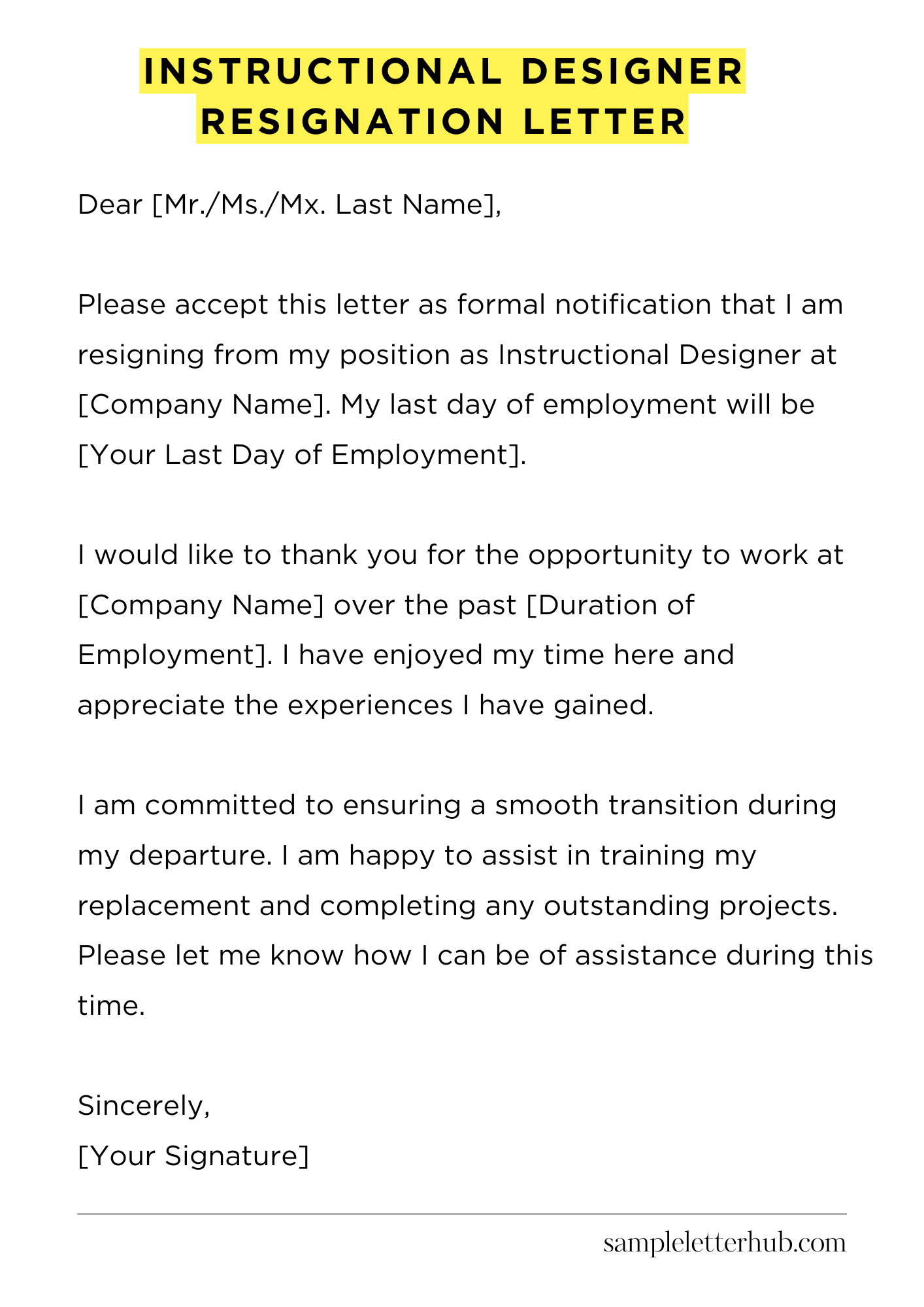
How to Write an Instructional Designer Resignation Letter
Leaving a job, even one you may not love, can be tricky. It’s a professional situation and requires careful handling. Writing a resignation letter as an Instructional Designer is no different. It’s your last official communication. You want to leave a good impression, even if you’re heading for greener pastures.
1. Keep it Short and Sweet
Get straight to the point. Your resignation letter should be concise and easy to read. You don’t need a lengthy explanation. Begin with a clear statement of your intent. State the date you’re resigning and the date your employment will end. Don’t beat around the bush; be direct!
For example: “Please accept this letter as formal notification that I am resigning from my position as Instructional Designer, effective [Date of Resignation].” That’s all you need at the beginning.
2. Show Gratitude and Professionalism
Even if the job wasn’t your dream, or maybe it was a nightmare, expressing gratitude is crucial. A simple thank you can go a long way. Acknowledge your experience and the opportunities you were given.
Consider mentioning specific individuals or experiences that were positive. Remember to keep the tone positive and respectful. This demonstrates professionalism. This shows you are a mature individual.
An example of gratitude: “I am grateful for the opportunities I’ve had at [Company Name]. I’ve learned a lot during my time here, and I appreciate the support I’ve received from [Specific Individuals, if applicable].”
3. Provide Necessary Details (and Be Flexible)
Your resignation letter should include essential information. It needs to contain your official departure date, which is especially important for the company. Always adhere to the required notice period as stated in your employment contract.
Think about if you are willing to help with the transition. It can show good faith. You might offer to assist in the handover of your responsibilities, especially if you have an extensive portfolio. If you are willing, mention it!
Example: “I am available to assist in the transition of my duties during the notice period.”
4. Avoid Negativity and Gossip
This is extremely important. Do not vent or complain about anything in your resignation letter. It is not the appropriate place for it. Refrain from mentioning negative aspects of your job. Avoid criticizing your colleagues or the company. Keep the focus positive and professional. Remember the goal: to leave a positive lasting impression.
Your letter becomes a part of your permanent record. It can come back to haunt you later. Remember that employers often share information about past employees.
5. Proofread, Proofread, Proofread!
This is non-negotiable! Before you submit your letter, meticulously proofread it. Check for any errors in grammar, spelling, and punctuation. Have someone else read it over too. A few minutes of extra effort can prevent a mistake that could undermine all your hard work.
Ensure the formatting is correct. Make sure your name and contact information are accurate. A polished letter reflects your attention to detail and professionalism. It is always worth the effort to ensure perfection.
FAQs about Instructional Designer Resignation Letter
What is the most important information to include in an Instructional Designer resignation letter?
The most crucial elements are a clear and concise statement of your resignation, the effective date of your departure, and a brief expression of gratitude for the opportunity. You should also include your contact information for any necessary follow-up during the transition period.
What should I avoid including in my Instructional Designer resignation letter?
Refrain from negative comments about your current employer, colleagues, or the company. Avoid oversharing details about your reasons for leaving or discussing your new job. Keep the tone professional and positive, focusing on the future and expressing thanks.
How much notice should I give in my Instructional Designer resignation letter?
The standard notice period is typically two weeks, although this can vary depending on your employment contract or company policy. Always refer to your employment agreement to confirm the required notice period. Giving ample notice demonstrates professionalism and allows for a smoother transition.
Can I customize a resignation letter template for an Instructional Designer role?
Yes, it’s generally advisable to customize a resignation letter template to fit your specific circumstances. Tailor the language to reflect your experience, the company, and your relationship with your manager. Ensuring the letter is personalized shows you’ve taken the time to write a thoughtful and professional communication.
Is it necessary to provide a reason for resigning in an Instructional Designer resignation letter?
While not mandatory, you may choose to briefly state a general reason, such as “to pursue other opportunities” or “to focus on career advancement.” You are not obligated to provide detailed explanations for your departure. Keep it brief and professional. If you want to disclose more, consider doing so in a separate conversation with your manager.
Related:
Resignation letter due to rude boss
Resignation letter moving to another state
Resignation letter due to illness of family member
Resignation letter due to study