

An Accounts Payable resignation letter is a formal document. It informs your employer of your intention to leave. This letter initiates the official departure process. It also helps in a smooth handover of your responsibilities.
Leaving a job can be tricky. Writing the perfect resignation letter is key. We are here to simplify that for you. This article offers helpful templates. These examples cover various scenarios. They make your letter-writing process easier.
Need to draft a resignation letter? We’ve got you covered. From basic formats to more personalized options, we have something for you. Explore our collection and get started!
Accounts Payable Resignation Letter
Below is a sample of a Accounts Payable Resignation Letter:
[Your Name]
[Your Address]
[Your Phone Number]
[Your Email Address]
[Date]
[Employer’s Name]
[Company Name]
[Company Address]
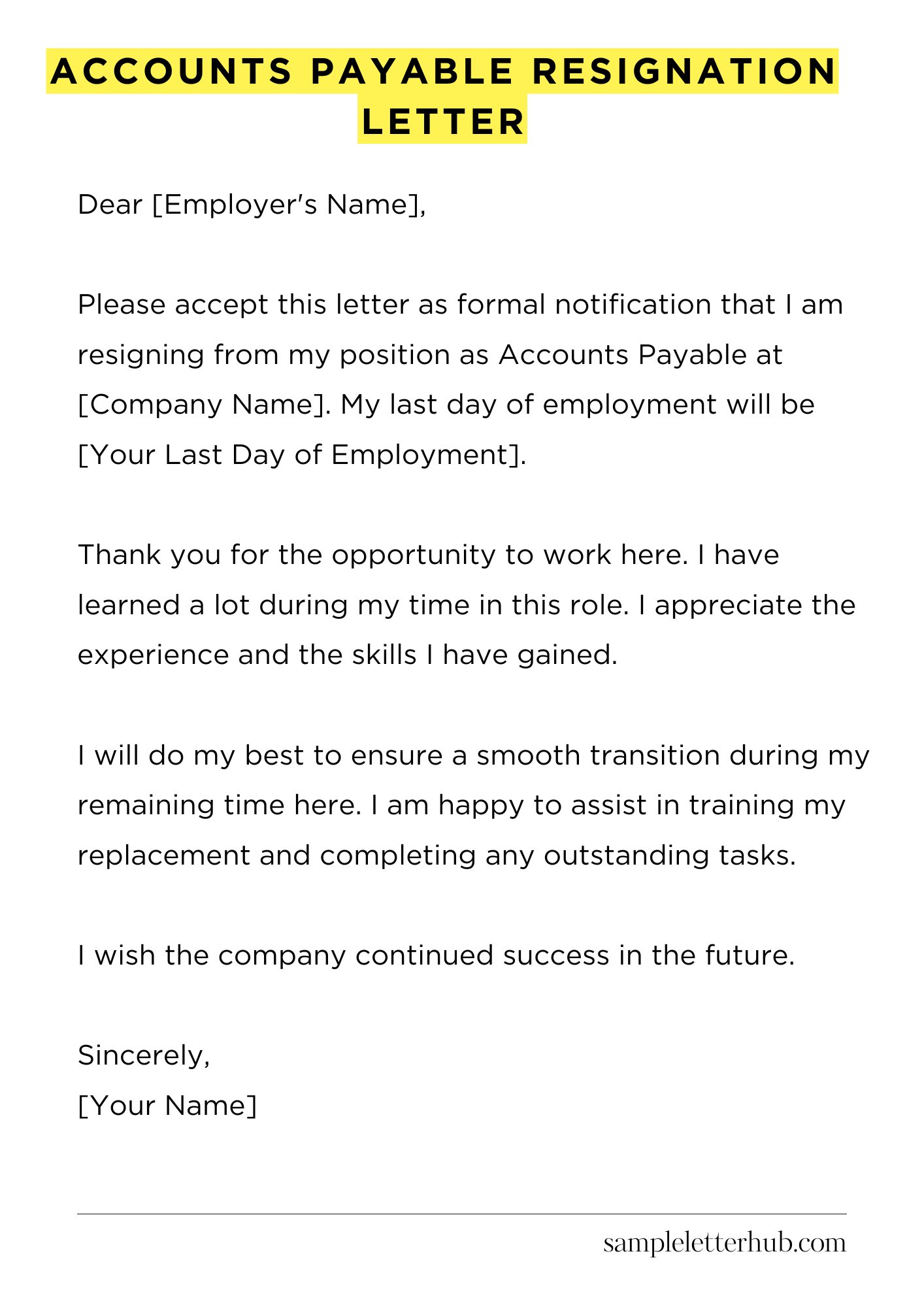
Dear [Employer’s Name],
Please accept this letter as formal notification that I am resigning from my position as Accounts Payable at [Company Name]. My last day of employment will be [Your Last Day of Employment].
Thank you for the opportunity to work here. I have learned a lot during my time in this role. I appreciate the experience and the skills I have gained.
I will do my best to ensure a smooth transition during my remaining time here. I am happy to assist in training my replacement and completing any outstanding tasks.
I wish the company continued success in the future.
Sincerely,
[Your Name]
How to Write an Accounts Payable Resignation Letter
Leaving a job, even one you don’t necessarily love, requires a degree of professionalism. It’s especially crucial when handling finances. Accounts payable (AP) is a critical function in any business. Your resignation letter needs to be clear, concise, and leave a positive lasting impression. Here’s a guide to help you do just that.
1. Know Your Audience & Timing is Everything
Before you even begin typing, consider who you’re writing to. Your direct supervisor? The CFO? HR? Addressing the letter correctly is key. Use their proper title. Double-check the spelling of their name. Simple courtesies go a long way.
Timing matters immensely too. Giving adequate notice is a must. Usually, this means two weeks, but confirm the standard in your employment contract or company policy. Don’t spring this on your employer.
Doing so can cause unnecessary stress for your team. This impacts your reputation, even if you are leaving. Hand your resignation letter in person, if possible. That’s considered the most respectful approach. Remember, you want to leave on good terms, paving the way for a positive reference later.
2. Essential Elements: What to Include
Your letter doesn’t have to be a novel. Keep it direct and to the point. Start with a formal salutation, like “Dear [Manager’s Name]”. Then, state your intention to resign.
This should be the first sentence, making your purpose immediately clear. Example: “Please accept this letter as formal notification that I am resigning from my position as Accounts Payable Specialist, effective [Your Last Day of Employment].”
Next, express your gratitude for the opportunity. Briefly acknowledge what you’ve learned or the experience you’ve gained. This shows you’re not simply running away. Indicate your willingness to assist with the transition. Offer to help train a replacement or complete any unfinished tasks.
This is incredibly important in the AP world. Include your contact information in the body of the letter. Finally, close with a professional sign-off, such as “Sincerely” or “Best Regards,” followed by your typed name and then your signature above it.
3. Keeping It Professional & Avoiding Pitfalls
Avoid negativity at all costs. Do not use your letter to vent about your frustrations or air grievances. Even if you’ve had a terrible experience, refrain from complaints. It’s better to maintain your professionalism. This is about your future, not about dwelling on the past. Do not include excessive detail. Keep it focused on the practicalities of your departure.
Proofread meticulously. Spelling and grammatical errors make you look careless. Ask someone else to read it over. A fresh pair of eyes can catch mistakes you might miss. Use standard fonts and formatting. Avoid slang, jargon, or overly casual language. A simple, clean style projects a professional image.
4. Transition Plan: What Comes Next?
This is where your offer to help comes in handy. Detail how you will help facilitate a smooth transition. Are you willing to create a handover document?
Will you be available to answer questions after your departure? Be specific in your offers of assistance. Consider preparing a list of open invoices, pending payments, and any recurring issues or key contacts. Make the process as seamless as possible for your replacement.
Also, ask about the exit process. Inquire about the return of company property, the status of your final paycheck, and any other relevant procedures. Include your contact information for this communication. Make yourself available to answer queries, even after your final day, provided it is reasonable and within the agreed-upon timeframe.
5. Final Thoughts & Next Steps
Your resignation letter is more than just a formality; it is an important final piece of communication. You want to showcase your professionalism and provide a positive lasting impression. By following these steps, you can write a letter that is respectful, courteous, and sets you up for future success.
Once you’ve written and proofread your letter, hand it to your supervisor. Be prepared for a conversation. They may want to discuss your reasons for leaving or the transition plan. Maintain a positive attitude and be ready to answer their questions. Leaving with your reputation intact is the best way to open doors for future opportunities.
FAQs about Accounts Payable Resignation Letter
What is the primary purpose of an Accounts Payable resignation letter?
The primary purpose of an Accounts Payable resignation letter is to formally notify your employer of your intention to leave your position. It serves as an official record of your departure, specifying your last day of employment and allowing for a smooth transition of your responsibilities. It allows the employer to plan for your replacement and ensure a handover of ongoing tasks.
What key elements should be included in an Accounts Payable resignation letter?
A well-crafted Accounts Payable resignation letter should include your formal notification of resignation, your official job title, the effective date of your resignation (your last day of employment), a brief and professional statement of your reason for leaving (if you choose to include one, though it’s not mandatory).
How much notice should I give in my Accounts Payable resignation letter?
The standard notice period for most professional positions is two weeks. However, this can vary depending on your employment contract, company policy, or local laws. It is best to review your employment agreement to determine the required notice period. Adhering to the required notice period is crucial to maintain a positive relationship with your employer.
Should I provide a reason for resigning in my Accounts Payable resignation letter?
While not mandatory, providing a reason for your resignation is often a courteous gesture. You can keep it brief and professional. Some common reasons include pursuing another opportunity, seeking career growth, or personal reasons. You are not obligated to disclose detailed explanations; a general statement is usually sufficient.
How should I handle the handover of my Accounts Payable responsibilities?
In your resignation letter, express your willingness to assist in the handover process. This includes preparing documentation, training your replacement, and answering any questions about ongoing tasks or pending payments.
Offer to complete current tasks. Good handover practices will leave a positive impression with your employer, even as you depart. This allows for a smooth transition and ensures continuity of accounts payable operations.
Related:
Resignation letter due to rude boss
Resignation letter moving to another state
Resignation letter due to illness of family member
Resignation letter due to study