


A business resignation letter is a formal document. Its main purpose is to notify your employer. It tells them that you are leaving your job. The letter officially marks the end of your employment. It is an important step in the leaving process.
Are you planning to resign from your job? This can be tough. Don’t worry! We’ve got you covered. This article offers helpful templates. You’ll find a variety of examples. We’ll show you how to craft a perfect resignation letter.
Whether you need a simple letter or something more detailed, we can assist you. Our samples make it easy to write your own letter. This will save you time and stress. Consider this your guide to a smooth job transition.
Business Resignation Letter
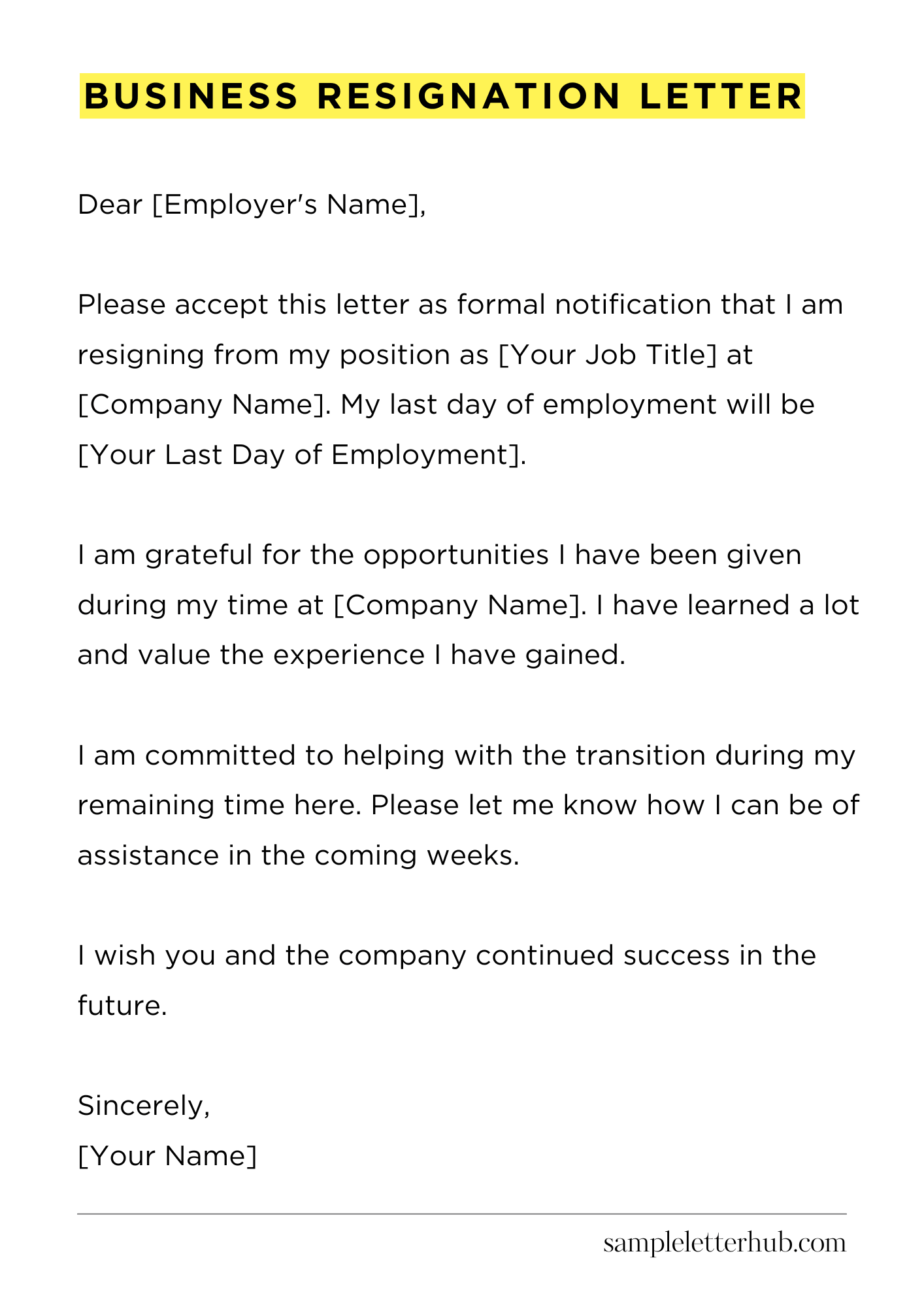
Below is a sample of a Business Resignation Letter:
[Your Name]
[Your Address]
[Your Phone Number]
[Your Email Address]
[Date]
[Employer’s Name]
[Employer’s Title]
[Company Name]
[Company Address]
Dear [Employer’s Name],
Please accept this letter as formal notification that I am resigning from my position as [Your Job Title] at [Company Name]. My last day of employment will be [Your Last Day of Employment].
I am grateful for the opportunities I have been given during my time at [Company Name]. I have learned a lot and value the experience I have gained.
I am committed to helping with the transition during my remaining time here. Please let me know how I can be of assistance in the coming weeks.
I wish you and the company continued success in the future.
Sincerely,
[Your Name]
How to Write a Business Resignation Letter
Why Your Resignation Letter Matters
You’re moving on! That’s great. But before you skip off into the sunset, you need a professional resignation letter. It is more than just a formality; it is important. This document is a crucial piece of your career history. It communicates your departure clearly and respectfully to your employer.
Think about it: this letter can shape your professional reputation. A well-written resignation letter can also assist in smooth transitions. After all, you will want a good reference. A poorly written letter can burn bridges. You don’t want that. It might even come back to haunt you someday.
Crafting the Perfect Opening
The beginning of your letter sets the tone. Keep it straightforward. Start by stating your intention to resign. Include your formal role, then the date you are resigning.
This is key information. Be brief and direct. For instance, you could open with: “Please accept this letter as formal notification that I am resigning from my position as Marketing Manager, effective October 27, 2024.” Your boss should know straight away why you are writing.
Expressing Gratitude and Providing Clarity
Following your declaration, express your gratitude. Acknowledge the opportunities you have received. Be positive. Mention something specific, such as a project or skill you learned.
For example, “I am grateful for the experience I’ve gained at [Company Name], particularly for the opportunity to lead the [Project Name] project.” Then, it is important to offer clarity. State your last day of employment. Then, think about the practicalities of a handover process.
The Handover and Transition
Offer assistance with the transition. It can be a simple sentence. Something like: “I am committed to ensuring a smooth handover of my responsibilities.” List your key tasks, any training required, and any ongoing projects.
This demonstrates professionalism and a good work ethic. Furthermore, provide your contact information. If your boss needs you, they have the means to reach you. Be available but set boundaries.
Finalizing and Proofreading
Your closing should be courteous. Reiterate your thanks. Offer well wishes for the future of the company. Before sending, always proofread carefully. Check for any errors in grammar and spelling.
Ensure the formatting is professional. Double-check your contact details. Save the letter in a professional format. Then, deliver the letter in the appropriate way. Usually, it is in hard copy. However, this is dependant on your company. Doing all these little things will mean you’ve left a lasting impression.
FAQs about Business Resignation Letter
What is the primary purpose of a business resignation letter?
The primary purpose of a business resignation letter is to formally notify an employer of an employee’s intent to leave their position. It serves as an official record of the resignation, providing a clear date of departure and initiating the necessary processes for separation, such as final pay, benefits, and the handover of responsibilities.
What essential information should be included in a resignation letter?
A well-crafted resignation letter should include: a clear statement of resignation, the effective date of the resignation, a brief expression of gratitude (optional, but recommended), and any necessary information regarding the handover of duties or return of company property. Contact information may also be included for post-employment communications.
When should I submit my resignation letter?
The timing of submitting your resignation letter is often governed by company policy or legal requirements. Typically, it is recommended to submit the letter at least two weeks before your intended departure date.
Always review your employment contract or company handbook to understand the required notice period. Adhering to the specified timeframes ensures a smooth transition and demonstrates professionalism.
How should I deliver my resignation letter?
The best method for delivering your resignation letter is often outlined in company policy. However, the most common approach is to submit a physical copy to your direct supervisor or HR department. For record-keeping purposes, it is also advisable to keep a copy for yourself. In many cases, it may be appropriate to follow up with an email as well.
What should I do after submitting my resignation letter?
After submitting your resignation letter, you should prepare for your departure by completing any outstanding tasks, transferring knowledge to your colleagues, and cooperating with the transition process. Address any questions or concerns from your employer to facilitate a smooth handover. Maintain a professional demeanor throughout the remainder of your employment.
Related:
Resignation letter due to rude boss
Resignation letter moving to another state
Resignation letter due to illness of family member
Resignation letter due to study