

An editor resignation letter is a formal document. It announces your departure from an editorial role. Its purpose is to officially inform your employer of your intention to leave. This letter includes the effective date of your resignation. It often expresses gratitude for the opportunity.
Preparing to resign can be stressful. We understand. Writing the perfect resignation letter is essential. It needs to be clear and professional. That’s why we’re here to help.
We’ve compiled various templates and examples. These are for different situations. Use these samples to create your own letter. Make the process easier and less overwhelming.
Editor Resignation Letter
Below is a sample of a Editor Resignation Letter:
[Your Name]
[Your Address]
[Your Phone Number]
[Your Email Address]
[Date]
[Editor’s Name]
[Publication Name]
[Publication Address]
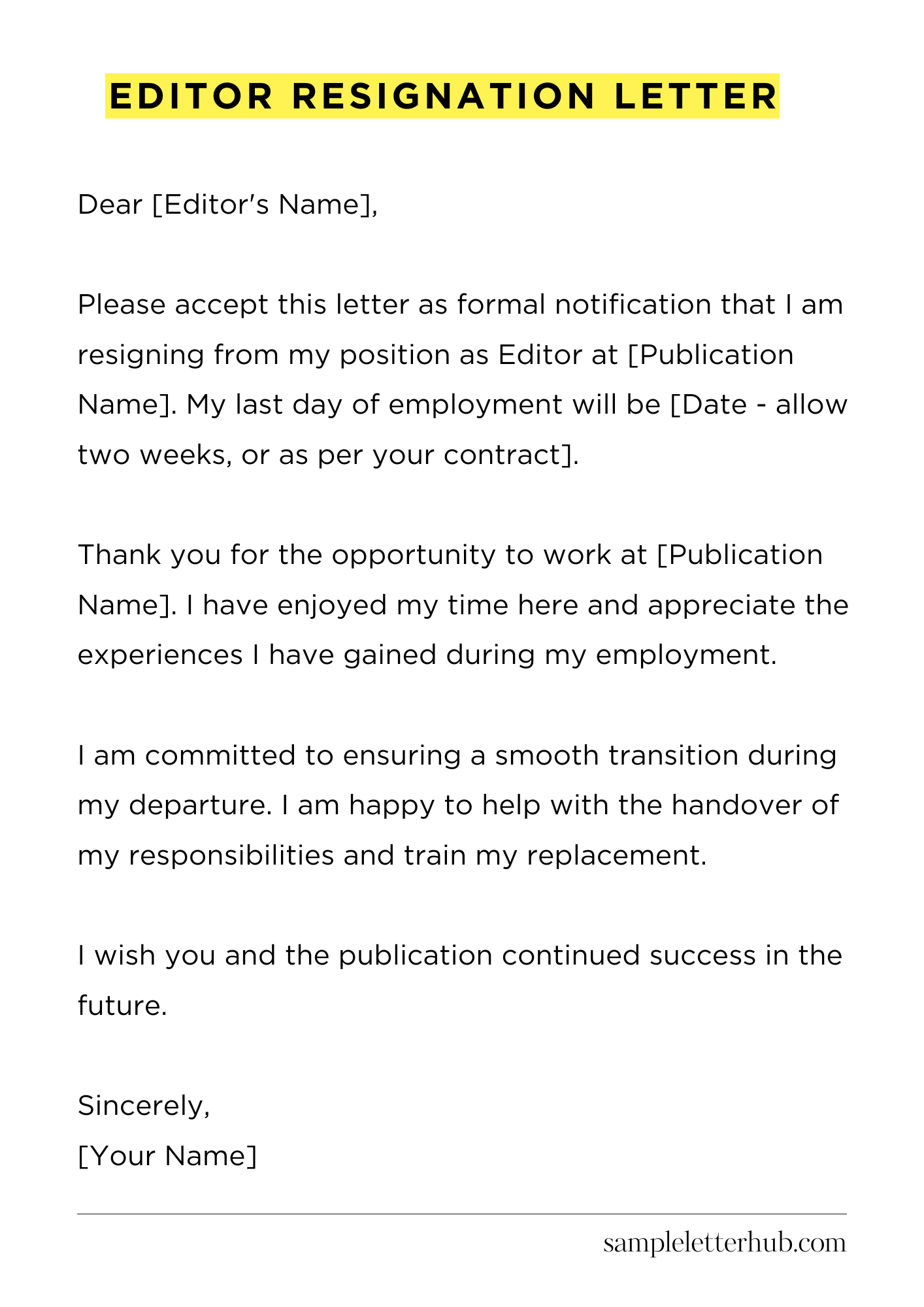
Dear [Editor’s Name],
Please accept this letter as formal notification that I am resigning from my position as Editor at [Publication Name]. My last day of employment will be [Date – allow two weeks, or as per your contract].
Thank you for the opportunity to work at [Publication Name]. I have enjoyed my time here and appreciate the experiences I have gained during my employment.
I am committed to ensuring a smooth transition during my departure. I am happy to help with the handover of my responsibilities and train my replacement. Please let me know how I can be of assistance.
I wish you and the publication continued success in the future.
Sincerely,
[Your Name]
How to Write Editor Resignation Letter
So, you’re moving on. Leaving a job is a big decision, and it’s important to handle it professionally. If you’re an editor, that means crafting a resignation letter that is clear, concise, and reflects well on you. Don’t worry, it’s not as difficult as editing a complex manuscript. Here’s a simple guide to get you through the process.
1. Preparation is Key: Before You Start Writing
Before putting pen to paper (or fingers to keyboard), take a few moments to think. What’s your reason for leaving? While you don’t need to overshare, a brief and positive explanation is often beneficial.
Have you already discussed your departure with your supervisor? That’s typically the first step. Also, consider the specific requirements of your company or organization. Do they have a standard resignation form? Are there any internal policies you need to be aware of regarding notice periods? Gathering this information will make the writing process much smoother.
Next, determine your notice period. Most companies require a standard two weeks’ notice, but this can vary. Check your employment contract or employee handbook for details. Finally, plan a time to deliver the letter. It’s best to give it to your direct supervisor in person or, if that’s not possible, via email.
2. The Essentials: What to Include
Your resignation letter doesn’t have to be a novel. Keep it direct and to the point. Start with a clear and formal statement of your intent to resign. Include your job title and the date your resignation will be effective.
Next, a brief reason for leaving is acceptable. You can say something like “I am pursuing other opportunities” or “I am seeking a role that aligns more closely with my career goals.”
Avoid overly negative language. Then, express your gratitude for the opportunity to work there. Mentioning any positive experiences you had can be helpful. Offer to help with the transition.
This shows your professionalism and willingness to ensure a smooth handover of your responsibilities. Finally, end with a professional closing, such as “Sincerely” or “Respectfully,” followed by your name and contact information.
3. Crafting the Perfect Letter: Example and Structure
Here’s a basic template you can adapt:
[Your Name]
[Your Address]
[Your Phone Number]
[Your Email Address]
[Date]
[Supervisor’s Name]
[Supervisor’s Title]
[Company Name]
[Company Address]
Dear [Supervisor’s Name],
Please accept this letter as formal notification that I am resigning from my position as [Your Job Title] at [Company Name], effective [Your Last Day of Employment].
[Brief Reason for Leaving – optional].
I am grateful for the opportunity to have worked at [Company Name] and for the experiences I have gained during my time here. I am happy to assist in the transition of my responsibilities.
Thank you for your support.
Sincerely,
[Your Signature (if printed)]
[Your Typed Name]
Remember to personalize this template to reflect your own circumstances. Tailor your message to the specific company and your relationship with your supervisor. The tone should be polite and respectful.
4. Important things to Avoid in Your Resignation Letter
Steer clear of certain pitfalls to ensure your letter makes a positive impression. Avoid negativity, complaining, or criticizing your employer or colleagues. Don’t burn bridges.
Refrain from revealing confidential company information. Keep it professional. Don’t include excessive personal details. Keep the focus on your resignation and the transition.
Also, don’t make demands. This isn’t the time to negotiate terms of your departure. Maintain a respectful and professional tone throughout the letter.
5. Review and Finalize: Before You Send
Before submitting your letter, proofread it carefully. Check for any grammatical errors, typos, or inconsistencies. Double-check the date and your last day of employment.
Consider having a trusted friend or colleague review it as a second set of eyes can often catch errors that you might have missed. Make sure your letter is easy to read and understand. Ensure that you have the correct name and title of your supervisor. After this, all that’s left is to submit the letter and be ready to move on to your next adventure. Good luck!
FAQs about Editor Resignation Letter
What are the essential components of an editor resignation letter?
An effective editor resignation letter typically includes: a clear statement of resignation, the editor’s name, the date of the letter, the intended last day of employment, a brief expression of gratitude for the opportunity, and any necessary information about the transition of responsibilities. It may also include a statement of willingness to assist with the handover and contact information.
How much notice should an editor provide when resigning?
The standard notice period for an editor usually depends on their employment contract or company policy. Common notice periods range from two weeks to a month. It’s crucial to review the employment agreement or consult with the human resources department to understand the specific requirements for the position.
Should an editor explain the reason for leaving in their resignation letter?
While not mandatory, briefly mentioning the reason for leaving can be beneficial. However, the level of detail is a personal choice. Reasons can be stated concisely, such as “to pursue new opportunities” or “for personal reasons.” It is generally recommended to keep the tone positive and professional, even if the reasons for leaving are complex.
What is the proper format for an editor resignation letter?
A professional format is recommended. Begin with a formal salutation (e.g., “Dear [Manager’s Name]”), followed by the body of the letter, and conclude with a professional closing (e.g., “Sincerely” or “Best regards”). The letter should be single-spaced with a standard font like Times New Roman or Arial. Include your name and contact information at the top or bottom of the letter.
How should an editor handle the handover of responsibilities?
An editor should offer assistance in the transition process. This might involve creating documentation, training the person taking over, or providing guidance on ongoing projects. Collaborate with the manager to develop a handover plan, including timelines and communication strategies to ensure a smooth transition of duties and minimal disruption to editorial workflow.
Related:
Resignation letter due to rude boss
Resignation letter moving to another state
Resignation letter due to illness of family member
Resignation letter due to study