

So, you’re saying goodbye. A receptionist resignation letter is your official notice to your employer. It states your intention to leave your job. It’s a professional document. Its purpose is to inform your employer and mark your exit date.
Feeling overwhelmed? Don’t worry, we’ve got you covered. We’ll explore different resignation letter examples. You can adapt these templates. Find one that fits your situation. Need to keep it short and sweet? We have a sample for that.
Need to express gratitude? We have examples for that, too. Use these samples as your starting point. Make your resignation clear and concise. This article is your guide to crafting the perfect letter. Good luck with your next adventure!
Receptionist Resignation Letter
Below is a sample of a Receptionist Resignation Letter:
[Your Name]
[Your Address]
[Your Phone Number]
[Your Email Address]
[Date]
[Recipient Name] (If known, otherwise use title)
[Recipient Title]
[Company Name]
[Company Address]
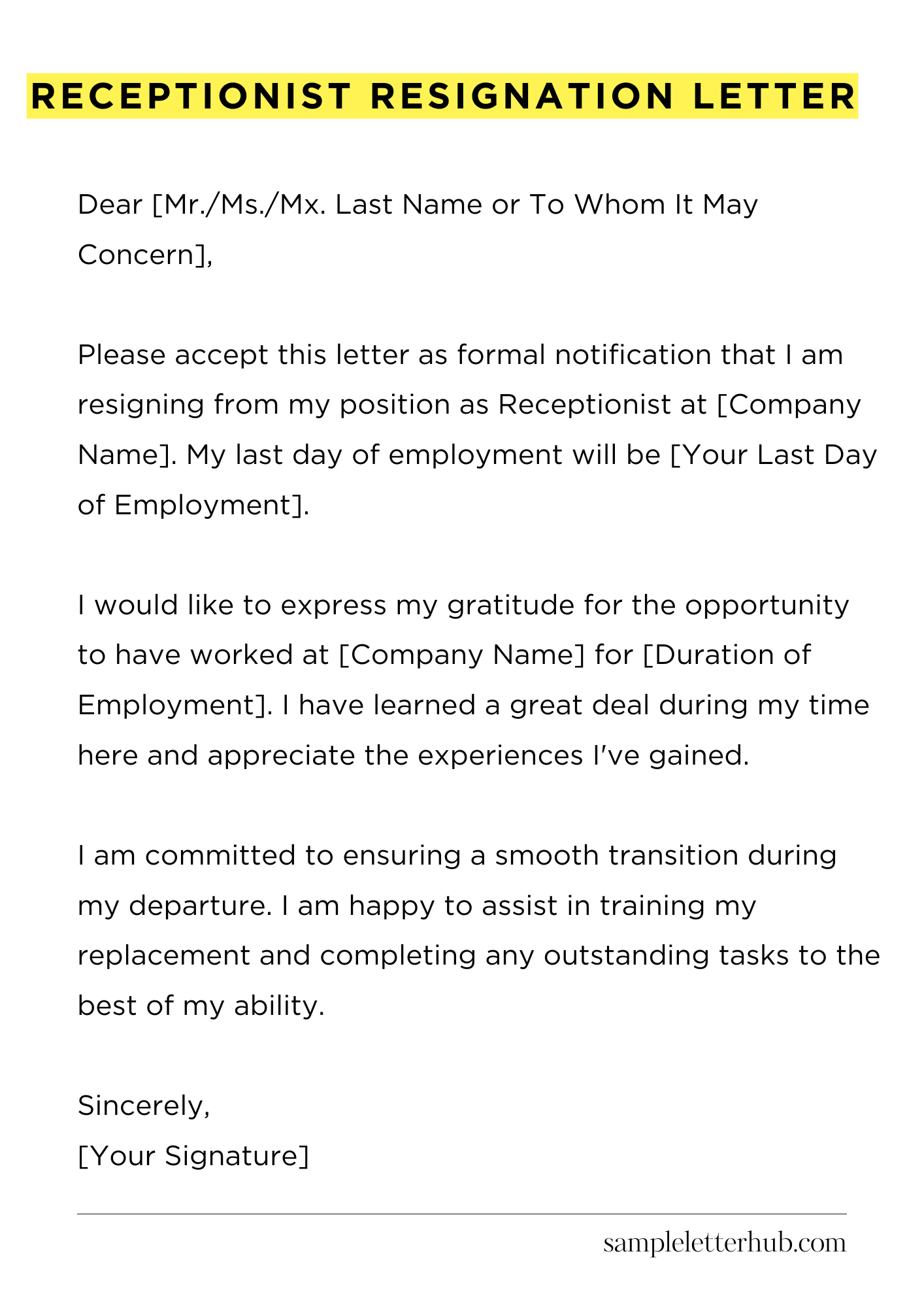
Dear [Mr./Ms./Mx. Last Name or To Whom It May Concern],
Please accept this letter as formal notification that I am resigning from my position as Receptionist at [Company Name]. My last day of employment will be [Your Last Day of Employment].
I would like to express my gratitude for the opportunity to have worked at [Company Name] for [Duration of Employment]. I have learned a great deal during my time here and appreciate the experiences I’ve gained.
I am committed to ensuring a smooth transition during my departure. I am happy to assist in training my replacement and completing any outstanding tasks to the best of my ability.
I wish you and the company all the best in the future.
Sincerely,
[Your Signature]
How to Write Receptionist Resignation Letter
1. Grasping the Basics: Why Your Letter Matters
Leaving a job requires a formal process. This includes a well-crafted resignation letter. As a receptionist, your departure is noticed. It impacts the daily operations of the workplace. Therefore, a professional and respectful resignation letter is essential. It’s a key document. Think of it as your final statement, and it should leave a positive impression.
A good letter ensures a smooth transition. This helps maintain a good relationship with your employer. It also protects your professional reputation. You may need a reference in the future. Don’t burn any bridges. Proper etiquette matters; it always does.
2. Essential Elements: What Your Letter Must Contain
Your receptionist resignation letter needs several key components. First, there’s the date. This helps establish the official date of your notification. Then, state your intention. Clearly and directly state you are resigning from your position. You must also specify your last day of employment. This is when your employment officially ends.
Next, express gratitude for the opportunity. Thank your employer for the experience and the skills you gained. Briefly mention any specific positive aspects of your time there. This shows your appreciation. Finally, provide your contact information. This is to facilitate communication during the transition period, if needed. Keep it simple and clear.
3. Structuring Your Letter: The Right Format
Use a professional business letter format. Start with your contact information. This is your name, address, phone number, and email. Below this, include the date. Then, add the recipient’s information. This includes the name of your supervisor or HR, their title, and the company address.
Begin with a polite salutation. “Dear [Name],” is a safe option. The body of your letter should be concise. Get straight to the point. The closing should reiterate your resignation and your last day. End with a professional closing, such as “Sincerely” or “Best regards.” Sign your name above your typed name. Keep it clean and easy to read.
4. Writing the Body: What to Say and What to Avoid
In the main body, state your resignation with clarity. Avoid unnecessary details about why you’re leaving. Briefly express your gratitude. Mention specific positive experiences if you wish. Offer to help with the transition. Be willing to assist in training your replacement. If you can, offer your help. It’s a nice gesture.
Refrain from negative comments about the company or colleagues. Don’t discuss your new job or salary expectations. Keep the tone positive and professional. Focus on your departure and gratitude. Keep it professional. That’s what matters most.
5. Proofreading and Finalizing: Before You Hit Send
Proofread your letter carefully. Check for any grammatical errors or typos. Ensure all names, dates, and titles are correct. Review the format to ensure it looks professional. Have a friend or family member read it over. Fresh eyes can catch mistakes you might miss.
Once you are completely satisfied, print a copy for your records. Then, submit your letter according to your company’s policy. Usually, this means handing it to your supervisor or HR department. Consider sending a digital copy via email, too. Keep things smooth and simple. Make sure everything goes according to the plan.
FAQs about Receptionist Resignation Letter
What is the purpose of a receptionist resignation letter?
The primary purpose of a receptionist resignation letter is to formally notify your employer of your intention to leave your position. It serves as an official record of your departure and provides essential information such as your last day of employment. This letter allows for a smooth transition and demonstrates professionalism.
What key information should be included in a receptionist resignation letter?
A well-written resignation letter should include your formal announcement of resignation, your official last day of employment, a brief and polite statement of your reason for leaving (optional), and an expression of gratitude to your employer. It’s also customary to offer assistance during the transition period, such as training a replacement.
How much notice should a receptionist give when resigning?
The standard practice is to give two weeks’ notice, which is usually sufficient for most employers to begin the hiring process and train a replacement. However, the required notice period can vary depending on your employment contract or company policy. Always review your contract or handbook to determine the specific requirements.
Should I provide a reason for resigning in my letter?
While it is generally not mandatory, you may optionally include a brief and professional reason for leaving. You can keep it concise and positive, such as “to pursue another opportunity” or “to focus on personal development.” If you have any serious grievances, it’s often better to address them separately through HR or in a private conversation.
How should I format and deliver my receptionist resignation letter?
The letter should be professionally formatted, using a standard business letter format. It should be typed and dated. You can deliver it as a hard copy to your direct supervisor or HR, or, with prior confirmation, as an email attachment. Always keep a copy for your records.
Related:
Resignation letter due to rude boss
Resignation letter moving to another state
Resignation letter due to illness of family member
Resignation letter due to study