

So, you’re an Education Specialist looking to move on? You’ll need an Education Specialist resignation letter. It is a formal document. It informs your employer of your decision to leave. It also states your last day of employment.
Writing this letter might seem daunting. But don’t worry! We’ve got you covered. We’ll share several templates and examples. They are designed to make the process simple.
Use these samples as inspiration. Adapt them to fit your unique situation. Craft your letter with ease and confidence. Good luck on your next adventure!
Education Specialist Resignation Letter
Below is a sample of a Education Specialist Resignation Letter:
[Your Name]
[Your Address]
[Your Phone Number]
[Your Email Address]
[Date]
[Recipient’s Name]
[Recipient’s Title]
[School/Organization Name]
[School/Organization Address]
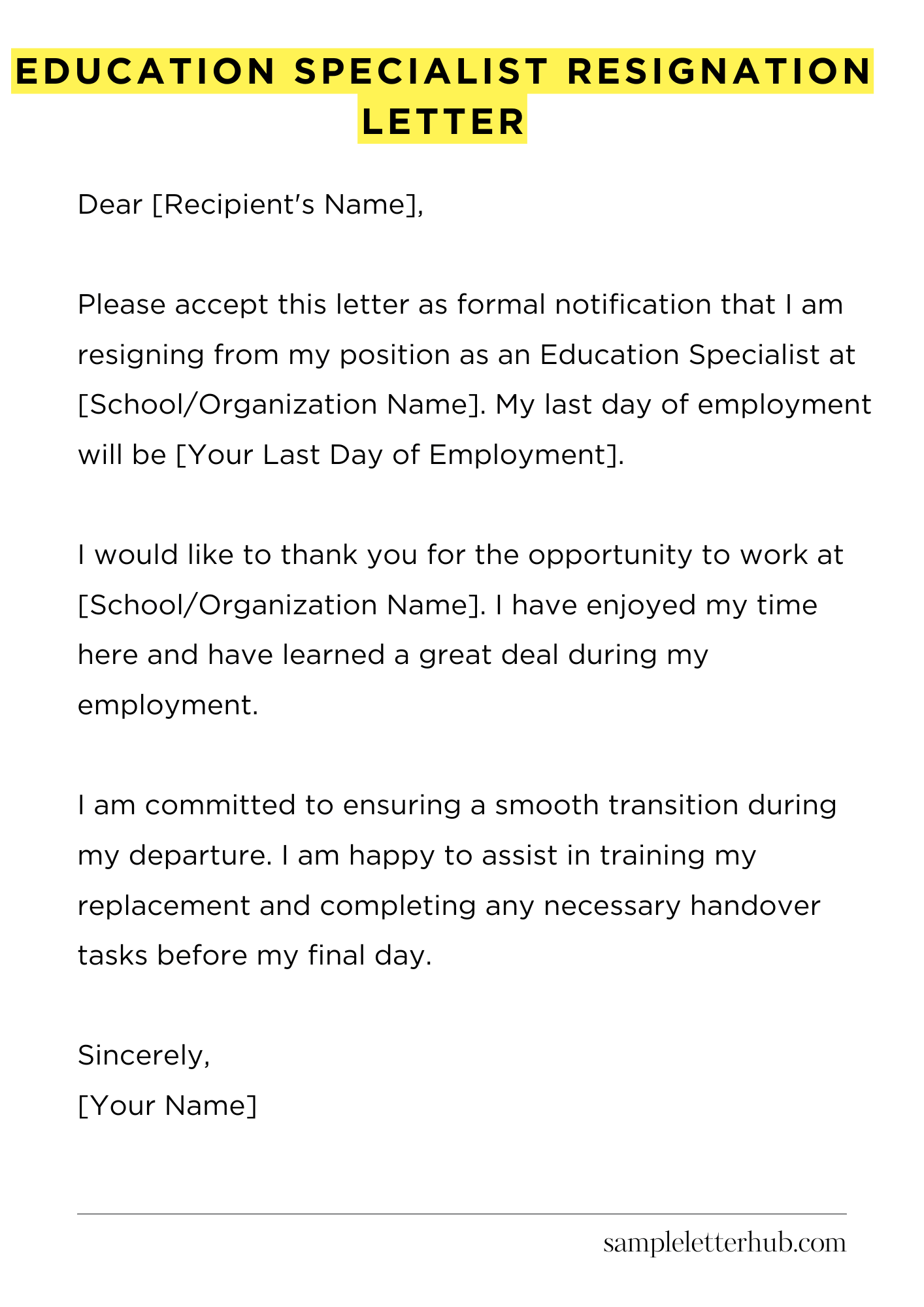
Dear [Recipient’s Name],
Please accept this letter as formal notification that I am resigning from my position as an Education Specialist at [School/Organization Name]. My last day of employment will be [Your Last Day of Employment].
I would like to thank you for the opportunity to work at [School/Organization Name]. I have enjoyed my time here and have learned a great deal during my employment.
I am committed to ensuring a smooth transition during my departure. I am happy to assist in training my replacement and completing any necessary handover tasks before my final day.
I wish you and the school/organization all the best in the future.
Sincerely,
[Your Name]
How to Write an Education Specialist Resignation Letter
Know Your Audience (and Their Expectations)
Leaving a job, especially a role as important as an Education Specialist, is a big deal. You want to make a good impression, even as you’re departing. This is where your resignation letter comes in.
First, think about who will be reading it: your principal, your supervisor, maybe even the superintendent. Consider their perspective. They’ll appreciate a clear, concise, and professional letter. They will be looking for specific information.
They have certain expectations regarding format and tone. Be sure you adhere to them. Your goal is to make the transition as smooth as possible for everyone involved, including yourself. Don’t cause unnecessary issues.
Formatting is Key: Keeping it Clean and Clear
A poorly formatted letter can create a bad impression. Stick to a standard business letter format. Start with your contact information (name, address, phone number, email address) at the top, followed by the date. Next, include the recipient’s information (name, title, school/district address).
Use a professional font like Times New Roman or Arial, size 12. Keep the body of your letter single-spaced, with a blank line between paragraphs. A well-formatted letter demonstrates professionalism and respect. It shows you care about the details, even when you’re leaving. This might seem like basic advice but it’s often overlooked.
What to Include: The Essential Elements
Your resignation letter needs to convey specific information clearly. Begin with a clear statement of your intention to resign. State your position (Education Specialist) and the effective date of your resignation. Be precise. This is the most crucial part.
Next, express your gratitude. Thank your employer for the opportunity to work there. Briefly mention any positive experiences or skills you’ve gained. While it’s fine to keep it brief, acknowledging the positive aspects makes a good impression. Make sure to keep it positive. Finally, offer assistance with the transition.
Be willing to help with training your replacement or completing any outstanding tasks. This demonstrates your commitment to a smooth handover.
The Tone: Professionalism and Respect
Maintain a professional and respectful tone throughout your letter. Even if you’re leaving due to negative experiences, avoid negativity. Focus on the positive aspects of your time there, even if they’re few. Avoid making accusations or complaints.
Keep your language formal and polite. Use phrases like “I would like to express my gratitude” instead of informal language. The goal is to leave on a good note, preserving your professional reputation. Think long-term. Remember, the education world can be surprisingly small.
Final Touches: Proofread and Send!
Before you send your letter, proofread it carefully. Check for any grammatical errors, typos, or spelling mistakes. Errors can detract from your message. Ask a friend or colleague to read it over for a fresh perspective. Having another set of eyes to review your letter is always a good idea.
Once you are satisfied, print the letter on good quality paper, if possible, and sign it by hand. Consider keeping a copy for your records. Submit the letter to the appropriate person, following your school district’s procedures. And that’s it! You’ve successfully written and submitted your Education Specialist resignation letter. Now, on to your next adventure!
FAQs about Education Specialist Resignation Letter
What is the primary purpose of an Education Specialist resignation letter?
The primary purpose of an Education Specialist resignation letter is to formally notify your employer, typically a school district or educational institution, of your intention to leave your position. It serves as a written record of your resignation, the effective date of your departure, and often expresses gratitude for the opportunity to work there.
What key information should be included in an Education Specialist resignation letter?
A well-crafted resignation letter should include your official name, the date the letter is written, the name of your supervisor or the appropriate HR department, your current job title as an Education Specialist, a clear statement of your intent to resign, your last day of employment (effective date).
How much notice should an Education Specialist give when resigning?
The amount of notice required usually depends on the employment contract or the policies of the employing institution. Most contracts specify a minimum notice period, which is generally two weeks to a month. It’s crucial to review your contract or employee handbook to determine the required notice period and adhere to it to avoid any potential issues.
Should an Education Specialist resignation letter explain the reasons for leaving?
While not mandatory, you can briefly mention the reason(s) for your resignation. Keep the explanation concise and professional. Common reasons might include pursuing a new opportunity, personal or family reasons, or career advancement. Avoid negative comments about the employer or colleagues. If you prefer, you can simply state that you are pursuing other opportunities.
How should an Education Specialist end their resignation letter?
Close your letter with a professional and appreciative tone. Express gratitude for the opportunity to have worked as an Education Specialist at the institution. You can offer to assist with the transition, such as training your replacement. End with a formal closing, such as “Sincerely,” or “Respectfully,” followed by your full name and signature.
Related:
Resignation letter due to rude boss
Resignation letter moving to another state
Resignation letter due to illness of family member
Resignation letter due to study