

A “Credit Manager resignation letter” is a formal document. It is written by a Credit Manager. The purpose is to officially announce their departure from a company. It informs the employer of the last day of employment. It may also provide context for the resignation.
This article is designed to help. We’ll share several templates. These are samples of resignation letters. They are tailored for Credit Managers. You can use them as a starting point. Feel free to modify them.
The goal is to make things easier. Writing a resignation letter can be stressful. We hope our samples simplify the process. They’ll assist you in crafting a professional letter.
Credit Manager Resignation Letter
Below is a sample of a Credit Manager Resignation Letter:
[Your Name]
[Your Address]
[Your Phone Number]
[Your Email Address]
[Date]
[Credit Manager’s Supervisor’s Name]
[Credit Manager’s Supervisor’s Title]
[Company Name]
[Company Address]
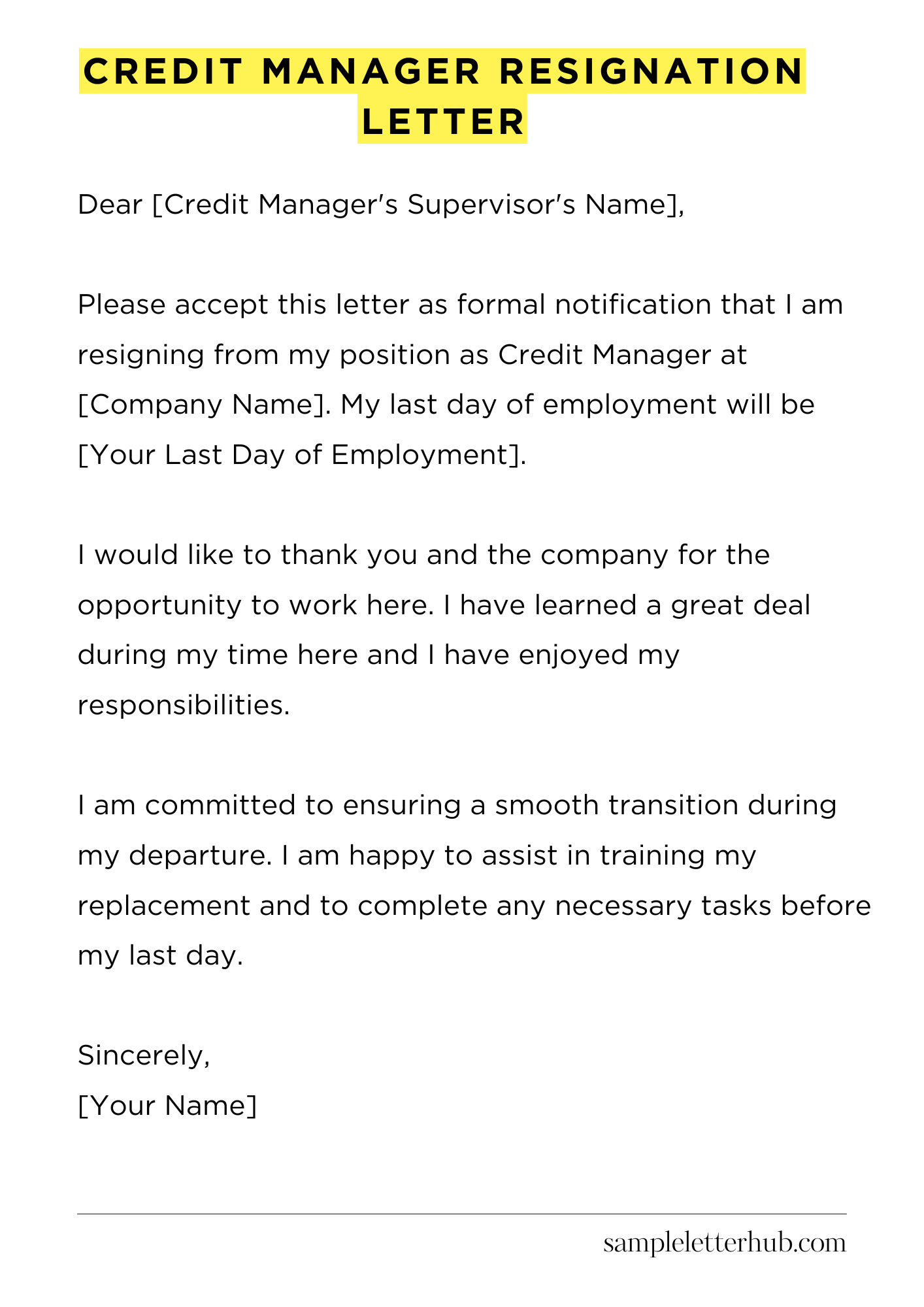
Dear [Credit Manager’s Supervisor’s Name],
Please accept this letter as formal notification that I am resigning from my position as Credit Manager at [Company Name]. My last day of employment will be [Your Last Day of Employment].
I would like to thank you and the company for the opportunity to work here. I have learned a great deal during my time here and I have enjoyed my responsibilities.
I am committed to ensuring a smooth transition during my departure. I am happy to assist in training my replacement and to complete any necessary tasks before my last day.
I wish you and [Company Name] all the best in the future.
Sincerely,
[Your Name]
How to Write a Credit Manager Resignation Letter
Getting Started: Why You Need a Resignation Letter
Leaving a job, especially a role like Credit Manager, requires a formal resignation. Think of it as the first step in ensuring a smooth transition. A well-crafted letter isn’t just a formality. It’s a professional courtesy.
It protects your reputation and helps maintain a positive relationship with your current employer. This document clearly communicates your intentions. It signals the official end of your employment.
What to Include: Essential Elements
Your letter should be concise, yet complete. Begin with the date. Next, state your formal resignation. Clearly state your last day of employment. Use a professional tone throughout.
Briefly, thank your employer for the opportunity. Mention any support you will provide during the handover period. Finally, and most importantly, remember to include your signature. This confirms your letter.
Structuring Your Letter: The Right Format
Format matters! Start with your contact information. Place it at the top. This includes your name, address, and contact details. Then, address the letter to your immediate supervisor or HR manager.
Clearly state your intention to resign. Specify your last day of employment. This is crucial for payroll and other administrative procedures. Show gratitude for the experience. Be polite and professional in your closing remarks. Include your signature and printed name below.
Tips for Tone and Content: Making it Professional
Keep your language professional. Avoid negativity or personal grievances. Focus on the positive aspects of your experience. Express your appreciation for the opportunities you’ve been given.
Offer to assist with the handover process. Be willing to train your replacement. Keep your letter brief and to the point. Proofread carefully. Check for grammar and spelling errors. These small details can have a big impact on the overall impression.
After the Letter: The Next Steps
Once you’ve submitted your letter, be prepared for a response. Your manager may want to discuss your resignation. They might want an exit interview. Be prepared to answer any questions openly and honestly. Follow through with your offer to assist during the transition. Make sure all your tasks are documented properly.
This will make the handover process much smoother for everyone. Finally, keep a copy of your resignation letter for your records. It’s an important document.
FAQs about Credit Manager resignation letter
What is the primary purpose of a Credit Manager resignation letter?
The primary purpose of a Credit Manager resignation letter is to formally notify the employer of the employee’s intent to leave the position. It serves as an official record of the resignation, the last day of employment, and often, a brief expression of gratitude or a handover plan.
What key information should be included in a Credit Manager resignation letter?
Essential components of a Credit Manager resignation letter include a clear and concise statement of resignation, the effective date of the resignation (last day of employment), the employee’s name and job title, and the employer’s name.
A brief expression of gratitude for the opportunity and, if applicable, a mention of any assistance in the transition process, such as offering to help train a replacement, is also typical.
How much notice should a Credit Manager provide in their resignation letter?
The amount of notice required is typically dictated by the employment contract, company policy, or local labor laws. Often, it’s two to four weeks. Review your employment agreement or company handbook to confirm the required notice period. If no specific time frame is mentioned, providing at least two weeks’ notice is generally considered a professional standard.
Is it necessary to provide a reason for resigning in the Credit Manager resignation letter?
While not mandatory, briefly stating the reason for leaving can be helpful, although it is not necessary to provide extensive details. You can state something simple and non-committal, such as “to pursue other opportunities,” “for personal reasons,” or “to accept another position.”
If you are comfortable, you may also state that you are resigning for a better opportunity. However, you are not required to disclose your reasons.
How should a Credit Manager handle the handover process when resigning?
The Credit Manager should offer to assist in the handover process to ensure a smooth transition. This might involve creating documentation, training the replacement, or providing a list of ongoing projects and outstanding issues.
The letter can include a statement regarding your willingness to assist during the notice period to ensure a seamless transfer of responsibilities and minimize disruption.
Related:
Resignation letter due to rude boss
Resignation letter moving to another state
Resignation letter due to illness of family member
Resignation letter due to study