

An adjunct faculty resignation letter is a formal document. It informs the college or university of your decision. The purpose is to officially end your employment. It allows a smooth transition.
Are you an adjunct faculty member? Do you need to resign? Crafting the perfect resignation letter can be tricky. We’ve got you covered. We’re sharing templates and examples. Use these to create your own letter.
Our goal is simple. We want to make it easy for you. You can adapt these samples. Write a resignation letter that suits your needs. Your departure can be professional and graceful.
Adjunct Faculty Resignation Letter
Below is a sample of a Adjunct Faculty Resignation Letter:
[Your Name]
[Your Address]
[Your Phone Number]
[Your Email Address]
[Date]
[Hiring Manager Name] (If known, otherwise use title)
[Hiring Manager Title]
[Department Name]
[University/College Name]
[University/College Address]
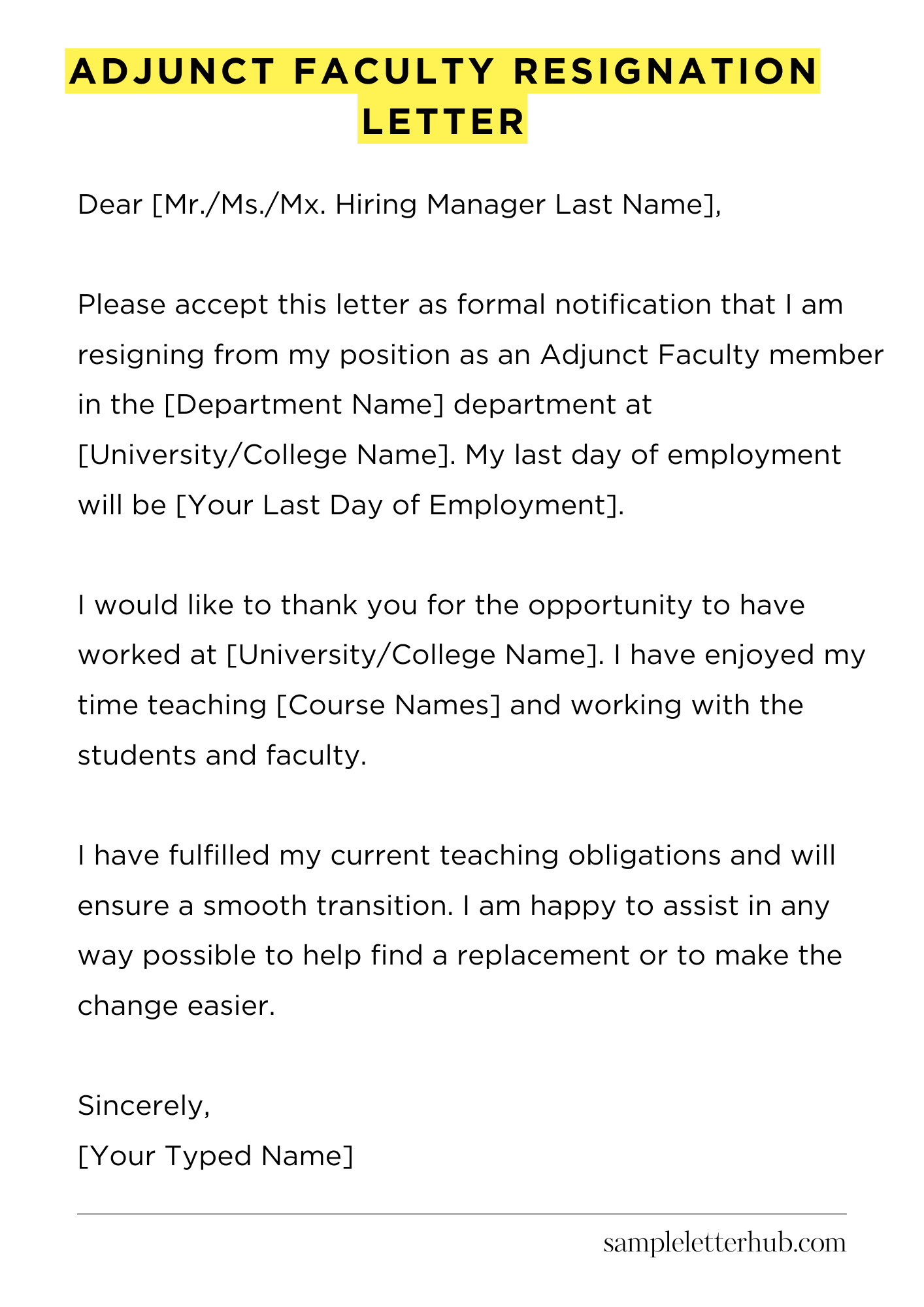
Dear [Mr./Ms./Mx. Hiring Manager Last Name],
Please accept this letter as formal notification that I am resigning from my position as an Adjunct Faculty member in the [Department Name] department at [University/College Name]. My last day of employment will be [Your Last Day of Employment].
I would like to thank you for the opportunity to have worked at [University/College Name]. I have enjoyed my time teaching [Course Names] and working with the students and faculty.
I have fulfilled my current teaching obligations and will ensure a smooth transition. I am happy to assist in any way possible to help find a replacement or to make the change easier.
I wish you and [University/College Name] all the best in the future.
Sincerely,
[Your Typed Name]
How to Write Adjunct Faculty Resignation Letter
Resigning from an adjunct faculty position can be a significant step. Whether you’re moving on to new opportunities or pursuing other interests, a well-crafted resignation letter is essential. This crucial document helps you maintain professionalism and leaves a positive lasting impression. Here’s a simple guide to navigate the process.
1. Preparation is Key
Before you even begin typing, take a moment to plan. Consider the timing. When is the best time to submit your resignation? Review your contract. Understand your obligations regarding notice periods. Generally, two weeks is a courteous timeframe, but your contract specifies the precise requirements.
Think about your reasons for leaving. While you don’t need to detail everything, a brief and neutral explanation is helpful. This sets the foundation for a professional, respectful letter. This initial planning phase saves time and prevents potential misunderstandings.
2. Essential Elements of Your Letter
Every resignation letter needs specific components. Start with your contact information. Include your name, address, phone number, and email. Then, add the date. Next, identify the recipient. Address your letter to the appropriate department head or person specified in your contract. Be formal and use their title.
The body of your letter is where you communicate your intentions. Clearly state that you are resigning from your position as an adjunct faculty member. Mention the specific date your resignation takes effect. This is absolutely critical.
3. Expressing Gratitude and Professionalism
Even if you’re not completely satisfied with your experience, it’s wise to maintain a positive tone. Express gratitude for the opportunity to have worked at the institution.
Acknowledge any positive experiences or professional development you received. Mention any specific individuals you appreciate. Keep it concise. This gesture leaves a positive final impression and reflects well on your character. It’s also just good manners. Professionalism matters.
4. Keeping it Concise and Focused
Keep your letter focused and to the point. Avoid lengthy explanations of why you are leaving. Stick to the essential information: your intent to resign, the effective date, and a brief expression of gratitude. Avoid any negativity or complaints. This helps to ensure your letter remains professional and easy to understand.
Concise writing gets the job done and is always appreciated by busy people. You want to make it easy for them. Less is often more.
5. Proofreading and Final Steps
Before sending your letter, proofread it carefully. Check for any grammatical errors or typos. Ensure your dates are accurate. Double-check the recipient’s name and title. It shows attention to detail.
Consider printing the letter on professional stationary. Keep a copy for your records. Submit the letter according to the institution’s guidelines, typically via email or in person. Once submitted, consider this part of your professional life completed. A well-written resignation letter can open future doors.
FAQs about Adjunct Faculty Resignation Letter
What is the typical format for an adjunct faculty resignation letter?
The typical format should include a formal business letter layout. Begin with your contact information (name, address, email, phone number) followed by the date.
Then, include the recipient’s information (department head’s name, title, department, and university address). The body of the letter should clearly state your intention to resign, your last day of employment, a brief expression of gratitude, and professional closing remarks.
Optional additions could include a reason for leaving (though not always required) and an offer to assist with the transition.
How much notice should I give when resigning as an adjunct faculty member?
The notice period is typically dictated by your contract or university policy. Review your employment agreement carefully. Common practice suggests providing at least two to four weeks’ notice.
However, specific requirements may vary, so it is crucial to adhere to the guidelines outlined in your contract or faculty handbook. Giving ample notice demonstrates professionalism and allows the department to find a suitable replacement.
What information is essential to include in my adjunct faculty resignation letter?
Essential information includes a clear and concise statement of your resignation, your last day of employment, and a professional closing. It’s important to state your intention without ambiguity.
Your last day should be stated explicitly to avoid any confusion. You should also include a brief expression of gratitude for the opportunity. Optionally, you may include your course title(s) if applicable. Your name and signature are also mandatory.
Should I provide a reason for resigning in my adjunct faculty resignation letter?
While providing a reason is not always mandatory, you have the option. If you choose to, keep it brief and professional. Common reasons include pursuing other opportunities, personal commitments, or career changes.
If the reason is positive, such as taking a better-paying position, you can state this clearly. If the reason is negative, such as dissatisfaction, consider if you want to share it. It’s generally best to keep it professional and succinct, focusing on the positive aspects of the experience or future endeavors.
Is it necessary to submit my resignation letter in a specific way (e.g., email or hard copy)?
The required submission method may vary depending on the university’s or department’s policy. The safest approach is to consult your contract, faculty handbook, or department guidelines. Often, a physical hard copy is preferred, particularly for official records, but email submission is increasingly common.
If in doubt, send it both ways (hard copy and email) to ensure it reaches the appropriate recipient and is properly documented. Always retain a copy of your resignation letter for your records.
Related:
Resignation letter due to rude boss
Resignation letter moving to another state
Resignation letter due to illness of family member
Resignation letter due to study