

A PR resignation letter formally announces your departure from a public relations role. It’s a professional document. Its purpose is to officially inform your employer of your decision. It also outlines the end date of your employment.
Crafting the perfect letter can feel daunting. Don’t worry, we’ve got you covered. We’ll explore various templates and examples. They are designed to simplify the process. They’ll help you create a compelling and professional resignation letter.
Think of these samples as your PR toolkit. Each example caters to different scenarios. You can adapt them to your specific needs. Say goodbye to guesswork and hello to a smooth transition.
Pr Resignation Letter
Below is a sample of a Pr Resignation Letter:
[Your Name]
[Your Address]
[Your Phone Number]
[Your Email Address]
[Date]
[Recipient’s Name]
[Recipient’s Title]
[Company Name]
[Company Address]
Dear [Mr./Ms./Mx. Last Name],
Please accept this letter as formal notification that I am resigning from my position as [Your Job Title] at [Company Name]. My last day of employment will be [Your Last Day of Employment].
I would like to thank you for the opportunity to work at [Company Name]. I have learned a great deal during my time here.
I am committed to ensuring a smooth transition during my departure. I am happy to assist in training my replacement and completing any outstanding tasks. Please let me know how I can be of assistance.
I wish you and the company all the best in the future.
Sincerely,
[Your Signature]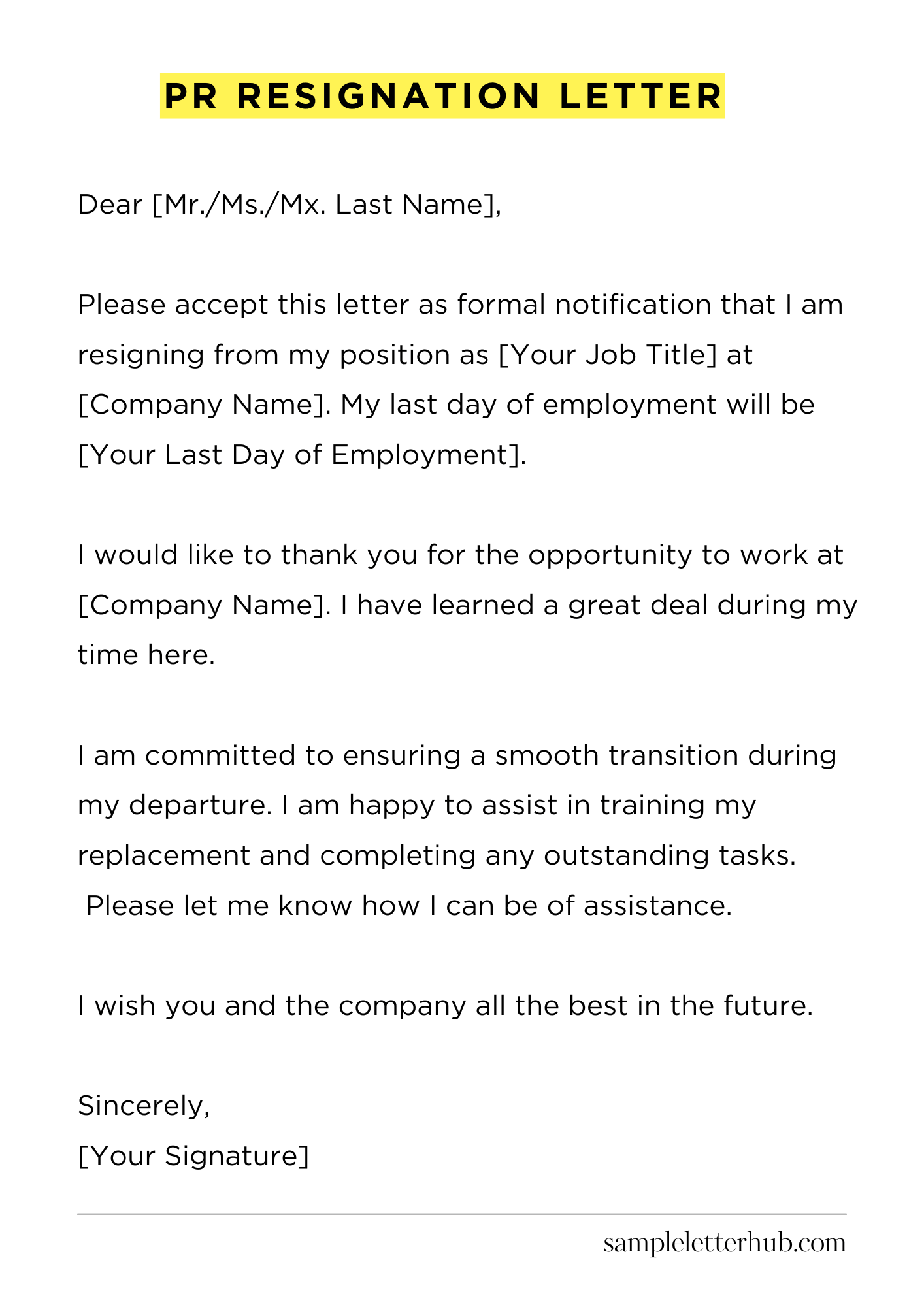
How to Write a PR Resignation Letter
Leaving a job is a big step. It requires careful planning and execution. Resigning gracefully is paramount, especially in the Public Relations (PR) field. Your professional reputation is built on relationships; burning bridges is never a good idea. Crafting a strong, yet polite, resignation letter is the first key step.
1. Setting the Stage: Knowing Your Audience
Before putting pen to paper (or fingers to keyboard), consider your audience. Who are you sending this letter to? Is it your direct supervisor, the head of the PR department, or perhaps HR? Tailor your tone and level of formality accordingly. A letter to a close supervisor might be slightly more informal, but maintain professionalism always.
Understand your company’s internal protocols. Are there specific channels they require for official resignations? Do your research!
2. The Anatomy of a Good Resignation Letter
Your PR resignation letter should follow a standard structure. Clarity is crucial. First, clearly state your intent to resign. Mention the effective date of your departure. This date should align with any company policies regarding notice periods. Next, express gratitude for the opportunity to work at the company.
Detail a few positive aspects of your experience, such as skills you’ve developed or relationships you’ve built. Keep it brief. Then, if you choose, you can offer to assist with the transition process. This is a classy move that is always appreciated.
3. What to Include (And What to Leave Out)
Beyond the basics, what else should you include? You might briefly mention the reason for your departure, but keep it concise and professional. Avoid lengthy explanations or negative commentary about your colleagues, the company culture, or your previous role. This is not the place for airing grievances! Stick to facts and positive sentiments.
Do not offer unsolicited advice. On the other hand, you can express your desire to stay in touch, perhaps through LinkedIn. Think of this as the final, professional statement you will give to this company.
4. The Importance of Professionalism and Tone
Maintain a professional tone throughout your letter. Use formal language, even if you have a friendly relationship with your supervisor. Avoid slang or overly casual expressions. Proofread your letter meticulously for any grammatical errors or typos. This reflects your professionalism. Remember, this letter is a reflection of your brand.
You want to leave a lasting positive impression. A positive tone makes all the difference; even if you are leaving because of difficult circumstances. Keep your head high.
5. Finalizing and Following Up
Once you’ve written your letter, review it again. Get a second pair of eyes to read it over before sending it. Make sure everything is clear, concise, and professional. Once you’ve sent the letter, be prepared to discuss your resignation with your supervisor. Be prepared to answer any questions. Cooperate during the transition period.
Be respectful. Following up politely ensures your smooth exit and protects your professional standing. Good luck, and onward!
FAQs about PR Resignation Letter
What is the primary purpose of a PR resignation letter?
The primary purpose of a PR resignation letter is to formally notify your employer of your intention to leave your position. It serves as an official record of your departure, providing a clear date of your last day of employment.
Furthermore, it allows you to express your gratitude for the opportunity and, if desired, to provide a brief explanation for your departure. A well-crafted letter can also help maintain a positive relationship with your employer and colleagues.
What key elements should be included in a PR resignation letter?
A PR resignation letter should include: a clear statement of your resignation, the effective date of your last day, a thank you to the employer for the opportunity, and, optionally, a brief and professional reason for leaving.
Your letter should also include your contact information for any follow-up communication, a request for information about final paycheck and benefits, and a professional closing.
How should the tone of a PR resignation letter be?
The tone of a PR resignation letter should be professional, respectful, and positive. Avoid negativity or complaints about your job or employer. Express gratitude for the opportunity and be concise and clear in your writing. Maintain a friendly and courteous tone, as you never know when your paths may cross again professionally.
Should I provide a reason for resigning in my PR resignation letter?
You are not obligated to provide a reason for resigning. However, if you choose to include one, keep it brief, professional, and positive. You might mention pursuing a new opportunity or a change in career goals. Avoid sharing personal or negative reasons. If you prefer to keep your reasons private, you can simply state that you are resigning to pursue other opportunities.
How far in advance should I submit my PR resignation letter?
The standard practice is to submit your resignation letter at least two weeks before your intended last day. However, this may vary depending on your employment contract, industry standards, or company policy.
Review your employment agreement or consult with your HR department to determine the required notice period. Providing adequate notice ensures a smooth transition and demonstrates professionalism.
Related:
Resignation letter due to rude boss
Resignation letter moving to another state
Resignation letter due to illness of family member
Resignation letter due to study