

A Safety Specialist resignation letter is a formal document. It is written by a Safety Specialist. The purpose is to officially inform an employer of their intention to leave their job. It marks the beginning of their departure process.
Are you a Safety Specialist ready to move on? Need help writing your resignation? We’ve got you covered. We understand it can be a tricky task. That’s why we’re sharing some helpful templates.
These examples offer a great starting point. They are designed to streamline the writing process. They will make it easier to communicate your message clearly and professionally.
Safety Specialist Resignation Letter
Below is a sample of a Safety Specialist Resignation Letter:
[Your Name]
[Your Address]
[Your Phone Number]
[Your Email Address]
[Date]
[Hiring Manager Name] (If known, otherwise use title)
[Hiring Manager Title]
[Company Name]
[Company Address]
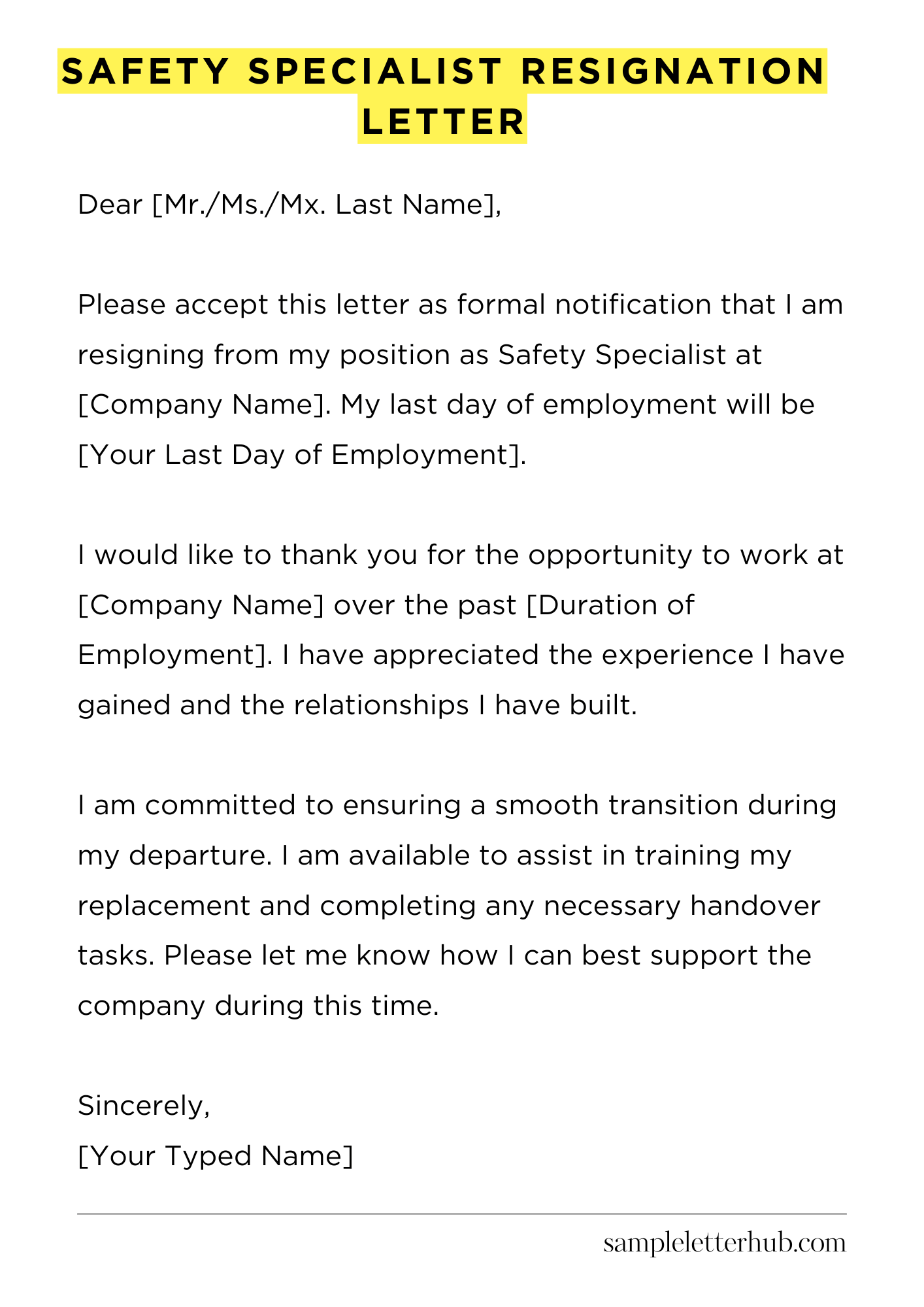
Dear [Mr./Ms./Mx. Last Name],
Please accept this letter as formal notification that I am resigning from my position as Safety Specialist at [Company Name]. My last day of employment will be [Your Last Day of Employment].
I would like to thank you for the opportunity to work at [Company Name] over the past [Duration of Employment]. I have appreciated the experience I have gained and the relationships I have built.
I am committed to ensuring a smooth transition during my departure. I am available to assist in training my replacement and completing any necessary handover tasks. Please let me know how I can best support the company during this time.
I wish you and [Company Name] all the best in the future.
Sincerely,
[Your Typed Name]
How to Write a Safety Specialist Resignation Letter
Resigning from any job can be tricky. It requires professionalism and a touch of planning. It’s especially true when you are dealing with a critical role like a Safety Specialist. Your responsibilities are important, and transitioning smoothly is crucial. This guide will help you craft a resignation letter that is clear, respectful, and sets you up for a positive departure.
1. Getting Started: The Essential Basics
First things first: you need to get the basics right. Your letter should start with your full name, address, and the date. Next, you will need to add your employer’s information. Include the recipient’s name (usually your direct supervisor or HR), their title, and the company’s address. It is important to remember this is a formal document. Always use a professional business letter format.
The core of your letter should be a clear statement of your intention to resign. Keep it straightforward. For example: “Please accept this letter as formal notification that I am resigning from my position as Safety Specialist, effective [Your Last Day of Employment].” This date is really important! Be sure to know it. Make sure you adhere to your employment contract’s notice period.
2. Expressing Gratitude and Showing Appreciation
Even if you’re leaving, there is no need to burn bridges. Take this chance to express your gratitude for the opportunity. Briefly acknowledge your time at the company.
Consider mentioning something specific you learned or enjoyed. For example, “I am grateful for the opportunities I’ve had during my time at [Company Name], particularly [Specific Experience or Project].” This small gesture can go a long way in maintaining a good relationship.
This is where your writing skills are especially important. Make sure to keep it short and professional. There’s no need for an overly effusive expression of feelings. A sincere, simple thank you is fine. It reflects well on you.
3. Highlighting Your Contributions (Optional but Recommended)
This section is optional, but it’s a great chance to recap your achievements. This part is especially useful if you want to leave a lasting positive impression. Briefly list your key accomplishments in the safety role. This might include reducing accident rates, implementing safety programs, or training employees.
This is a very good opportunity to mention any specific achievements. Using numbers (like percentages or the number of incidents reduced) can be very effective.
Keep this section concise and avoid boasting. Instead, simply state the facts and show the impact of your work. For instance, “During my tenure, I implemented a new safety training program that resulted in a 15% reduction in workplace incidents.”
4. Detailing the Transition Plan
As a Safety Specialist, you have specific responsibilities. This section is all about showing your professionalism and making the transition easy. Indicate your willingness to help with the transition. Offer assistance in training your replacement or completing any unfinished projects. The key here is to offer your time and assistance in a structured manner.
For example, “I am committed to ensuring a smooth handover of my responsibilities. I am available to train my replacement and assist with any ongoing projects during my remaining time here.” This will reassure your employer that you are committed to the safety of all, even as you leave the job. This shows you are dependable.
5. Closing and Formatting the Letter
Finish your letter with a polite and professional closing. Use a standard closing like “Sincerely,” or “Respectfully,” followed by your full name. Print the letter on good-quality paper. If you’re submitting a physical copy, sign it. If sending an email, your typed name is sufficient.
Proofread the letter carefully. Double-check the date, your name, the recipient’s name, and any specific details. Ensure you have the right spelling and grammar! A well-written, professional resignation letter will leave a positive and lasting impression. Following these guidelines will give you confidence to move on to your next job.
FAQs about Safety Specialist Resignation Letter
What are the essential elements to include in a Safety Specialist resignation letter?
A comprehensive resignation letter for a Safety Specialist should include: a formal salutation, a clear statement of resignation (including the effective date), a brief expression of gratitude for the opportunity, mention of any assistance you can offer during the transition period (e.g., training a replacement), and a professional closing with your signature.
It’s also wise to keep a copy of the letter for your records.
How much notice should a Safety Specialist give when resigning?
The standard notice period is typically two weeks, although this can vary based on your employment contract, company policy, and the seniority of your role. Review your employment agreement to confirm the required notice period. Providing more notice, if possible, can be beneficial for maintaining a positive relationship with your employer.
Should I provide a reason for resigning in my Safety Specialist resignation letter?
While not mandatory, briefly stating your reason for leaving can be helpful. This is especially true if you’re comfortable providing constructive feedback, such as better opportunities, or seeking a different career path. Keep the reason professional and avoid negativity. If you prefer, a simple “for personal reasons” or “to pursue other opportunities” is acceptable.
What if I have uncompleted projects or responsibilities as a Safety Specialist when resigning?
Address uncompleted projects in your resignation letter or, ideally, during a meeting with your supervisor. Offer to assist in the handover process, document your ongoing work, train a replacement, or provide any necessary information to ensure a smooth transition. This demonstrates professionalism and commitment.
How should a Safety Specialist handle sensitive information or confidential data when resigning?
When resigning, a Safety Specialist must adhere to all company policies regarding sensitive information and confidential data. Refrain from disclosing any proprietary information.
Make sure you return all company property, including access badges, keys, laptops, and any documents containing confidential data. Adhere to any non-disclosure agreements you’ve signed.
Related:
Resignation letter due to rude boss
Resignation letter moving to another state
Resignation letter due to illness of family member
Resignation letter due to study