

Account resignation letters are formal notices. They inform a company about your decision to leave. The purpose is to officially end your employment. It communicates your last day of work. It is also a professional courtesy.
Need to quit your accountancy job? Writing this letter can feel daunting. We’ve got you covered. We’ll share several templates. You can use them as a starting point.
Our goal is simple. We aim to make this task easier. You’ll find a variety of examples. Each is designed to fit different situations. Choose the one that suits your needs best.
Account Resignation Letter
Below is a sample of a Account Resignation Letter:
[Your Name]
[Your Address]
[Your Phone Number]
[Your Email Address]
[Date]
[Recipient Name] (If known, otherwise use title)
[Recipient Title]
[Company Name]
[Company Address]
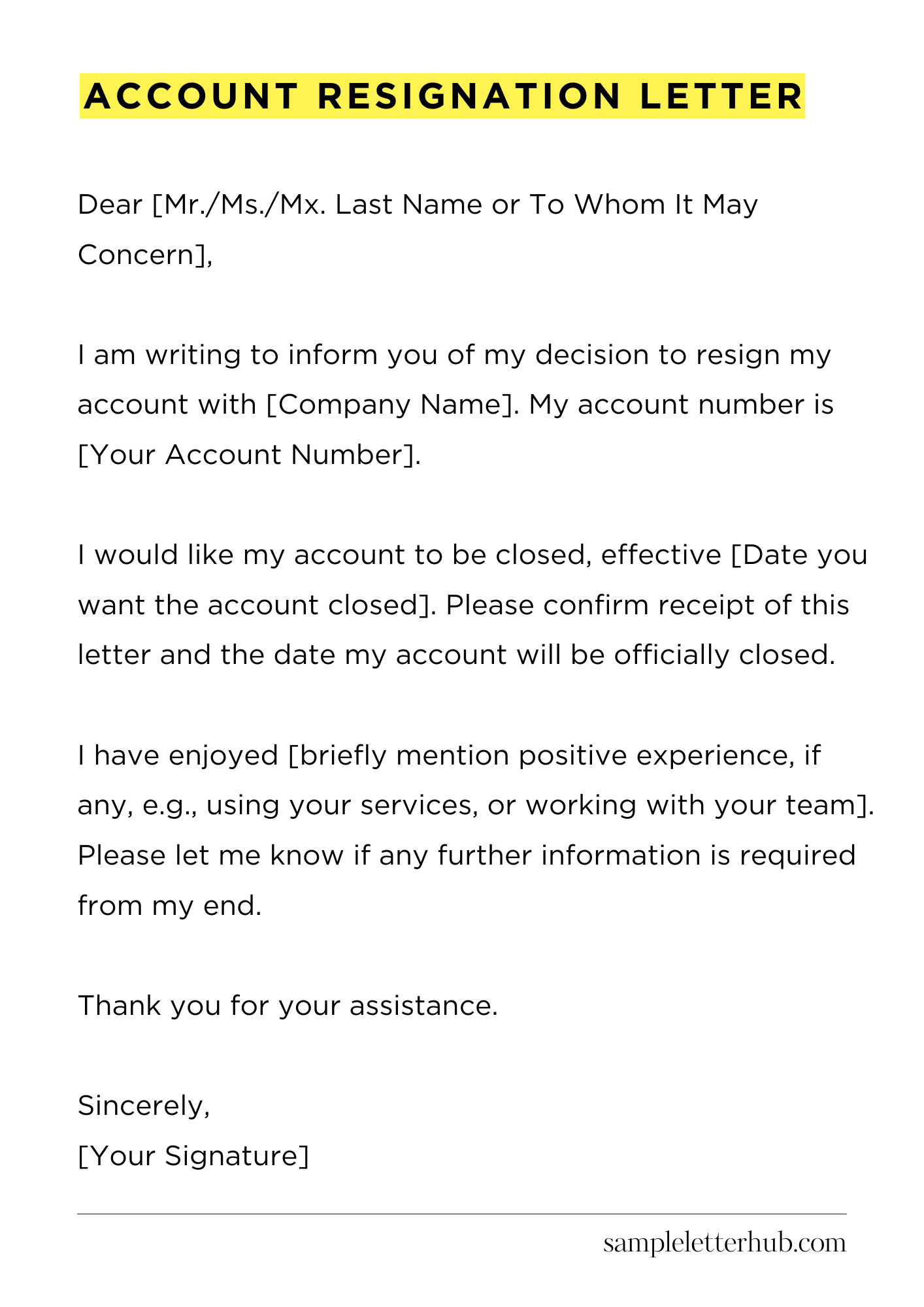
Dear [Mr./Ms./Mx. Last Name or To Whom It May Concern],
I am writing to inform you of my decision to resign my account with [Company Name]. My account number is [Your Account Number].
I would like my account to be closed, effective [Date you want the account closed]. Please confirm receipt of this letter and the date my account will be officially closed.
I have enjoyed [briefly mention positive experience, if any, e.g., using your services, or working with your team].
Please let me know if any further information is required from my end.
Thank you for your assistance.
Sincerely,
[Your Signature]
How to Write an Account Resignation Letter
Leaving a job is a big deal. You’ve made a decision. You’ve thought about it. Now, it’s time to put it in writing. One crucial piece of documentation in this process is your account resignation letter. It is a formal way to notify your employer of your departure. Here’s a simple guide to help you craft a professional and effective one.
1. Keep It Concise and Clear
Brevity is key when writing a resignation letter. This isn’t the time for flowery language or long-winded explanations. Start with a straightforward statement. Clearly state your intention to resign and the effective date of your last day of employment. Use simple, easily understood words. No need for complex jargon.
Your goal is to convey your message quickly and efficiently. Consider using phrases like, “Please accept this letter as formal notification that I am resigning from my position as…” or “I am writing to inform you of my resignation from…” This approach avoids any confusion. Remember, clarity is your best friend in this instance.
2. Be Professional and Polite
Even if you’re not thrilled about leaving, maintaining a professional tone is vital. Your resignation letter is a reflection of your character. It’s also often added to your personnel file.
Avoid negativity or complaints about your job or employer. Refrain from making accusations. Instead, express gratitude for the opportunities you’ve had. Thank your employer for the experience and what you learned.
A simple, “Thank you for the opportunity to work here,” can go a long way. End on a positive note, wishing the company and your colleagues well. This helps you leave a positive lasting impression.
3. Provide Necessary Information
Your letter must include specific details. These are important for it to be accepted as a formal notice. Firstly, include the date you’re writing the letter. Next, clearly state your name and the position you are leaving. Most importantly, clearly state your last day of employment. This is crucial for payroll and administrative purposes.
Ensure this date aligns with your employment contract or company policy regarding notice periods. Review your company’s policy. If you’re unsure, ask HR. Failing to adhere to the required notice period can cause problems. Keep a copy of the letter for your records. Consider sending it via certified mail.
4. Offer Assistance with the Transition
Show your professionalism by offering assistance during the transition period. You are leaving. You still want to be helpful. This shows that you care about the company’s success. It shows you want to make the shift easier. Offer to help train your replacement, complete any outstanding tasks, or document your processes.
State your availability for any handover-related meetings. A statement like, “I am happy to assist in any way possible to ensure a smooth transition,” is perfect. However, be realistic about what you can do. Do not overpromise. Focus on your willingness to help.
5. Review and Proofread Carefully
Before you send your letter, double-check everything. Proofread it meticulously. This is the last step and very important. Check for any grammatical errors, spelling mistakes, and punctuation issues. Errors can undermine your professionalism. Ensure all the information is accurate.
Make sure the date, your name, and position, and the last date of employment are correct. Read the letter aloud to make sure it flows smoothly. Get a second pair of eyes to review it if possible. A polished letter demonstrates attention to detail. This reflects well on you. Finalize your letter, and then send it off.
FAQs about Account Resignation Letter
What is an Account Resignation Letter, and Why is it Necessary?
An Account Resignation Letter is a formal document that officially notifies a company or service provider of your intention to close or discontinue your account. It serves as a written record of your request and provides a clear date for when you wish the account to be terminated.
This letter is crucial as it protects both the account holder and the service provider by providing documentation of the closure request and the terms under which it was made. Without it, you may risk continued charges or disputes.
What Information Should I Include in My Account Resignation Letter?
A comprehensive Account Resignation Letter typically includes your full name, the account name or number you wish to close, the date of the letter, the date you want the account to be closed, and your signature.
It’s often helpful to provide your contact information (address, email, phone number) for confirmation and any further communication. Consider including a brief statement of the reason for the closure if you desire (e.g., “moving to a different service provider,” “no longer need the service”), though this is not always required.
Always check the company’s specific guidelines, if available.
How Should I Submit My Account Resignation Letter?
The method of submission can vary by company. Common methods include email, postal mail, or a dedicated online form if the provider offers such functionality. Always retain a copy of your letter and any confirmation received from the service provider, regardless of the submission method.
Consider sending the letter via certified mail with return receipt requested, especially if you anticipate potential issues or the account involves significant financial transactions.
What Happens After I Submit My Account Resignation Letter?
After submitting your letter, the service provider should process your request and inform you of the account closure date. You should receive a confirmation acknowledging receipt of your letter and the scheduled date.
This confirmation is crucial for your records. It’s advisable to verify that all outstanding balances are paid and that no further charges are incurred after the closure date. If you experience any issues or discrepancies, contact the provider’s customer service immediately, providing copies of your letter and any confirmations.
Can I Resign an Account If I Have an Outstanding Balance?
Typically, service providers require you to settle any outstanding balances before closing an account. Your resignation letter should address the payment of any remaining charges, outlining how you intend to settle the balance (e.g., a specific payment method or confirmation that payment has already been made).
Ensure you pay the full amount due before the account closure to avoid incurring penalties or complications. If you dispute a balance, include a separate communication with the details of your concern.
Related:
Resignation letter due to rude boss
Resignation letter moving to another state
Resignation letter due to illness of family member
Resignation letter due to study