

A “Working Student resignation letter” is a formal document. It is written by a student who is also an employee. The letter officially informs their employer about their decision to leave the job. Its main purpose is to communicate the resignation clearly and professionally.
Are you a working student needing to quit your job? Don’t worry, it’s a common situation. Writing a resignation letter can seem tricky. This article is here to help!
We’ve got you covered. We’re providing several templates. These are examples of different working student resignation letters. Use them as a starting point. Make your letter clear and concise. This makes the whole process easy for you.
Working Student Resignation Letter
Below is a sample of a Working Student Resignation Letter:
[Your Name]
[Your Address]
[Your Phone Number]
[Your Email Address]
[Date]
[Employer’s Name]
[Employer’s Title]
[Company Name]
[Company Address]
Dear [Mr./Ms./Mx. Last Name],
Please accept this letter as formal notification that I am resigning from my position as [Your Job Title] at [Company Name]. My last day of employment will be [Your Last Day of Employment].
I am currently a student, and due to my studies, I am unable to continue working. I need to dedicate more time to my coursework.
I want to thank you for the opportunity to work at [Company Name]. I have learned a lot during my time here, and I appreciate the experience.
I am happy to assist in training my replacement or completing any outstanding tasks before my departure. Please let me know how I can help with the transition.
I wish you and the company all the best in the future.
Sincerely,
[Your Signature]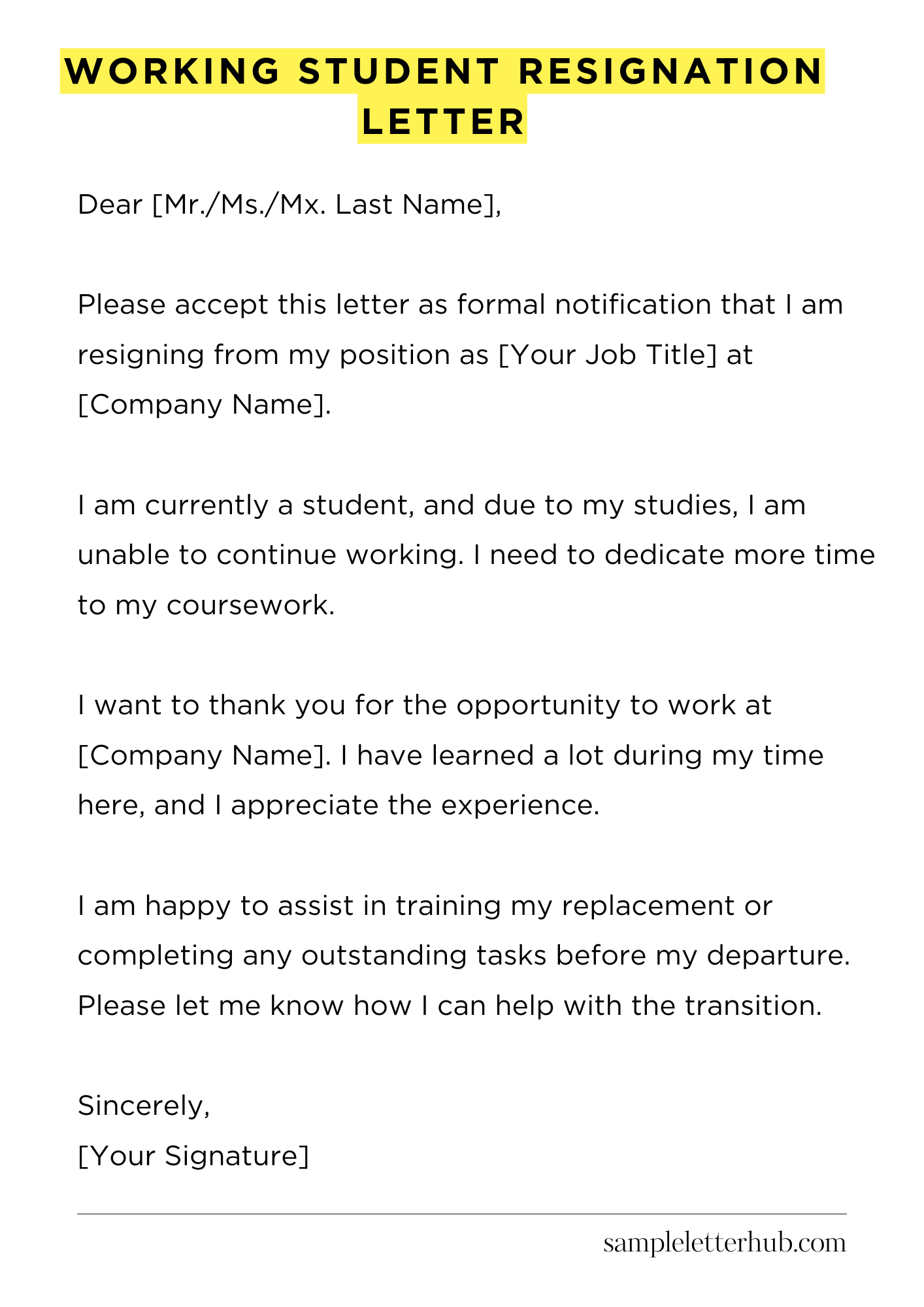
How to Write a Working Student Resignation Letter
Know the Why Before You Write
Resigning from a job, especially as a student, can be tricky. It is important to know your reasons first. Have you found a better opportunity? Are your studies becoming too demanding? Or is the job just not a good fit? Really think this through.
Understanding your motivations will help you articulate them clearly and professionally in your letter. Maybe the shift in priorities, that’s fine. Clarity sets the tone. Honesty, even more so.
Formatting is Your Friend
Let’s talk about how the letter looks. It should be clean and easy to read. Stick to standard business letter format. Your contact information goes at the top, followed by the date, then your employer’s details.
Keep it simple. Use a common font like Times New Roman or Arial. One page is usually enough, unless the situation is unusual. Be concise to the point.
Crafting the Content: Key Elements
Now, to the important part: what to actually say. Start by stating your intent to resign, of course. Clearly mention your position and the date of your last day of employment.
Express gratitude for the opportunity. You learned, right? Acknowledge the experience and any positive aspects of the job. Then, briefly explain your reason for leaving, if you feel comfortable sharing it. You don’t need to overshare, though. Keep it professional. Maintain your professional demeanor.
Finally, offer to assist with the transition. Maybe you can help train your replacement. This shows you care about the company. Finish with a polite closing, like “Sincerely” or “Best regards”, and your name.
The Importance of Tone and Style
The way you write is as important as what you write. Keep the tone professional, even if you are not thrilled with your experiences. Avoid negativity and negativity.
Be respectful, and don’t burn any bridges. Proofread the letter carefully. Grammatical errors and typos look unprofessional, and you want to leave a good impression. Remember, you might need a reference from this employer later on.
Putting it All Together: Sample Outline
Need some help getting started? Here’s a basic outline you can adapt.
- Your Contact Information: Name, Address, Phone, Email
- Date
- Employer’s Contact Information: Name, Title, Company Address
- Salutation: “Dear [Manager’s Name],”
- First Paragraph: State your resignation and last day of employment.
- Second Paragraph: Express gratitude for the opportunity.
- Third Paragraph: Briefly state your reason for leaving (optional).
- Fourth Paragraph: Offer assistance with the transition.
- Closing: “Sincerely,” or “Best regards,”
- Signature
Following this structure, you’ll create a polite and professional letter. Then, you will be done with it. Now you can move on to the next chapter of your life.
FAQs about Working Student Resignation Letter
What is the purpose of a working student resignation letter?
The primary purpose of a working student resignation letter is to formally notify your employer of your intention to leave your position. It serves as an official record of your departure and helps to ensure a smooth transition by providing the necessary details about your last day of employment.
What key information should be included in a working student resignation letter?
A well-crafted resignation letter should include your formal announcement of resignation, the date of your last day of employment, a statement of gratitude for the opportunity, and possibly a brief reason for leaving (optional). You should also include your contact information and any other relevant details the company might need during the transition period.
How much notice should a working student provide in their resignation letter?
The amount of notice required varies based on your employment contract and company policy. As a general rule, provide as much notice as possible. A minimum of two weeks is standard, but check your contract for specific requirements. Providing more notice allows for a smoother handover of responsibilities.
What is the best way to format a working student resignation letter?
The format should be professional and clear. Begin with your contact information, the date, and the recipient’s information. Use a formal tone, state your intention to resign, specify your last day, express gratitude, and optionally provide a brief reason. Keep it concise, proofread it for any errors, and deliver it to your supervisor or HR representative.
Can a working student resign via email, and what are the best practices for this?
Yes, resigning via email is often acceptable. The email should contain the same information as a traditional letter. Subject lines should be clear and concise (e.g., “Resignation – [Your Name]”). Ensure the body of the email follows a professional format. Keep it concise, formal, and proofread carefully. Consider sending a hard copy of the letter if you have the opportunity.
Related:
Resignation letter due to rude boss
Resignation letter moving to another state
Resignation letter due to illness of family member
Resignation letter due to study