

So, you’re moving on to new adventures? An office resignation letter is your formal notice. It informs your employer of your departure. This document is crucial for a smooth transition. It also protects your professional reputation.
Writing a resignation letter can seem daunting. Where to start? What to include? Don’t worry. We’ve got you covered. We’re sharing templates and examples. These will help you craft the perfect letter.
Whether you’re switching careers or retiring, you’ll find inspiration here. We have options for various situations. Consider these letters as a roadmap. Write a professional and polite resignation letter with ease.
Office Resignation Letter
Below is a sample of a Office Resignation Letter:
[Your Name]
[Your Address]
[Your Phone Number]
[Your Email Address]
[Date]
[Employer’s Name]
[Employer’s Title]
[Company Name]
[Company Address]
Dear [Mr./Ms./Mx. Last Name],
Please accept this letter as formal notification that I am resigning from my position as [Your Job Title] at [Company Name]. My last day of employment will be [Your Last Day of Employment].
I would like to thank you for the opportunity to have worked at [Company Name] for the past [Number] years/months. I have learned a great deal and appreciate the experiences I have gained during my time here.
I am committed to ensuring a smooth transition during my departure. I am happy to assist in training my replacement and completing any outstanding tasks.
I wish you and the company all the best in the future.
Sincerely,
[Your Signature]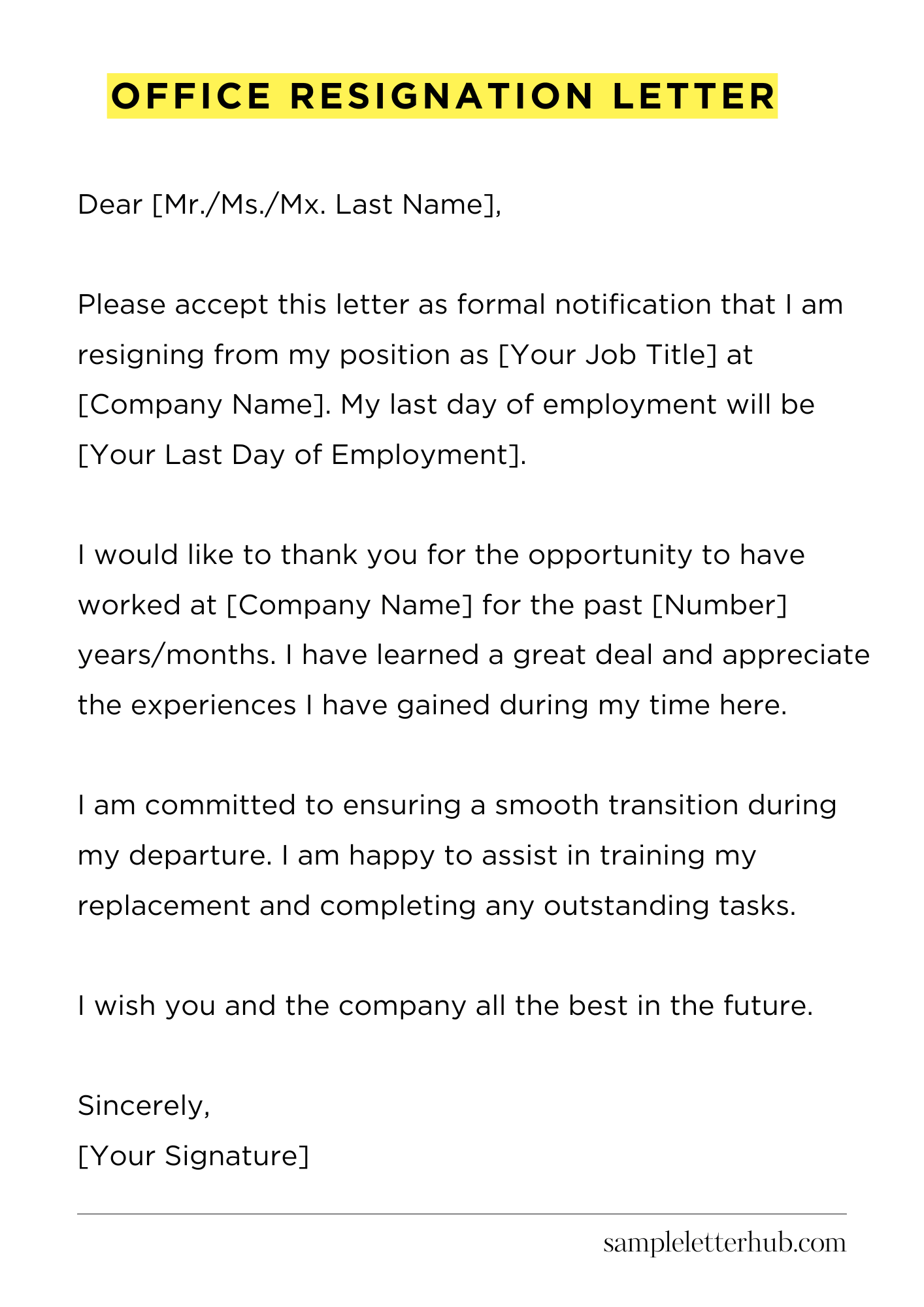
How to Write Office Resignation Letter
1. Why Bother with a Resignation Letter?
Leaving a job is a big step. Seriously, it is! You’ve likely spent a considerable amount of time working there. Even if things weren’t perfect, you still built relationships and gained experience. So, why bother with the formality of a resignation letter? Well, several reasons! A well-written letter is a professional courtesy.
It formally notifies your employer of your departure. This can prevent misunderstandings and helps ensure a smooth transition. It also documents your resignation date which is important for records. And believe me, it is the right thing to do.
2. Essential Elements to Include
What should you actually write? First things first: be direct and clear. State your intention to resign. The core of your letter should include a few critical pieces of information.
Start with a formal salutation like “Dear [Manager’s Name]”. Then, state clearly that you are resigning. Include your official last day of employment. This is crucial for payroll and benefits purposes. Keep it concise.
Next, it’s polite to express gratitude for the opportunities you received. This doesn’t mean you have to gush, but a brief acknowledgment of your time at the company can go a long way. Consider mentioning any specific skills or experiences you gained. You might also want to offer assistance with the transition.
This is not always necessary, but it shows professionalism and can improve your reputation. Finally, end with a professional closing, such as “Sincerely” or “Best regards”, followed by your typed name and signature. These are easy to write, so don’t fret!
3. Crafting the Right Tone
Tone matters. You want to appear professional. No matter your reasons for leaving, maintain a respectful and neutral tone. Avoid venting frustrations or complaints. It’s better to keep the focus on your departure and any assistance you can offer. Do not burn any bridges.
Even if you’ve had a less-than-ideal experience, now isn’t the time to air grievances. If you feel it necessary, you can address any issues separately through HR channels or an exit interview. Remember, the letter is a record of your departure. Keep your language clear and to the point.
4. Formatting and Delivery
Proper formatting is important. Keep it simple and easy to read. Use a standard business letter format. This means a formal heading with your name, address, and the date.
Below that, include the recipient’s name and title, and the company address. Use standard fonts like Times New Roman or Arial. Keep the font size at a readable 11 or 12 points. Maintain adequate margins.
Once your letter is ready, proofread it carefully for any grammatical errors or typos. Ensure you have the correct names, dates, and other details.
Then, deliver your letter in a timely manner, according to your company’s policy. Often, this means submitting the letter to your manager or HR department. Consider delivering a printed copy, and keep a copy for yourself for your own records. Check with your company’s policies.
5. Examples and Templates
Still not sure where to begin? Don’t worry! There are plenty of resources available. Search online for resignation letter templates. Adapt the templates to fit your specific situation. Here’s a basic example:
[Your Name]
[Your Address]
[Your Phone Number]
[Your Email]
[Date]
[Manager’s Name]
[Manager’s Title]
[Company Name]
[Company Address]
Dear [Manager’s Name],
Please accept this letter as formal notification that I am resigning from my position as [Your Job Title] at [Company Name]. My last day of employment will be [Your Last Day].
I am grateful for the opportunities I have been given during my time here. I wish the company continued success.
Please let me know how I can be of assistance during this transition.
Sincerely,
[Your Typed Name]
[Your Signature (if submitting a hard copy)]
Remember to customize this example with your details. Good luck with your next endeavor!
FAQs about Office resignation letter
What is the purpose of an office resignation letter?
The primary purpose of an office resignation letter is to formally notify your employer of your intention to leave your current position. It serves as an official record of your departure and helps to initiate the process of your exit from the company. It’s a crucial step in maintaining a professional relationship and ensuring a smooth transition.
What essential elements should be included in a resignation letter?
A well-crafted resignation letter should include your official resignation, the date of your last day of employment (in accordance with your employment contract or company policy), a statement of gratitude for the opportunity to work at the company, and, optionally, a brief explanation for your departure.
It’s also professional to offer your assistance during the transition period if possible. Be sure to include your name and signature.
How much notice should I give in my resignation letter?
The amount of notice you should give is typically outlined in your employment contract or company policy. Standard notice periods are often two weeks, but this can vary. Always refer to your contract first. If no period is specified, consult with your HR department or review company guidelines. Providing adequate notice is crucial for maintaining a positive relationship with your employer.
Should I provide a reason for resigning in my letter?
While not always mandatory, providing a brief reason for your resignation is often helpful, especially if you’re leaving for a new job or opportunity. Keeping your reason concise and positive is generally advisable.
Avoid negative comments or complaints. If you prefer, you can simply state that you are pursuing other opportunities. The specifics depend on your relationship with your employer and personal preference.
How should I deliver my resignation letter?
It’s generally recommended to deliver your resignation letter in writing, either as a hard copy or electronically (e.g., email), depending on your company’s policy.
It’s often considered best practice to personally hand the letter to your direct supervisor or the appropriate HR representative. Always keep a copy of your letter for your records. Following up with a conversation allows for an open discussion.
Related:
Resignation letter due to rude boss
Resignation letter moving to another state
Resignation letter due to illness of family member
Resignation letter due to study