

A caregiver resignation letter is a formal notice. It informs an employer of your intent to leave your position. The letter serves a vital purpose. It officially ends your employment.
Writing a resignation letter can be tough. We understand it needs to be clear and concise. This article is here to help. We’ll provide you with various templates. You can use them to craft your own perfect letter.
Whether you need a simple notice or a more detailed letter, we’ve got you covered. These samples will guide you. They’ll make the process easy. Get ready to write your resignation with confidence!
Caregiver Resignation Letter
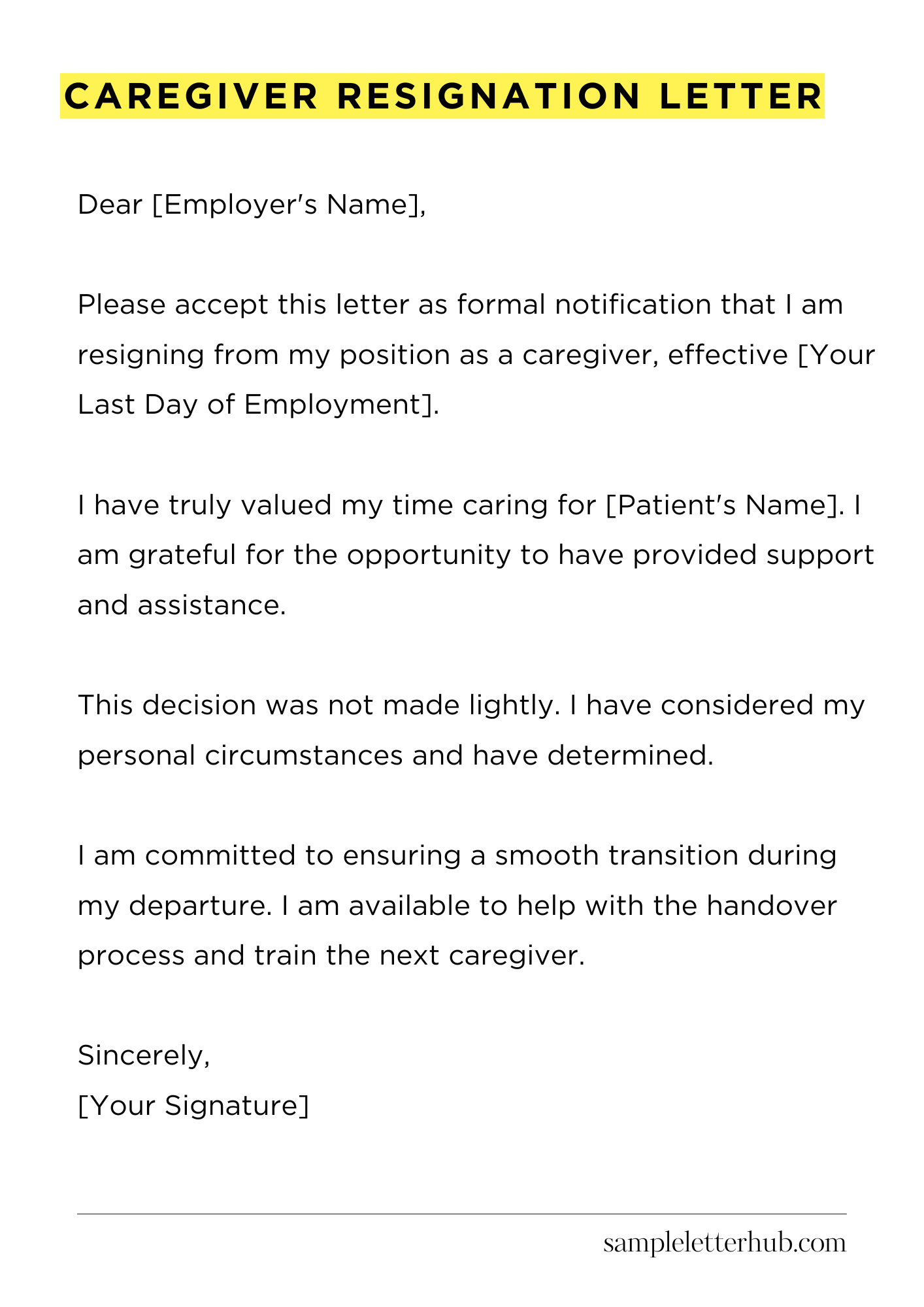
Below is a sample of a Caregiver Resignation Letter:
[Your Name]
[Your Address]
[Your Phone Number]
[Your Email Address]
[Date]
[Employer’s Name]
[Employer’s Title]
[Employer’s Address]
Dear [Employer’s Name],
Please accept this letter as formal notification that I am resigning from my position as a caregiver, effective [Your Last Day of Employment].
I have truly valued my time caring for [Patient’s Name]. I am grateful for the opportunity to have provided support and assistance.
This decision was not made lightly. I have considered my personal circumstances and have determined that I need to focus on [brief, general reason if you wish, e.g., personal matters].
I am committed to ensuring a smooth transition during my departure. I am available to help with the handover process and train the next caregiver, if needed, during my remaining time here. Please let me know how I can best assist with this.
Thank you again for the opportunity to work here. I wish you and [Patient’s Name] all the best.
Sincerely,
[Your Signature]
How to Write a Caregiver Resignation Letter
Why a Resignation Letter Matters
Leaving a caregiver position is a significant decision. You’ve likely formed a close bond with the person you’ve been assisting, and you need to leave on good terms. A well-written resignation letter is crucial for several reasons. Primarily, it’s a formal way of informing your employer or the family you work for about your departure.
Secondly, it documents your resignation for record-keeping. Furthermore, it helps maintain professionalism and respect.
Think of it as the first step in ensuring a smooth transition. That’s very important. A properly written letter helps everyone involved.
Essential Elements to Include
Your caregiver resignation letter should be clear, concise, and respectful. It needs to include specific pieces of information. Otherwise, it is going to be ineffective. Consider these critical elements:
- Your Name and Contact Information: Start with your full name, address, phone number, and email address.
- Date: The date you are writing the letter.
- Recipient’s Name and Address: Address the letter to the appropriate person, such as the family member or agency supervisor.
- Formal Salutation: Begin with a polite greeting, such as “Dear [Name].”
- Statement of Resignation: Clearly state your intention to resign from your position as a caregiver. Be direct and avoid ambiguity.
- Effective Date of Resignation: Specify the last day you will be working. Make sure it aligns with any agreed-upon notice period.
- Reason for Resignation (Optional): You can briefly state your reason. You are not obligated to provide extensive details. Keep it brief.
- Expression of Gratitude: Thank the family or agency for the opportunity to work as a caregiver.
- Offer of Assistance (Optional): If you wish, offer to help with the transition. You could offer to train a replacement.
- Closing and Signature: End with a professional closing, such as “Sincerely,” followed by your handwritten signature (if submitting a hard copy) and your typed name.
Crafting the Right Tone
The tone of your letter is just as important as the content. You must be professional and respectful. Here’s how to do it effectively:
- Be Polite: Always use polite language. Remember, you want to leave a positive impression.
- Be Direct: Get straight to the point. Avoid unnecessary fluff or complicated language.
- Be Positive: Focus on the positive aspects of your experience. Acknowledge and appreciate the support provided by the family.
- Avoid Negativity: Refrain from complaining or criticizing your employer or the care recipient.
- Be Concise: Keep your letter brief and to the point. This makes it easier to read.
Sample Resignation Letter Template
Here’s a basic template that you can adapt to your situation:
        [Your Name]
        [Your Address]
        [Your Phone Number]
        [Your Email Address]

        [Date]

        [Recipient's Name]
        [Recipient's Address]

        Dear [Name],

        Please accept this letter as formal notification that I am resigning from my position as a caregiver, effective [Your Last Day of Employment].

        [Optional: Briefly state your reason, e.g., "I am resigning to pursue a new opportunity."]

        I am grateful for the opportunity to have worked with [Care Recipient's Name] and your family over the past [Duration]. I have truly enjoyed my time here.

        [Optional: If possible, I am happy to assist with the transition.]

        Thank you again for the experience. I wish you and your family all the best.

        Sincerely,
        [Your Signature (if sending a hard copy)]
        [Your Typed Name]
Finalizing and Delivering Your Letter
Before submitting your letter, always proofread it carefully. Check for any grammatical errors, spelling mistakes, and ensure the information is accurate. If possible, have someone else review it as well. Once you’re satisfied with your letter, decide how you will deliver it.
If you’re unsure, ask your employer or the family about their preferred method. Good communication is key! Depending on your workplace, you can either:
- Submit a hard copy.
- Send it via email.
- Use a company’s internal system.
Regardless of the method, keep a copy of your resignation letter for your records. Remember, a well-written caregiver resignation letter is a sign of professionalism. It can leave a positive lasting impression. Follow these guidelines, and you’ll handle your departure with grace and integrity.
FAQs about Caregiver Resignation Letter
What is the primary purpose of a caregiver resignation letter?
The primary purpose of a caregiver resignation letter is to formally notify an employer or the client/family of your intent to leave your position. It serves as an official record of your departure and helps to establish a clear timeline for your last day of work.
Furthermore, it allows you to express your gratitude, provide a reason for leaving (if desired), and potentially offer assistance during the transition period.
What essential information should be included in a caregiver resignation letter?
A well-crafted caregiver resignation letter should include your name, the date, the name of the recipient (employer or client/family), a clear statement of your resignation, the effective date of your resignation (last day of employment), and a polite closing.
Consider including a brief statement of gratitude for the opportunity and, optionally, a brief explanation for leaving. You may also offer to assist with the transition.
How much notice should a caregiver provide when resigning?
The amount of notice a caregiver should provide depends on the terms of their employment agreement, company policy, and any local laws. Typically, a minimum of two weeks’ notice is considered standard.
However, it’s always best to review your employment contract or discuss the notice period with your employer or the client/family to ensure you meet the necessary requirements. Providing more notice is often appreciated, especially when dealing with vulnerable individuals.
Should a caregiver explain the reason for their resignation in the letter?
While not mandatory, you can include a brief and polite explanation for your resignation. Common reasons include accepting a new job, personal circumstances, health concerns, or simply seeking a different work environment.
Keep the explanation concise and professional. You are not obligated to go into extensive detail. If you prefer, you can simply state that you are resigning for personal reasons.
What are some tips for writing a professional and courteous caregiver resignation letter?
To write a professional and courteous resignation letter, be clear and concise in your language. Maintain a positive and respectful tone, even if you are leaving due to negative experiences. Express gratitude for the opportunity to have worked as a caregiver. Proofread the letter carefully for any errors in grammar or spelling.
Consider offering assistance during the transition period, such as training a replacement or documenting the client’s needs and routines. Finally, deliver the letter in a timely manner and retain a copy for your records.
Related:
Resignation letter due to rude boss
Resignation letter moving to another state
Resignation letter due to illness of family member
Resignation letter due to study