

So, you’re a photojournalist moving on? A “photojournalist resignation letter” is your official goodbye. It’s a formal document. It informs your employer of your departure. It’s a key step in ending your employment professionally.
Crafting the perfect letter can feel daunting. We get it! It needs to be clear and concise. It also needs to be polite.
We’ve got you covered. We’ve created some easy-to-use templates. These are samples to help you. These are for crafting your own perfect resignation. Let’s get started.
Photojournalist Resignation Letter
Below is a sample of a Photojournalist Resignation Letter:
[Your Name]
[Your Address]
[Your Phone Number]
[Your Email Address]
[Date]
[Employer’s Name]
[Employer’s Title]
[Company Name]
[Company Address]
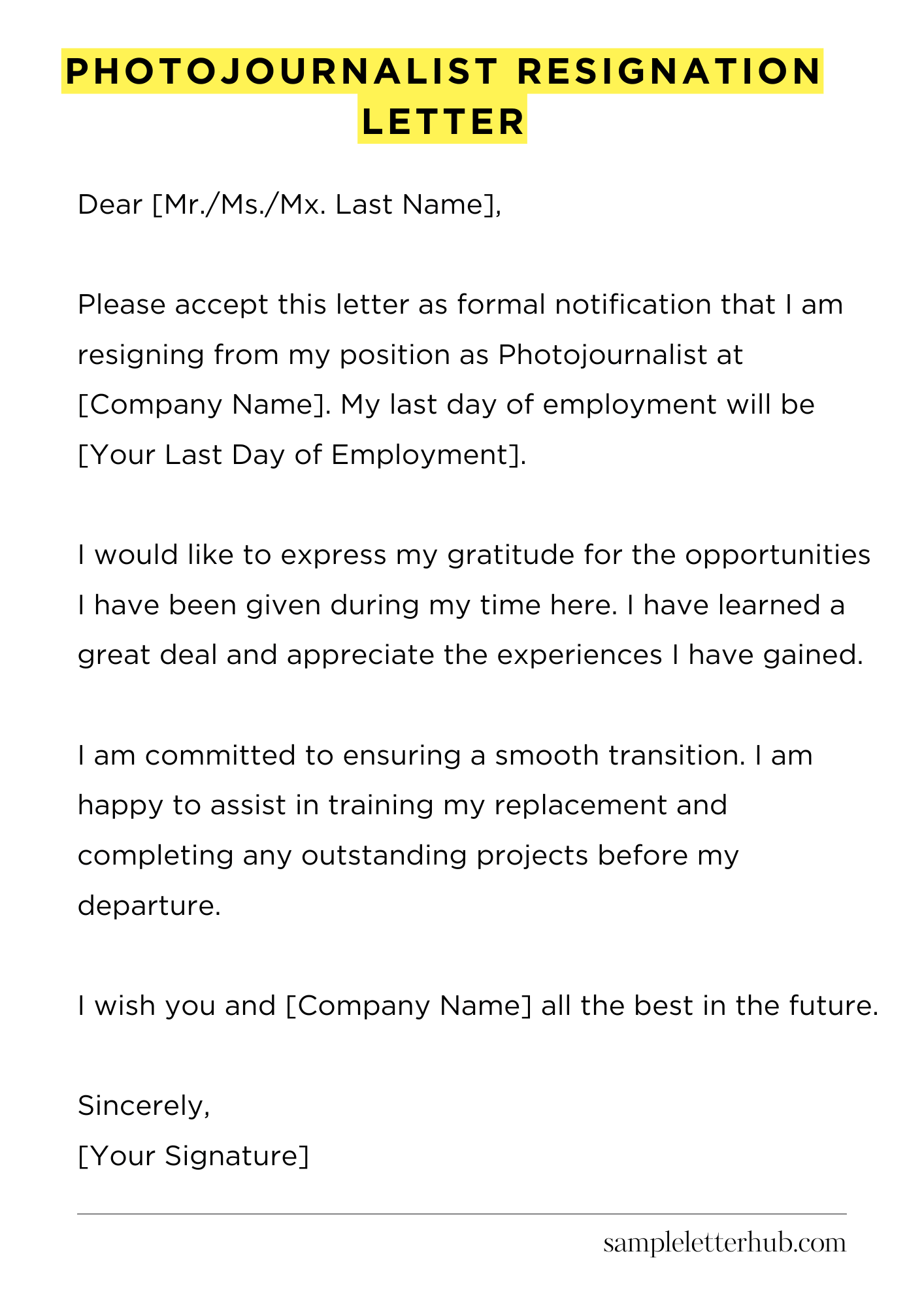
Dear [Mr./Ms./Mx. Last Name],
Please accept this letter as formal notification that I am resigning from my position as Photojournalist at [Company Name]. My last day of employment will be [Your Last Day of Employment].
I would like to express my gratitude for the opportunities I have been given during my time here. I have learned a great deal and appreciate the experiences I have gained.
I am committed to ensuring a smooth transition. I am happy to assist in training my replacement and completing any outstanding projects before my departure.
I wish you and [Company Name] all the best in the future.
Sincerely,
[Your Signature]
How to Write a Photojournalist Resignation Letter
Understanding the Basics
Resigning from a job is never easy. When you’re a photojournalist, capturing powerful images and telling stories visually, it can feel even more personal. A well-crafted resignation letter is critical.
It allows you to leave professionally and maintain a positive relationship with your previous employer. This letter serves as your formal notice. It informs them of your departure and provides details about your final day of employment.
The letter is more than just a formality; it reflects your professionalism. Think of it as your last piece of writing for the organization. Make it count.
Structuring Your Letter
The structure is straightforward. Start with your contact information (name, address, phone number, email) and the date. Next, address the letter to your direct supervisor or the appropriate HR representative. Use a formal salutation like “Dear [Name].”
The body should have a few key parts. First, clearly state your intention to resign and your last day of employment. Be specific. Next, briefly express your gratitude for the opportunity. Mention any positive experiences or skills you gained. Acknowledge your contribution to the team.
Include a sentence or two for a smooth transition. Offer assistance with the handover process if needed. This demonstrates your commitment to a seamless transition.
Key Content and Considerations
Be direct and concise. Avoid rambling or negativity. Maintain a professional tone throughout the letter. Focus on your departure and the facts. Keep your personal opinions about your time there out. You do not need to provide a detailed reason for leaving; a simple “I am pursuing other opportunities” is often sufficient.
If you’re willing to assist with training a replacement, mention it. Proofread the letter carefully. Ensure there are no spelling or grammatical errors. A poorly written letter undermines your credibility.
Formatting for Impact
Your letter should be easy to read. Use a standard business letter format. Avoid unusual fonts. Stick to something like Times New Roman or Arial in a readable size (12-point is typical). Keep paragraphs relatively short.
Use a professional closing like “Sincerely” or “Best regards,” followed by your full name. If you have the option, print the letter and sign it by hand. This adds a personal touch and reinforces its formality.
Finalizing and Delivering Your Letter
Before sending, review the letter one last time. Make sure everything is accurate. Consider having a trusted colleague read it over as well. They might catch anything you missed.
Deliver the letter in person if possible. This shows respect and allows for a brief conversation. If that is not possible, send it via email. Keep a copy for your records. This is vital for your future employment history.
Remember, the goal is to leave a positive lasting impression, even as you embark on a new chapter in your photojournalism career.
FAQs about Photojournalist Resignation Letter
What are the essential elements to include in a photojournalist’s resignation letter?
A photojournalist’s resignation letter should contain: a clear and direct statement of resignation, the effective date of your departure, a concise expression of gratitude for the opportunity (mentioning the company or individual), and any necessary information about the handover of ongoing projects or equipment.
You may also include brief reasons for leaving, if you choose, but this is optional and should be professional.
How should a photojournalist address concerns about copyright and image usage in their resignation letter?
It’s crucial to clarify copyright and usage rights, especially if you have an agreement. State that you acknowledge and will adhere to the terms and conditions outlined in your contract regarding your photographic work.
If there are any outstanding usage agreements or potential future projects with the company, this can also be mentioned with how you will be abiding by the contract. This proactive approach can prevent future disputes.
Should a photojournalist provide reasons for leaving in their resignation letter, and if so, what is the best way to do this?
Providing reasons is optional but can be beneficial. If you choose to, keep your reasons brief, positive, and professional. Focus on career advancement, new opportunities, or personal growth.
Avoid negative comments or criticisms about the employer or colleagues. If you have any formal complaints that need to be made, it may be better suited to use a separate channel.
What is the appropriate tone and style for a photojournalist’s resignation letter?
The tone should be professional and respectful. The style should be concise and direct. The letter should be well-written, free of errors, and clearly communicate your intention to leave. Avoid emotional language, sarcasm, or any unprofessional comments. The letter serves as a professional record of your departure.
How can a photojournalist ensure a smooth transition and maintain a positive relationship with their employer during and after their resignation?
A smooth transition involves offering to assist in finding a replacement or training someone to take over your responsibilities. Provide a list of projects, deadlines, and contact information.
Be cooperative and helpful during your notice period. Follow up any outstanding projects or requirements. Maintaining a positive relationship involves professionalism and courtesy throughout the process, focusing on your future goals instead of past disputes.
Related:
Resignation letter due to rude boss
Resignation letter moving to another state
Resignation letter due to illness of family member
Resignation letter due to study