

Sometimes, internships end. A “Research and Development Intern resignation letter” is a formal way to inform your employer of your decision to leave. It’s a professional document. Its main purpose is to officially communicate your departure.
Writing this letter can feel tricky. Luckily, crafting the perfect resignation letter doesn’t need to be hard. We’ve got you covered. We’ll provide different templates and examples.
These samples will make things simpler. You’ll find options for various situations. Use these to tailor your own letter with confidence.
Research And Development Intern Resignation Letter
Below is a sample of a Research And Development Intern Resignation Letter:
[Your Name]
[Your Address]
[Your Phone Number]
[Your Email Address]
[Date]
[Hiring Manager Name] (If known, otherwise use title)
[Hiring Manager Title]
[Company Name]
[Company Address]
Dear [Mr./Ms./Mx. Last Name],
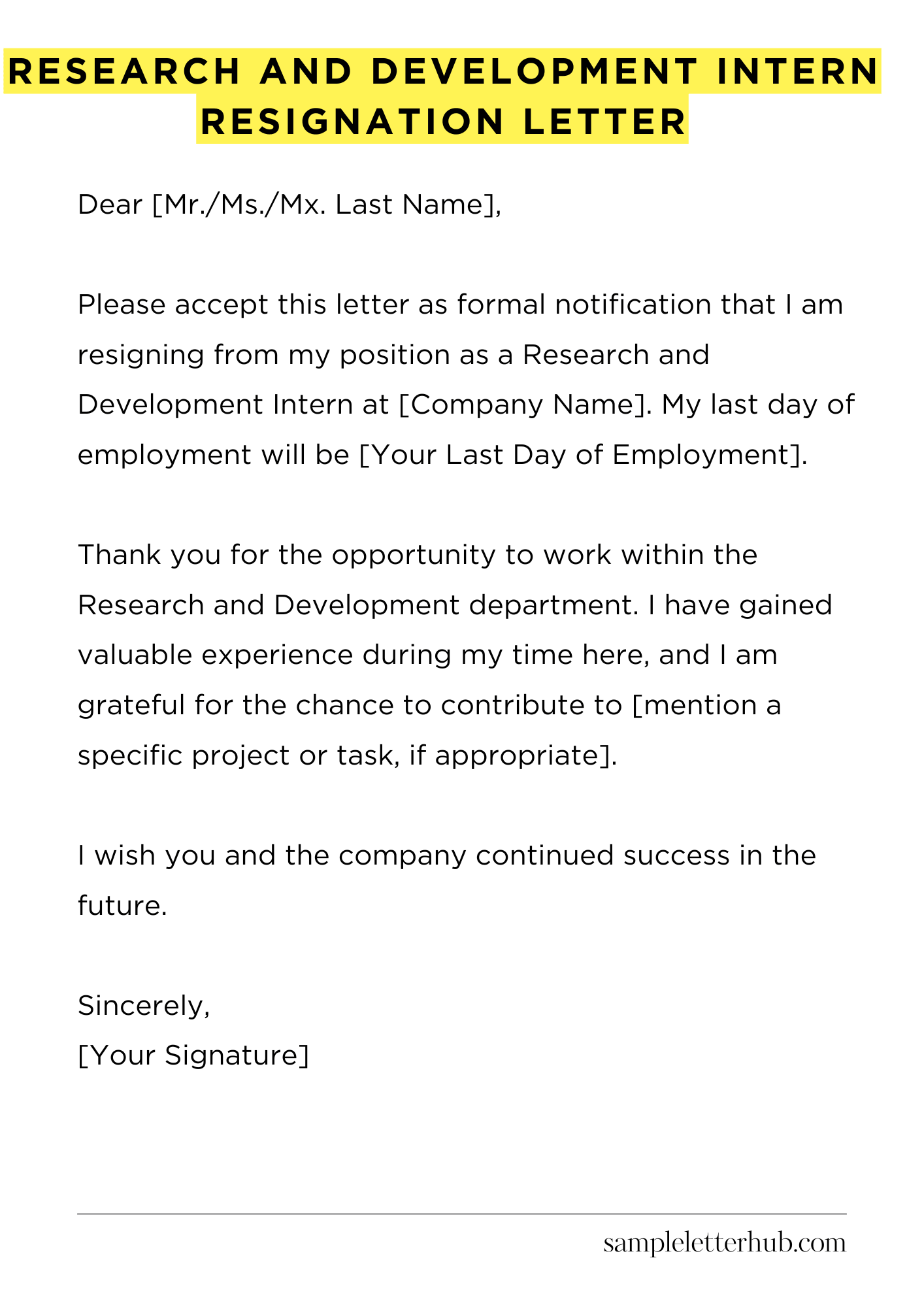
Please accept this letter as formal notification that I am resigning from my position as a Research and Development Intern at [Company Name]. My last day of employment will be [Your Last Day of Employment].
Thank you for the opportunity to work within the Research and Development department. I have gained valuable experience during my time here, and I am grateful for the chance to contribute to [mention a specific project or task, if appropriate].
I wish you and the company continued success in the future.
Sincerely,
[Your Signature]
How to Write a Research and Development Intern Resignation Letter
So, you’re moving on. Leaving your R&D internship behind? That’s great! Maybe you’ve got a fantastic new opportunity, or perhaps the internship just wasn’t the right fit. Whatever the reason, you’ll need to submit a resignation letter.
This isn’t just a formality; it’s your final professional interaction with the company. Get it right, and you leave a positive lasting impression. Mess it up, and… well, it’s best to avoid any regrets. Let’s delve into how to craft a compelling Research and Development Intern resignation letter.
1. Keep it Concise and Clear: The Essentials
Your resignation letter should be straightforward and to the point. No need for lengthy explanations or dramatic flair. The primary purpose is to officially announce your departure. Begin by clearly stating your intention to resign.
Then, include the date of your last day of employment. These are the absolute must-haves. Everything else is secondary, but still important. Think of it as the basic skeleton; we will then add some flesh.
For example, a solid opening could read: “Please accept this letter as formal notification that I am resigning from my position as a Research and Development Intern at [Company Name], effective [Your Last Day of Employment].” See? Simple and direct.
2. Show Gratitude and Professionalism: The Power of Thank You
Even if the internship wasn’t perfect, expressing gratitude is always a good idea. Acknowledge the opportunity you were given. Highlight anything positive you gained from the experience.
This demonstrates maturity and professionalism, and it’s a courtesy that’s appreciated. Mentioning specific projects or skills you learned will help personalize your message. Be sincere.
Consider something like: “I am grateful for the opportunity to have interned at [Company Name]. During my time here, I have gained valuable experience in [mention specific skills or projects], which will be instrumental in my future career endeavors.” Remember, you’re building bridges, not burning them.
3. Provide Necessary Information and Offer Assistance: The Smooth Transition
While you’re leaving, think about making the transition easier for your team. You can offer assistance in any way possible. Willingly offer to help with the handoff of your ongoing tasks or documentation. If there are any urgent projects, indicate your willingness to support during your remaining time. This consideration will not go unnoticed.
For instance: “I am happy to assist in the transition process and will do my best to complete my current tasks or train anyone who takes over my responsibilities before my departure.” This shows you are a team player and dedicated to seeing things through, even after you’re leaving.
4. Keep it Positive and Avoid Negativity: No Complaints, Please!
This is crucial. Avoid any negativity or complaints about your internship experience. Even if you weren’t completely satisfied, this isn’t the place to air grievances. Keep the tone positive and professional. Focus on the future and your aspirations. This shows that you are mature.
Think about phrases like, “I am excited to pursue new opportunities” instead of, “I didn’t feel challenged.” Remember the goal is to depart on a high note and preserve your professional reputation.
5. Review, Revise, and Proofread: The Final Check
Before you hit send or print, carefully review your letter. Check for any grammatical errors, typos, or inconsistencies. Ensure the tone is professional and the language is clear.
Consider asking a friend or mentor to read it over for a second opinion. This final step is paramount. A polished letter shows you care about details and professionalism. Good luck with your next adventure!
FAQs about Research And Development Intern resignation letter
How do I write a Research and Development Intern resignation letter?
Your resignation letter should be concise, professional, and include the following: a clear statement of your intent to resign, the date of your last day of employment, a brief expression of gratitude for the opportunity (optional), and your contact information. Keep it brief and focused on the essential details.
What should I include in the subject line of my Research and Development Intern resignation letter?
The subject line should be clear and professional. Suitable options include “Resignation – [Your Name]”, “Resignation Letter – Research and Development Intern”, or simply “Resignation”. This helps the recipient quickly understand the purpose of the email or letter.
Is it necessary to provide a reason for resigning in my Research and Development Intern resignation letter?
While not always required, briefly stating your reason can be beneficial. It’s generally best to keep it positive and concise. Examples include stating you’re pursuing further education, accepting a different role, or have personal reasons. Avoid providing overly negative or detailed explanations.
What is the typical notice period for a Research and Development Intern?
The notice period is typically specified in your internship agreement or company policy. Common notice periods for interns range from one to four weeks. Always review your contract and company guidelines. If in doubt, inquire with your supervisor or HR department for clarification.
Should I offer to help with the transition in my Research and Development Intern resignation letter?
Offering to assist with the transition is a professional and courteous gesture. You can state your willingness to help train your replacement, complete any outstanding tasks, or provide any necessary documentation. This demonstrates your commitment to a smooth handover.
Related:
Resignation letter due to rude boss
Resignation letter moving to another state
Resignation letter due to illness of family member
Resignation letter due to study