

A Junior Associate resignation letter is a formal document. It informs your employer of your intention to leave your job. The letter officially ends your employment. It’s a crucial step in the job-leaving process.
Writing a resignation letter can be tricky. Don’t worry, we’re here to help. This article offers helpful templates. We’ll share several examples. Use these to craft your own perfect letter.
Need a quick and easy solution? Look no further. Our samples cover various situations. From simple to more specific, find what fits your needs. This makes the writing process easier.
Junior Associate Resignation Letter
Below is a sample of a Junior Associate Resignation Letter:
[Your Name]
[Your Address]
[Your Phone Number]
[Your Email Address]
[Date]
[Hiring Manager Name] (If known, otherwise use title)
[Hiring Manager Title]
[Company Name]
[Company Address]
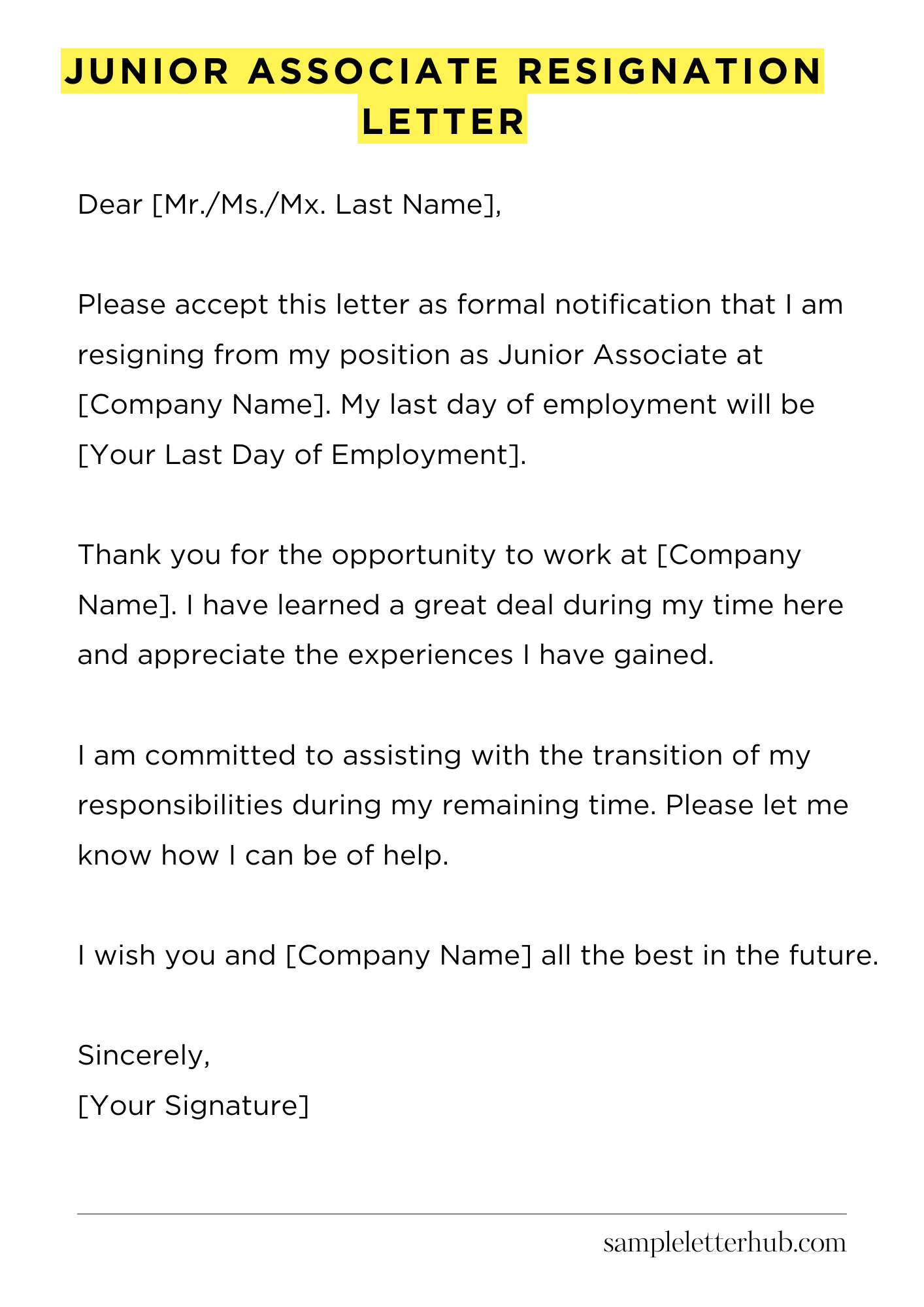
Dear [Mr./Ms./Mx. Last Name],
Please accept this letter as formal notification that I am resigning from my position as Junior Associate at [Company Name]. My last day of employment will be [Your Last Day of Employment].
Thank you for the opportunity to work at [Company Name]. I have learned a great deal during my time here and appreciate the experiences I have gained.
I am committed to assisting with the transition of my responsibilities during my remaining time. Please let me know how I can be of help.
I wish you and [Company Name] all the best in the future.
Sincerely,
[Your Signature]
How to Write Junior Associate Resignation Letter
Resigning from your job as a Junior Associate can be a big step. Maybe you’ve found a better opportunity. Perhaps you’re moving on to something new. Whatever the reason, crafting a professional resignation letter is essential.
This document serves as a formal notification to your employer and starts the process of your departure. Here’s a breakdown to guide you through it.
1. Get the Basics Right: Format and Style
First things first, your letter needs to look the part. Keep it clean and easy to read. Use a standard business letter format. This shows respect for the process. Start with your contact information (name, address, phone number, email) at the top, followed by the date.
Then, include the recipient’s information: the name of your supervisor or HR representative, their title, and the company address. Use a professional font like Times New Roman or Arial. Maintain a single-spaced format and use a clear, concise tone throughout.
2. The Opening: State Your Intent
The first paragraph is the most crucial. Here, you clearly state your intention to resign. Keep it brief and direct. Avoid ambiguity. Something along the lines of “Please accept this letter as formal notification that I am resigning from my position as Junior Associate, effective [Your Last Day of Employment]” works perfectly. This paragraph sets the stage and confirms your decision.
3. The Body: Express Gratitude and Briefly Explain (Optional)
Next, express your gratitude for the opportunity to work at the company. A simple “I would like to express my gratitude for the opportunities and experiences I have gained during my time here” is usually sufficient. You don’t need to go into great detail here. If you choose, you may briefly mention why you are leaving, but it’s not required.
You could say “I am leaving to pursue another opportunity.” Avoid negative comments about your current role, company, or colleagues. Keep it positive and professional. The less you say, the better.
4. The Closing: Logistics and Well Wishes
In your closing paragraph, be sure to confirm your last day of employment. This creates a clear timeline. Offer to assist with the transition. Include a line like, “I am happy to assist with the transition of my responsibilities during my remaining time here.”
This demonstrates professionalism and a willingness to help. End with a polite closing, such as “Sincerely,” or “Respectfully,” followed by your typed name. Sign the letter above your typed name.
5. Review and Proofread: The Final Check
Before you send it, proofread, proofread, and proofread again! Check for any spelling or grammatical errors. Ensure your dates and contact information are accurate. Have a friend or colleague review it as well. A second pair of eyes can catch mistakes that you might have missed.
Sending a well-written, error-free resignation letter leaves a positive lasting impression. Remember, this letter is a reflection of your professionalism. Make it count.
FAQs about Junior Associate resignation letter
How do I start a junior associate resignation letter?
A professional resignation letter typically starts with a formal salutation (e.g., “Dear [Manager’s Name]”) followed by a clear statement of your intent to resign. Include the date of your resignation, as this is a crucial piece of information.
What should I include in the body of my junior associate resignation letter?
The body of the letter should briefly state your resignation and the last day of your employment. You may also include a brief expression of gratitude for the opportunity and any experience gained. Keep it concise, professional, and avoid negative comments about the company or colleagues.
Is it necessary to provide a reason for leaving in my junior associate resignation letter?
While not mandatory, it’s generally not required to provide a detailed reason for your departure. However, you can briefly mention a reason if you wish, such as pursuing another opportunity or personal reasons, in a neutral way. Avoid being overly specific or critical.
How should I end my junior associate resignation letter?
Conclude your letter by expressing your willingness to assist with the transition process if possible, and thank your employer for the opportunity. Include your contact information for future correspondence. End with a professional closing (e.g., “Sincerely,” or “Regards,”), followed by your typed name.
What format should I use for a junior associate resignation letter?
The letter should be formatted professionally, using a standard business letter format. Use a clear font (e.g., Times New Roman, Arial) and keep the letter concise, typically one page. Ensure there are no grammatical errors or typos. It should be printed on white paper and delivered in person or sent via email.
Related:
Resignation letter due to rude boss
Resignation letter moving to another state
Resignation letter due to illness of family member
Resignation letter due to study