


A Teaching Artist resignation letter is a formal document. It is written by a teaching artist. Its purpose is to officially inform an employer about leaving a job. This letter confirms the last day of employment. It also helps to maintain a professional relationship.
Planning to move on? You’re in the right place. Crafting the perfect goodbye can be tough. We’ve got you covered. We’ll share various templates and examples. Use them as inspiration. Customize your own letter with ease.
Consider this your creative launchpad. Need to announce a change? We’ll provide a variety of sample letters. They’re designed to fit different situations. Say goodbye gracefully and professionally.
Teaching Artist Resignation Letter
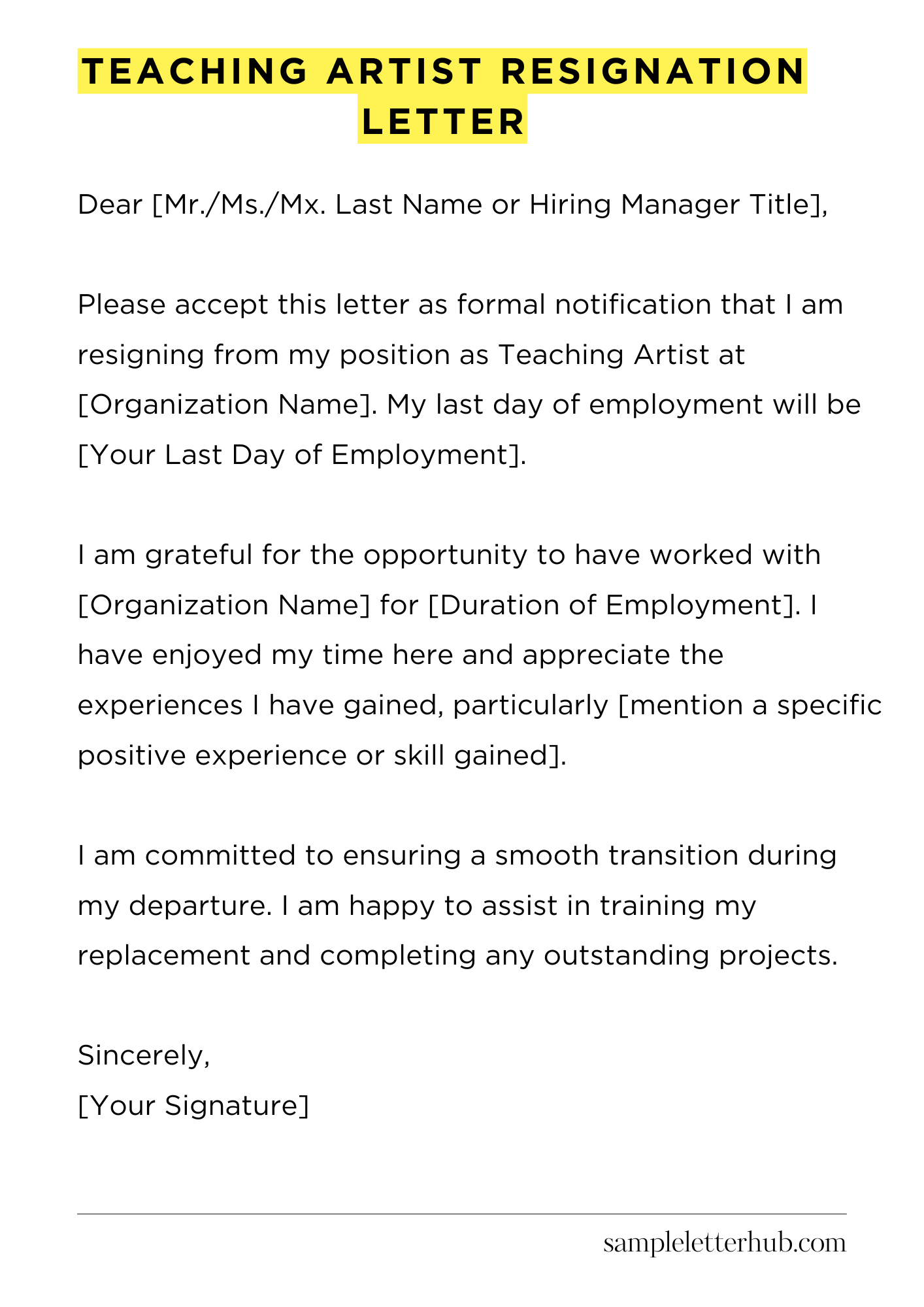
Below is a sample of a Teaching Artist Resignation Letter:
[Your Name]
[Your Address]
[Your Phone Number]
[Your Email Address]
[Date]
[Hiring Manager Name] (If known, otherwise use title)
[Hiring Manager Title]
[Organization Name]
[Organization Address]
Dear [Mr./Ms./Mx. Last Name or Hiring Manager Title],
Please accept this letter as formal notification that I am resigning from my position as Teaching Artist at [Organization Name]. My last day of employment will be [Your Last Day of Employment].
I am grateful for the opportunity to have worked with [Organization Name] for [Duration of Employment]. I have enjoyed my time here and appreciate the experiences I have gained, particularly [mention a specific positive experience or skill gained].
I am committed to ensuring a smooth transition during my departure. I am happy to assist in training my replacement and completing any outstanding projects. Please let me know how I can be of help during this period.
I wish you and [Organization Name] all the best in the future.
Sincerely,
[Your Signature]
How to Write a Teaching Artist Resignation Letter
So, you’ve decided to move on. That’s perfectly understandable, and happens all the time in the arts. You’re ready to start a new chapter. Perhaps it’s a new opportunity or a simple need for a change of pace. Whatever the reason, you’ll need to write a resignation letter to your teaching artist employer.
1. Keep it Concise and Clear
First things first: Be direct. This letter is not the place for lengthy explanations or dramatic pronouncements. State your intention to resign from your position as a Teaching Artist. Indicate the specific date your resignation will be effective. Keep it brief and to the point. Nobody wants to read an essay. A few well-chosen words are enough.
For example, you could start with something like: “Please accept this letter as formal notification that I am resigning from my position as a Teaching Artist, effective [Date].” Simple and straightforward, right? Absolutely.
2. Show Your Gratitude
This is extremely important. Even if your experience wasn’t perfect, express your appreciation for the opportunity. Mention any positive aspects of your time there. Reflect on what you learned or the experiences you gained. A little bit of appreciation goes a long way. It’s professional. It keeps bridges intact. It also makes you look good.
Consider adding a sentence like: “I am grateful for the opportunity to have worked as a Teaching Artist here, and I have greatly valued my time with [Organization Name].” It demonstrates professionalism and respect.
3. Address Outstanding Obligations and Offer Assistance
Don’t just disappear. If you have any ongoing projects, responsibilities, or unfinished tasks, briefly address them. Show you’re committed to a smooth transition. Offer to assist in the handover process. This is good form and displays courtesy. Your employer will appreciate the consideration.
You might include a phrase such as: “I am happy to assist in any way possible during the transition. I am available to help train my replacement and finish my ongoing programs.” This shows that you are thoughtful. It proves you’re still a team player, even while leaving.
4. Maintain a Professional Tone
Even if you’re leaving on less than amicable terms, resist the urge to air grievances. Keep the tone of your letter professional and respectful. Avoid any negative comments about your colleagues, the organization, or your experience. This is crucial for maintaining your reputation.
It can be tempting, but it is better to avoid burning bridges. A short, polite, and well-written letter is always the best approach. Focus on the positive. Keep the negative out of the picture. Always.
5. Review and Proofread Carefully
Before you send it, carefully proofread your letter. Check for any grammatical errors or typos. Ensure the dates and names are correct. Ask a friend to read it over, too. A well-written and error-free letter reflects well on you. It shows that you care about making a good impression.
A few minutes of proofreading could save you from an embarrassing mistake. The extra effort pays off. Get it right the first time.
FAQs about Teaching Artist Resignation Letter
What is the typical format for a Teaching Artist resignation letter?
A Teaching Artist resignation letter typically follows a standard business letter format. This includes your contact information, the date, the employer’s contact information, a formal salutation (e.g., “Dear [Hiring Manager Name]”), a clear statement of resignation, the effective date of resignation, a brief expression of gratitude for the opportunity.
What key information should be included in a Teaching Artist resignation letter?
The core elements of a Teaching Artist resignation letter must include a clear and direct statement of your intent to resign, the specific date your resignation takes effect, a brief expression of gratitude to the organization or individuals for the experience, and your signature.
Optional inclusions may be a brief reason for leaving, though it isn’t required, and an offer to assist with the transition.
How much notice should a Teaching Artist give when resigning?
The standard notice period for a Teaching Artist is often two weeks, however, this can vary. It’s best to consult your employment contract or employee handbook for the specific notice requirements of your organization. Providing more notice than required is always appreciated and shows professionalism, potentially allowing for a smoother transition.
Should I provide a reason for resigning in my Teaching Artist resignation letter?
While not mandatory, including a brief, neutral reason for resigning can be helpful. This is particularly relevant if you’re leaving for a new opportunity or to pursue further education. Avoid negative comments about the organization or colleagues.
Focus on the positive aspects of your departure, such as career advancement or personal growth. If you are leaving due to a sensitive reason, consider omitting it or stating “for personal reasons.”
How should I handle outstanding projects or commitments in my resignation letter?
Your resignation letter should briefly acknowledge any outstanding projects or commitments. Offer your assistance in a smooth transition, such as completing projects or training your replacement. If applicable, propose how you can complete the projects you are working on before your last day. This demonstrates professionalism and a commitment to ensuring a seamless handover.
Related:
Resignation letter due to rude boss
Resignation letter moving to another state
Resignation letter due to illness of family member
Resignation letter due to study