

A Shift Leader resignation letter is a formal document. Its purpose is to officially inform your employer of your intent to leave. It should state your last day of employment. It’s a key step in ending your employment professionally.
Deciding to move on is a big decision. Writing the letter shouldn’t be stressful. We’ve got you covered. We’re sharing helpful templates. These are crafted for Shift Leaders.
Need inspiration? Explore various examples. They’re designed to be easy to adapt. You can tailor them to your specific situation. Create a polished resignation letter with ease.
Shift Leader Resignation Letter
Below is a sample of a Shift Leader Resignation Letter:
[Your Name]
[Your Address]
[Your Phone Number]
[Your Email Address]
[Date]
[Manager’s Name] (or “Hiring Manager”)
[Company Name]
[Company Address]
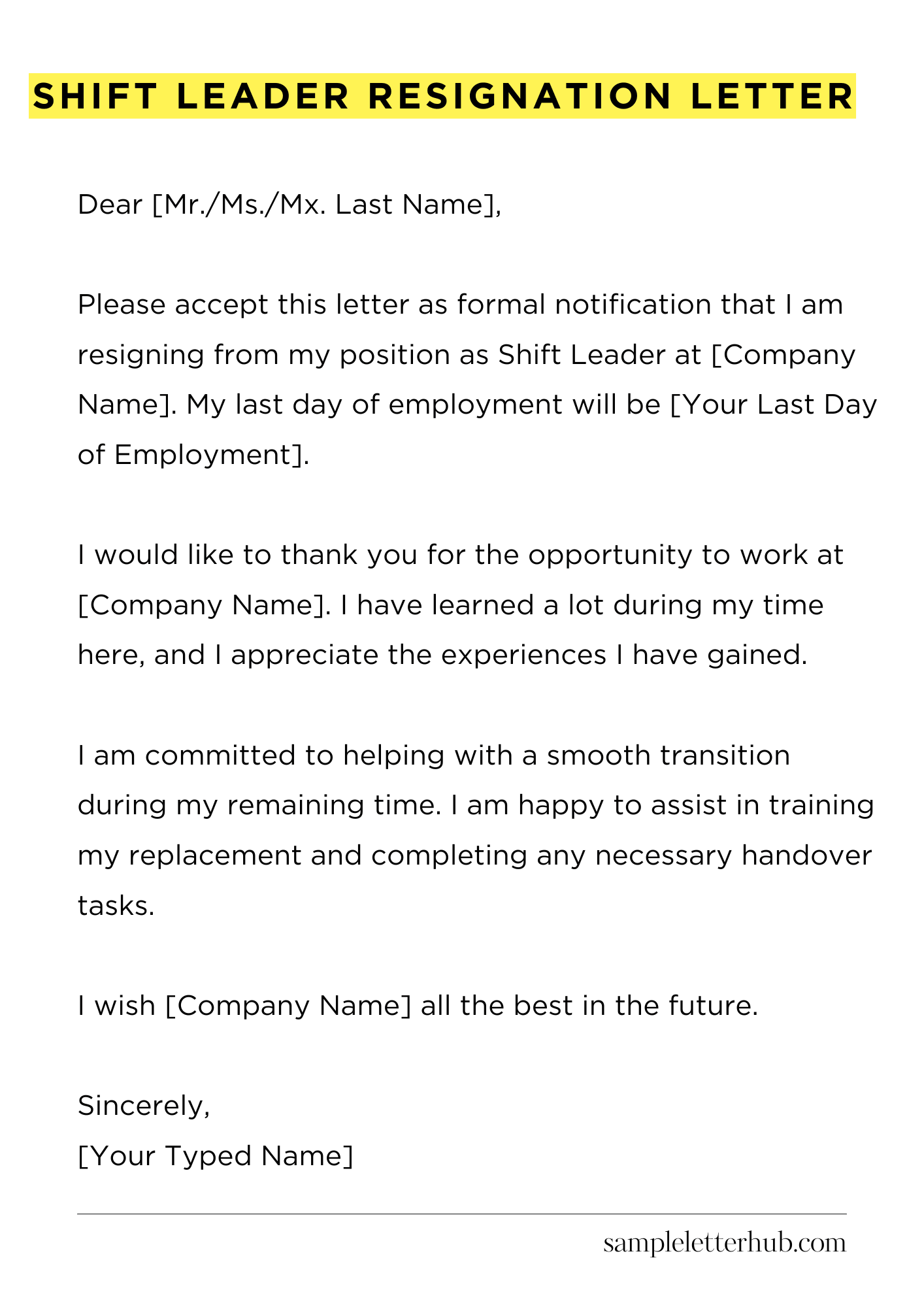
Dear [Mr./Ms./Mx. Last Name],
Please accept this letter as formal notification that I am resigning from my position as Shift Leader at [Company Name]. My last day of employment will be [Your Last Day of Employment].
I would like to thank you for the opportunity to work at [Company Name]. I have learned a lot during my time here, and I appreciate the experiences I have gained.
I am committed to helping with a smooth transition during my remaining time. I am happy to assist in training my replacement and completing any necessary handover tasks.
I wish [Company Name] all the best in the future.
Sincerely,
[Your Typed Name]
How to Write a Shift Leader Resignation Letter
So, you’re moving on? Congratulations! Leaving a job, especially one in a leadership role like shift leader, is a big decision. You’ve likely put in some effort, built some relationships, and learned a thing or two. But now, it’s time to craft a professional resignation letter.
This is important: it’s your official farewell to your employer. Let’s make sure you do it right. Here’s how to do it in a way that respects your past and opens doors for your future.
1. Keep It Simple and Direct
Don’t overthink this! Your resignation letter isn’t the place for lengthy explanations or dramatic pronouncements. Start with a clear and concise statement of your intent. State the obvious – you are resigning. Include the specific date your resignation takes effect. This is the official date of your last day.
This is vital to ensure everything is properly processed on your employer’s end. Here’s a basic example: “Please accept this letter as formal notification that I am resigning from my position as Shift Leader, effective [Your Last Day of Employment].”
2. Show Gratitude (Yes, Even If It’s Been Tough!)
Even if the job wasn’t perfect, showing gratitude is crucial. It’s the polite and professional thing to do. A few well-chosen words of thanks can go a long way. You don’t have to wax poetic, but acknowledge the opportunity you were given. Consider mentioning something specific you learned or a positive aspect of your time there.
For instance: “I would like to thank you for the opportunity to work as a Shift Leader for the past [Number] years. I’ve gained valuable experience in [Mention a skill or two]. I am grateful for the chance to develop my skills.” This adds a touch of class and leaves a good impression.
3. Provide Assistance With the Transition
This is a major opportunity to demonstrate professionalism. Offering to assist with the transition period reflects well on your character. It’s also often appreciated by your employer. Depending on your role, you could offer to help train your replacement, document key processes, or finish outstanding tasks.
A simple sentence like, “I am happy to assist in the transition process to ensure a smooth handover of my responsibilities” goes a long way. Be reasonable with your offer. Don’t promise more than you can deliver, but make the effort to be helpful.
4. Maintain Professionalism and Tone
Your resignation letter is a formal document. Therefore, maintain a professional tone throughout. Avoid negativity, complaints, or personal attacks. Even if you’re leaving because of issues with your supervisor or the company, keep your letter focused on your decision to resign and your willingness to help with the transition.
Stick to the facts. Proofread carefully before sending. Check for any grammatical errors or typos. Ensure your letter conveys a sense of respect and professionalism. This is about maintaining your reputation.
5. Include Contact Information and Your Signature
Include your contact information. This is standard practice and makes it easy for your employer to reach you with any questions or regarding the transition. Include your phone number and your personal email address.
Be sure to physically sign your letter. If you are submitting an electronic version, consider typing your name above the digital signature (if you are required to have one). Make sure your digital signature is clear.
Writing a resignation letter, especially as a shift leader, is about closing a chapter professionally and respectfully. Follow these steps, and you’ll leave with your reputation intact, ready to embark on your next adventure.
FAQs about Shift Leader Resignation Letter
What is the primary purpose of a Shift Leader resignation letter?
The primary purpose of a Shift Leader resignation letter is to formally notify your employer of your intention to leave your position. It serves as an official record of your departure and provides essential information, such as your last day of employment. It also allows you to express your gratitude for the opportunity and, if desired, to offer assistance during the transition period.
What key information should be included in a Shift Leader resignation letter?
A well-crafted Shift Leader resignation letter should include your formal announcement of resignation, the date of your last day of employment, and a brief and professional statement of your reason for leaving (if you choose to include one).
It’s also important to express your gratitude for the opportunity to work there and to offer assistance with the handover process. Finally, you should include your contact information for future correspondence.
How much notice should I give when resigning as a Shift Leader?
The amount of notice you should give as a Shift Leader depends on your employment contract, company policy, and local labor laws. Typically, a minimum of two weeks’ notice is standard practice.
However, some companies may require a longer notice period, especially for managerial positions. Review your employment agreement to confirm the required notice period and adhere to the specified timeframe.
Should I provide a reason for resigning in my Shift Leader resignation letter?
While not mandatory, providing a brief and professional reason for your resignation can be helpful. This allows your employer to understand your decision and potentially offer an opportunity to address any concerns. Keep the reason concise and positive, focusing on future career goals or personal circumstances.
Avoid negative comments or complaints, as this can affect your relationship with your former employer and may impact references.
How should I format and deliver my Shift Leader resignation letter?
Your Shift Leader resignation letter should be professionally formatted, using a standard business letter format. Ensure the letter is typed, well-organized, and free of grammatical errors. It is best to address the letter to your direct supervisor or the appropriate HR representative.
Deliver the letter in person if possible, or send it via email if an in-person delivery is not feasible. Keep a copy of the letter for your records.
Related:
Resignation letter due to rude boss
Resignation letter moving to another state
Resignation letter due to illness of family member
Resignation letter due to study