

A Senior Engineer resignation letter is a formal document. It officially announces your departure from a company. Its purpose is to inform your employer of your decision. It also outlines your last day of employment.
Thinking of moving on? Crafting the right words can be tough. We’ve got you covered. This article offers helpful samples. Explore various templates and examples. They are designed to ease the writing process.
Need a head start? The provided samples offer a fantastic foundation. Adapt them to fit your specific needs. Say goodbye to guesswork. Start writing your resignation letter today with confidence.
Senior Engineer Resignation Letter
Below is a sample of a Senior Engineer Resignation Letter:
[Your Name]
[Your Address]
[Your Phone Number]
[Your Email Address]
[Date]
[Employer’s Name]
[Company Name]
[Company Address]
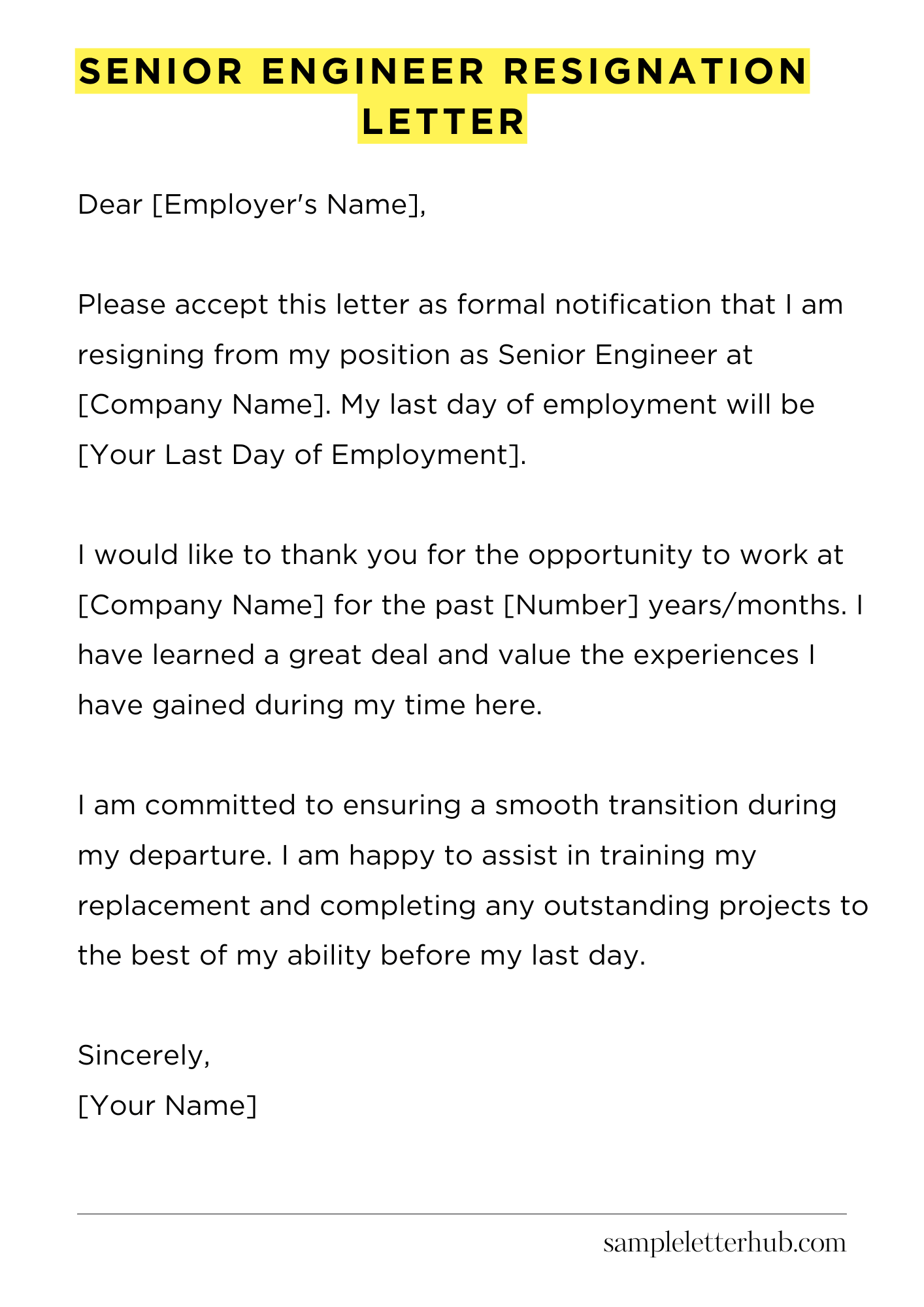
Dear [Employer’s Name],
Please accept this letter as formal notification that I am resigning from my position as Senior Engineer at [Company Name]. My last day of employment will be [Your Last Day of Employment].
I would like to thank you for the opportunity to work at [Company Name] for the past [Number] years/months. I have learned a great deal and value the experiences I have gained during my time here.
I am committed to ensuring a smooth transition during my departure. I am happy to assist in training my replacement and completing any outstanding projects to the best of my ability before my last day.
I wish you and [Company Name] all the best for the future.
Sincerely,
[Your Name]
How to Write a Senior Engineer Resignation Letter
1. Start with the Basics: Your Contact and the Date
Alright, let’s get down to business. First things first: you’re resigning, and you need a professional letter to do it. You must do it right, especially at your level. Senior Engineers need to communicate clearly.
Begin by including your full name, address, phone number, and email address at the very top. This establishes who you are. Next, directly below your contact information, put the date. Use the standard format – Month, Day, Year (e.g., December 20, 2024).
This is crucial for record-keeping and official documentation.
2. Addressing the Letter and Stating Your Intent
Okay, now for the important part. Address the letter to your immediate manager. Use their formal title. For example, “Dear [Manager’s Name], [Manager’s Title]”. Get this right. Then, clearly state your intention to resign. Keep it direct and unambiguous.
A good opening line might be: “Please accept this letter as formal notification that I am resigning from my position as Senior Engineer at [Company Name], effective [Your Last Day of Employment].” Remember, be precise and mention the official date when you will no longer be working there.
Your intent must be crystal clear to eliminate confusion.
3. Expressing Gratitude and Highlighting Contributions
Now, let’s inject a little bit of positivity. You don’t want to burn bridges. Even if you’re leaving for a better opportunity, always express gratitude for the opportunities you’ve been given at the company. Briefly mention any key accomplishments or contributions you’re proud of.
This demonstrates professionalism and shows that you value the experience. For instance, you could say: “I am grateful for the opportunities I have been given during my time here and for the experience I have gained. I am particularly proud of my contributions to [Specific Project or Initiative].” You were a senior engineer! Show it.
This is where you can be slightly creative, but stay professional.
4. Offer Assistance with the Transition and Next Steps
A Senior Engineer’s departure has a big impact. Offer to assist with the transition. This is crucial for maintaining a positive relationship and ensuring a smooth handover.
Offer to help train a replacement, complete any ongoing projects, or document your work. Mention your availability for a handover period. For example: “I am happy to assist in any way possible during the transition period.
I am available to help train my replacement and complete any ongoing projects before my last day.” This is the right thing to do. Always do the right thing.
Show you are a team player to the very end. The company will appreciate it.
5. The Closing: Signature and Contact Information
You’re almost done. Finish by writing a polite and professional closing. Use phrases like “Sincerely” or “Best Regards.” Below the closing, type your full name. Leave space for your signature, which you should sign in blue or black ink. If you are submitting electronically, your typed name usually suffices.
Consider including your personal email address and phone number for future contact, if you are comfortable. Proofread your letter carefully before sending it. Check for any errors in grammar or spelling. A well-written letter reflects positively on your professionalism and leaves a lasting good impression.
The final touch makes all the difference.
FAQs about Senior Engineer resignation letter
Navigating a job change, especially when leaving a senior role, requires careful planning and execution. A well-crafted resignation letter is a crucial part of this process. Here are some of the most frequently asked questions on this topic.
What essential information should a Senior Engineer’s resignation letter include?
A Senior Engineer’s resignation letter should contain: a clear statement of resignation, your official last day of employment, a brief expression of gratitude for the opportunity (optional but recommended), and any necessary details about the handover process or ongoing projects. You should also confirm any outstanding benefits or final pay procedures. Be professional and concise.
How much notice should a Senior Engineer give when resigning?
The standard notice period is typically two to four weeks, but this can vary depending on your employment contract, company policy, and the laws of your jurisdiction. Senior roles often require a longer notice period. Always review your contract to determine the required amount of notice and adhere to it to maintain a positive professional reputation.
Should a Senior Engineer explain the reason for leaving in the resignation letter?
It’s generally not required to go into great detail about why you are leaving in your resignation letter. You can simply state that you are pursuing other opportunities or making a career change. If you have a positive relationship with your employer, a brief, professional explanation might be included. Avoid negativity or providing a long list of complaints.
How should a Senior Engineer handle the handover of responsibilities in the resignation letter?
Your resignation letter should briefly mention your willingness to assist with the transition. Offer to help train your replacement, document ongoing projects, and provide any necessary support during your notice period. Specify your availability for meetings or consultations to ensure a smooth handover.
Can a Senior Engineer include contact information in the resignation letter?
It’s generally not necessary to include personal contact information (e.g., personal email, phone number) in your resignation letter, unless you are specifically requested to do so for handover purposes. However, providing a personal email can be helpful to maintain a professional network, but it is best to only provide it if you are comfortable.
Related:
Resignation letter due to rude boss
Resignation letter moving to another state
Resignation letter due to illness of family member
Resignation letter due to study