

A “Head of Finance Resignation Letter” is a formal document. It is written by a Head of Finance. The letter officially informs an employer of their intention to leave their job. Its primary purpose is to provide notice and state the effective date of departure.
Leaving a role like Head of Finance requires careful wording. We understand writing this letter can feel tricky. That’s why we’ve prepared examples for you.
We will share templates and samples. These are designed to make the writing process simple. You can easily adapt them for your specific needs.
Head Of Finance Resignation Letter
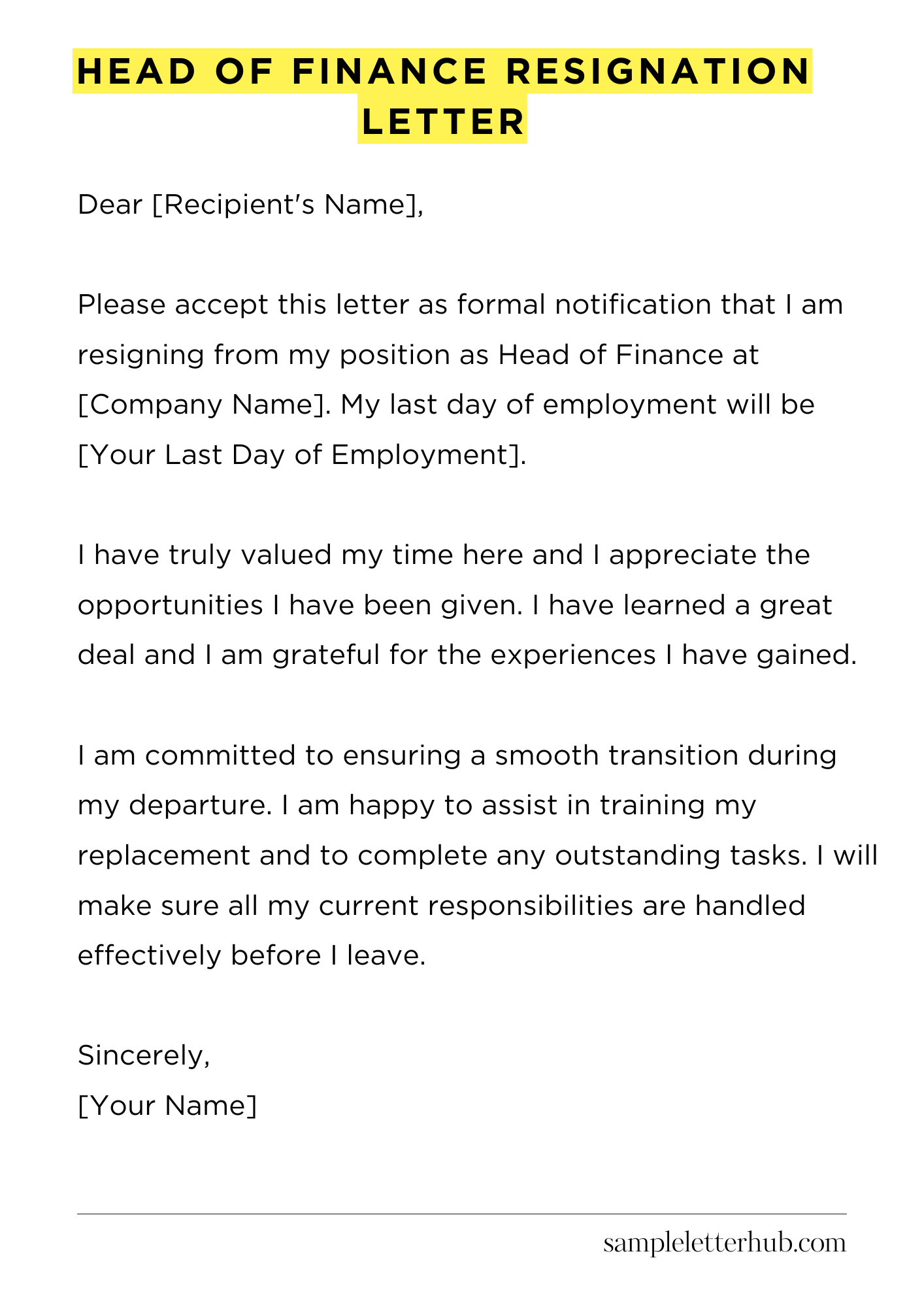
Below is a sample of a Head Of Finance Resignation Letter:
[Your Name]
[Your Address]
[Your Phone Number]
[Your Email Address]
[Date]
[Recipient’s Name]
[Recipient’s Title]
[Company Name]
[Company Address]
Dear [Recipient’s Name],
Please accept this letter as formal notification that I am resigning from my position as Head of Finance at [Company Name]. My last day of employment will be [Your Last Day of Employment].
I have truly valued my time here and I appreciate the opportunities I have been given. I have learned a great deal and I am grateful for the experiences I have gained.
I am committed to ensuring a smooth transition during my departure. I am happy to assist in training my replacement and to complete any outstanding tasks. I will make sure all my current responsibilities are handled effectively before I leave.
I wish you and [Company Name] all the best in the future.
Sincerely,
[Your Name]
How to Write a Head of Finance Resignation Letter
1. Grasp the Basics: Why Your Letter Matters
Leaving a key role like Head of Finance is a big deal. This letter isn’t just a formality; it’s your final professional statement. That’s why it’s really important you get it right. It reflects on your reputation, your professionalism, and how you’ll be remembered. You want to leave a good impression, even if you’re unhappy.
Think of it as the ultimate exit interview document. It sets the stage for future references and potential opportunities. Therefore, thoughtful writing is key.
2. Essential Elements: What to Include
Your letter should be clear, concise, and courteous. Begin with a formal greeting, addressed to the appropriate person (usually your direct supervisor or HR). First, clearly state your intention: “I am writing to formally resign from my position as Head of Finance…” Next, specify your last day of employment. This is crucial for planning the transition.
Following this, express your gratitude for the opportunity. Briefly acknowledge any positive experiences or learnings during your tenure. Keep it sincere but avoid getting overly sentimental. A brief expression of appreciation goes a long way. This shows you valued your time there. Now, offer to assist with the handover process.
This is a classy move that demonstrates commitment. Offer your help with training a successor or completing ongoing projects. Finally, end with a professional closing, such as “Sincerely” or “Respectfully.”
3. Key Considerations: Tone and Content
Maintain a professional and respectful tone throughout your letter. Even if your departure is due to negative circumstances, avoid negativity or criticism.
Focus on the positive aspects of your experience, and phrase your reasoning diplomatically, if you choose to include it. Consider keeping the reason for your departure brief and generic, unless you have a particularly good relationship with your manager.
Stick to the facts and avoid emotional language. Proofread carefully for any typos or grammatical errors. A well-written letter reflects attention to detail. This makes a great impression. Keep it brief – aim for one page, if possible.
4. Crafting the Content: Specific Examples
Here’s a basic template to give you an idea:
        [Your Name]
        [Your Address]
        [Your Phone Number]
        [Your Email Address]

        [Date]

        [Recipient's Name]
        [Recipient's Title]
        [Company Name]
        [Company Address]

        Dear [Mr./Ms./Mx. Last Name],

        Please accept this letter as formal notification that I am resigning from my position as Head of Finance at [Company Name]. My last day of employment will be [Date].

        I would like to express my gratitude for the opportunities I have been given during my time here. [Optional: Briefly mention a positive experience].

        I am committed to ensuring a smooth transition. I am happy to assist in any way possible, including training my replacement and completing ongoing projects.

        Thank you for your support.

        Sincerely,

        [Your Signature]

        [Your Typed Name]
Remember to customize the template to fit your specific situation and the company culture.
5. Proofread and Deliver: Final Steps
Before sending your letter, proofread it multiple times. Get a second pair of eyes to review it for any mistakes. This is critical. Make sure the date and other details are accurate. Once you are satisfied, deliver the letter according to company policy. This usually means submitting it to your direct supervisor or Human Resources.
Consider requesting a confirmation of receipt, either in person or via email. Keep a copy of the letter for your records. Following these steps helps ensure a clean and professional departure. This shows that you are responsible and professional. Now, you’re ready to move on!
FAQs about Head Of Finance resignation letter
How much notice should a Head of Finance provide in their resignation letter?
The standard notice period for a Head of Finance typically aligns with their employment contract. This period is usually between one to three months, although this can vary based on the company’s size, industry norms, and the specific terms outlined in the employment agreement.
It’s crucial to review the contract to determine the exact required notice period and ensure compliance to avoid any potential legal or financial implications.
What key information should be included in a Head of Finance resignation letter?
A Head of Finance’s resignation letter should clearly state their intent to resign, including the effective date of their departure. It should also express gratitude for the opportunities and experiences gained during their tenure.
Additionally, the letter should briefly address the handover of responsibilities, offering to assist in the transition process. It’s also professional to express best wishes for the company’s future.
Should a Head of Finance explain the reasons for their resignation in the letter?
While not mandatory, providing a concise reason for resignation can be beneficial. It’s generally advisable to keep the explanation brief and professional, such as “pursuing other opportunities” or “seeking new challenges.” Avoid negative comments about the company or its employees.
However, if there are significant internal issues impacting performance, you can consider it, but it should be done professionally and cautiously.
How should a Head of Finance handle the handover process outlined in the resignation letter?
A Head of Finance should proactively offer assistance in the handover process. This includes offering to train their replacement, documenting key processes and procedures, and ensuring a smooth transition of financial responsibilities.
The letter should express a willingness to collaborate during this time. The letter should also specify the steps taken or planned to ensure a smooth transition of responsibilities.
What is the appropriate tone for a Head of Finance resignation letter?
The tone of a Head of Finance’s resignation letter should be professional, courteous, and positive. It should convey respect for the company and its leadership. Even if the resignation is due to negative circumstances, maintaining a professional and composed tone is essential. Avoid negativity, and focus on expressing gratitude and outlining a smooth transition process.
Related:
Resignation letter due to rude boss
Resignation letter moving to another state
Resignation letter due to illness of family member
Resignation letter due to study