

A payroll resignation letter is a formal notice. It informs your employer that you’re leaving your job. The letter officially ends your employment. It’s a crucial step in the resignation process.
Need to resign? Writing a payroll resignation letter can be tricky. We’ve got you covered. We’re sharing templates and examples. Use these samples to create your own letter.
This article is your guide. It offers ready-made letter samples. Each sample helps you craft a clear and effective letter. Make your resignation process simple and smooth.
Payroll Resignation Letter
Below is a sample of a Payroll Resignation Letter:
[Your Name]
[Your Address]
[Your Phone Number]
[Your Email Address]
[Date]
[Employer’s Name]
[Employer’s Title]
[Company Name]
[Company Address]
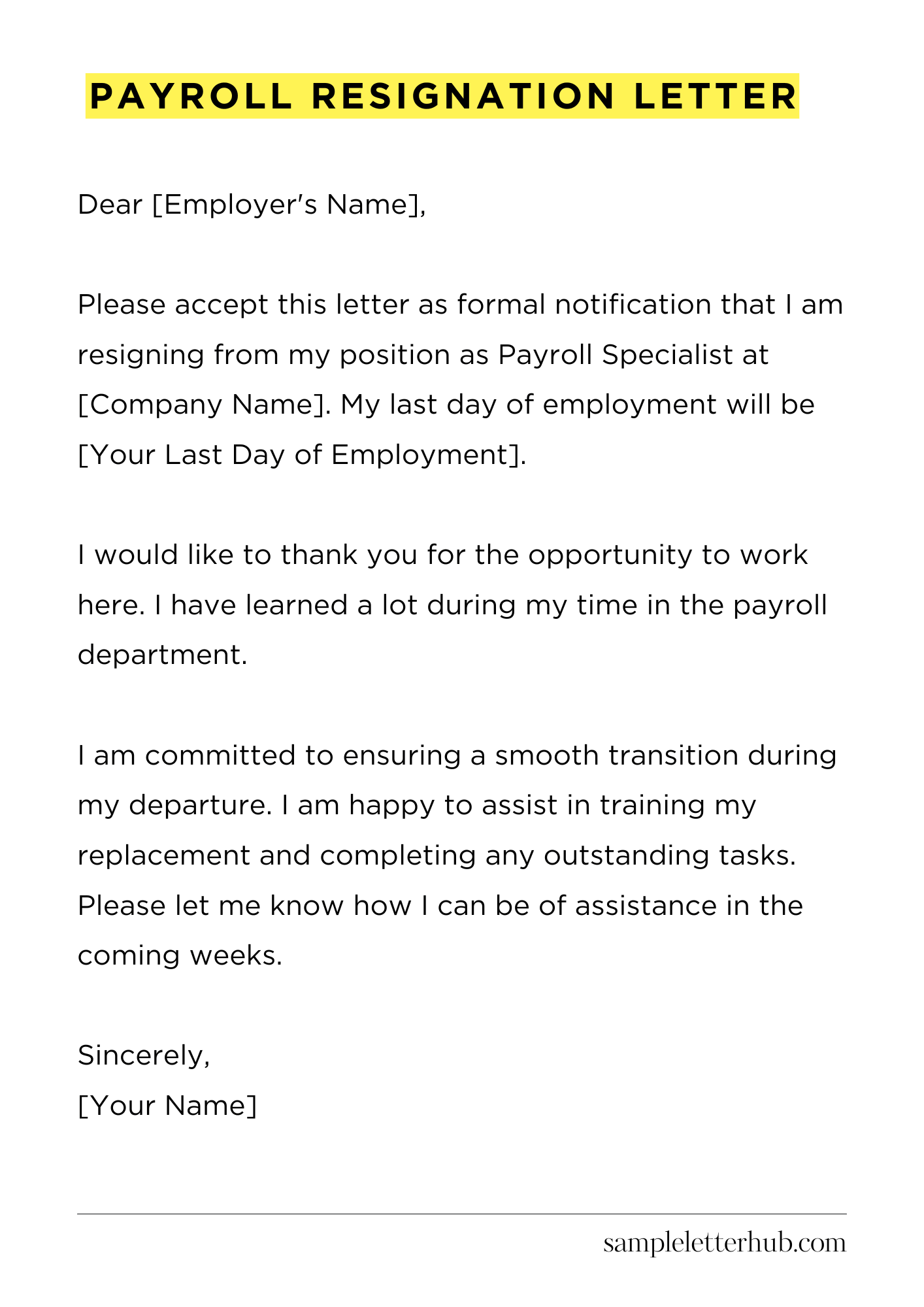
Dear [Employer’s Name],
Please accept this letter as formal notification that I am resigning from my position as Payroll Specialist at [Company Name]. My last day of employment will be [Your Last Day of Employment].
I would like to thank you for the opportunity to work here. I have learned a lot during my time in the payroll department.
I am committed to ensuring a smooth transition during my departure. I am happy to assist in training my replacement and completing any outstanding tasks. Please let me know how I can be of assistance in the coming weeks.
I wish you and the company all the best in the future.
Sincerely,
[Your Name]
How to Write a Payroll Resignation Letter
1. Why Bother with a Resignation Letter?
Leaving a job is a big deal. You want to do it right. Especially when dealing with payroll, accuracy is critical. A payroll resignation letter is your official notice to your employer. It’s more than just a formality; it’s a vital step in ensuring a smooth transition. Think of it as your official goodbye document. It protects you and the company.
Without a letter, things could get messy when it comes to your final paycheck and benefits. Seriously. A well-crafted letter can help you avoid potential issues later on, like discrepancies in your final pay or problems with your tax documents.
2. Essential Elements to Include
Your letter should be clear, concise, and professional. Start with the basics. Begin with your full name, address, and the date. Next, you need to identify the recipient, usually your direct supervisor or the HR department. Then, the most important part: explicitly state your intention to resign. Make it crystal clear you are leaving your position. Include your last day of employment.
This is crucial for payroll processing, and it sets the clock ticking for your final paycheck. Briefly mention the reason for your departure if you want. It’s not always necessary, but a brief, positive statement can be beneficial. Consider adding a thank you for the opportunity you had. Finally, sign and type your name.
3. Formatting Your Letter for Maximum Impact
Presentation matters. Keep it clean and easy to read. Use a standard business letter format. This means single-spaced text, with a professional font like Arial or Times New Roman. Use a 10-12 point font size. Be sure to use proper salutations (e.g., “Dear Mr./Ms. [Last Name]”) and closing phrases (e.g., “Sincerely,” or “Best regards,”).
Keep paragraphs short and to the point. Proofread carefully. Typos can undermine your professionalism. Double-check all dates and names. Formatting ensures your letter is easily understood and taken seriously.
4. What to Avoid in Your Resignation Letter
There are some things you should leave out. Avoid negativity. This is not the place to air grievances. Keep the tone positive. Do not include overly personal details, unless they are relevant to your transition. Avoid making demands. Stick to the facts. Don’t be vague. Be specific about your last day of employment.
Never burn bridges. Keep it professional. Maintain a positive attitude, even if you are not happy. Finally, don’t forget to keep a copy of your letter for your records. That’s always a smart move.
5. Sample Payroll Resignation Letter
Here’s a template you can adapt.
[Your Name]
[Your Address]
[Your Phone Number]
[Your Email Address]
[Date]
[Recipient’s Name/Title]
[Company Name]
[Company Address]
Dear [Mr./Ms. Last Name],
Please accept this letter as formal notification that I am resigning from my position as [Your Job Title] at [Company Name]. My last day of employment will be [Your Last Day of Employment].
[Optional: Briefly, and positively, mention your reason for leaving – e.g., “I have accepted a position that offers new challenges.” or “I am pursuing a career change.”]
Thank you for the opportunity to have worked here. I wish you and the company all the best in the future.
Sincerely,
[Your Typed Name]
[Your Signature]
FAQs about Payroll Resignation Letter
Here are some of the most frequently asked questions surrounding payroll resignation letters, providing clarity and guidance on this important employment matter.
What is the primary purpose of a payroll resignation letter?
The primary purpose of a payroll resignation letter is to formally notify your employer of your intention to leave your position and to request information regarding your final paycheck and related payroll matters. It serves as an official record of your resignation and facilitates the processing of your final compensation, including any outstanding wages, vacation pay, and other benefits.
What key information should be included in a payroll resignation letter?
A well-crafted payroll resignation letter should include your full name, job title, the date of submission, a clear statement of your resignation, the effective date of your departure, and a polite expression of gratitude.
Crucially, it should also include a request for information about your final paycheck, including the method of payment and the date it will be issued. Including contact information, such as your personal email or mailing address, will help in communication.
How far in advance should I submit my payroll resignation letter?
The timing for submitting your payroll resignation letter typically depends on your employment contract or company policy. However, as a general rule, it’s customary to provide at least two weeks’ notice.
Always refer to your employment agreement or employee handbook to confirm the required notice period. Providing ample notice allows your employer time to find a replacement and process the paperwork associated with your departure.
What happens to my final paycheck after I submit my payroll resignation letter?
After submitting your letter, your employer will begin processing your final paycheck. This involves calculating any remaining wages, accrued vacation time, and other benefits. The final paycheck will usually include any wages earned up to your last day of employment, as well as any other funds that are owed to you.
Typically, the final paycheck is issued on your last working day or shortly thereafter. Check your local labor laws, as these vary by location.
Can I negotiate the terms of my final paycheck in my payroll resignation letter?
While your payroll resignation letter is primarily for formal notification and information, you can include brief, polite inquiries about the terms of your final payment if you need clarification on how the payment is made.
However, extensive negotiations regarding the terms of your final paycheck are usually handled separately, often with the HR department. It’s important to familiarize yourself with the company’s policies regarding final pay and any relevant state or federal labor laws.
Related:
Resignation letter due to rude boss
Resignation letter moving to another state
Resignation letter due to illness of family member
Resignation letter due to study