

A Senior Writer resignation letter is a formal document. Its main purpose is to notify an employer of your departure. This letter signals the end of your employment. It’s a crucial step in leaving a writing position.
Preparing to resign can be daunting. You need the right words. We have you covered. This article offers helpful templates. We’ll share various examples. They can guide you through the process.
Think of these samples as your writing toolkit. Use them to craft your own perfect letter. Making the resignation process stress-free is our goal. You can find options for any situation.
Senior Writer Resignation Letter
Below is a sample of a Senior Writer Resignation Letter:
[Your Name]
[Your Address]
[Your Phone Number]
[Your Email Address]
[Date]
[Hiring Manager Name] (If known, otherwise use title)
[Hiring Manager Title]
[Company Name]
[Company Address]
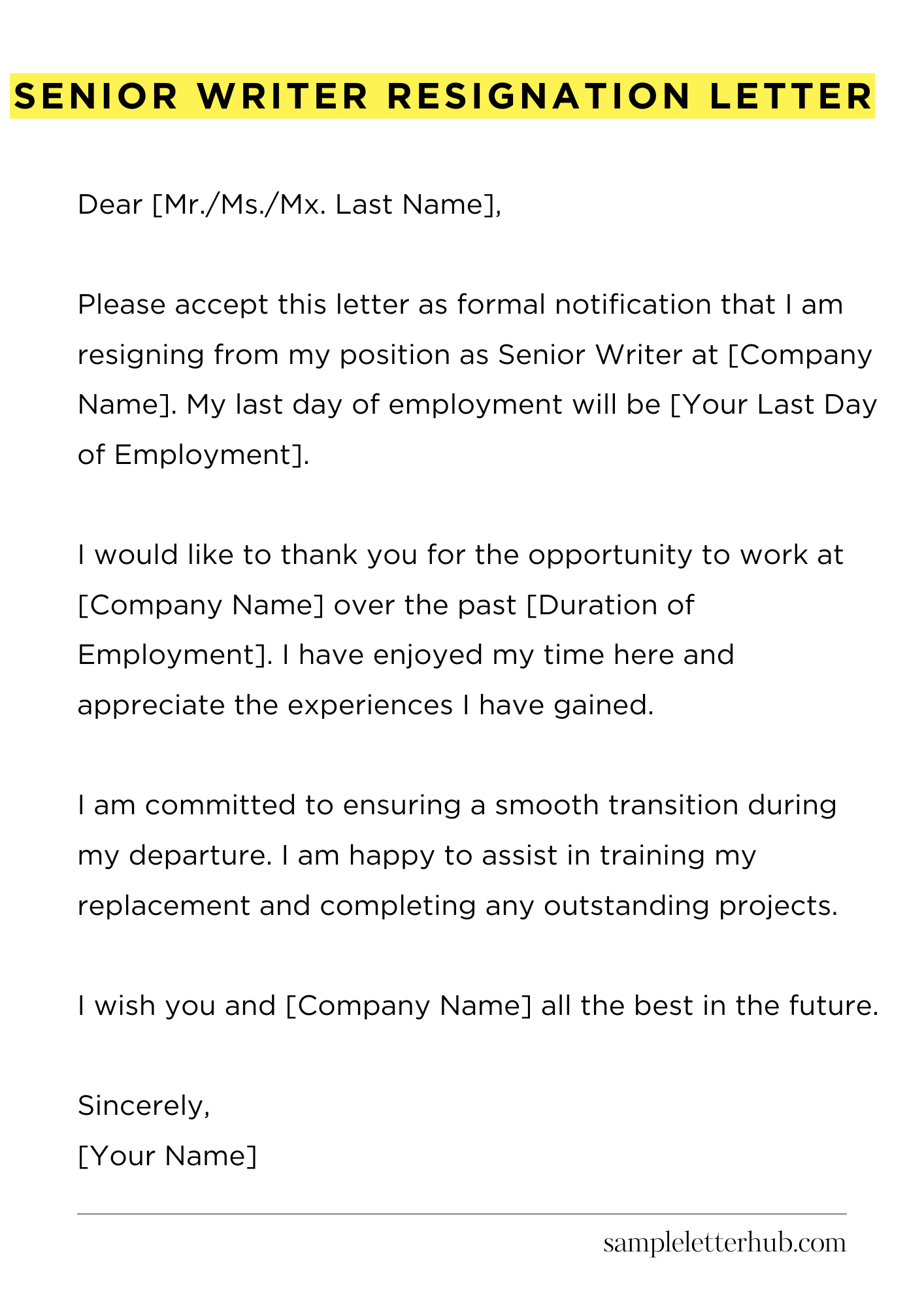
Dear [Mr./Ms./Mx. Last Name],
Please accept this letter as formal notification that I am resigning from my position as Senior Writer at [Company Name]. My last day of employment will be [Your Last Day of Employment].
I would like to thank you for the opportunity to work at [Company Name] over the past [Duration of Employment]. I have enjoyed my time here and appreciate the experiences I have gained.
I am committed to ensuring a smooth transition during my departure. I am happy to assist in training my replacement and completing any outstanding projects.
I wish you and [Company Name] all the best in the future.
Sincerely,
[Your Name]
How to Write a Senior Writer Resignation Letter
1. Getting Started: The Basics You Can’t Skip
Resigning from any job can feel like a big step. A Senior Writer resignation requires thoughtfulness and professionalism. First things first: you need the right tools! You’ll need a word processor or a text editor. Next, you should know that a resignation letter isn’t just about quitting. It’s a formal communication.
Think of it as a bridge, a way to leave your current role on good terms. Begin with a clear and concise date. This date establishes when the letter was written. After that, address the letter to your direct supervisor or the appropriate HR representative. Make sure you get their name right!
The goal is to maintain a professional tone throughout the letter.
2. Expressing Your Intent: The Core of Your Letter
This is where you make your intentions clear. The very first sentence must state your decision to resign. Be direct. Avoid beating around the bush. For example, you can write: “Please accept this letter as formal notification that I am resigning from my position as Senior Writer, effective [Your Last Day of Employment].”
Remember to specify your last day. This is crucial for payroll and other administrative procedures.
The sentence needs to be straightforward.
3. Showing Appreciation: A Touch of Class
Now, let’s inject a little bit of class into this letter. Expressing gratitude is always a good idea. Acknowledge the opportunities you’ve been given. Mention any positive experiences you’ve had. This shows respect for your employer and the role you’ve held.
For instance, you could say: “I am grateful for the opportunities I’ve been given during my time at [Company Name], and I have greatly valued my experience as a Senior Writer.” Even if things weren’t always perfect, focusing on the positives leaves a better impression.
It’s important to be sincere in your words.
4. Detailing the Handover: Smooth Transition
This section is all about making the transition as smooth as possible. Offer your assistance during the handover period. This shows professionalism and consideration for your colleagues.
You can offer help by writing a sentence like: “I am committed to ensuring a smooth transition and am happy to assist in training my replacement or completing any pending projects before my departure.” Mentioning your willingness to help demonstrates your commitment. This is the mark of a valuable employee.
Plan out what you can do before the deadline.
5. Closing and Next Steps: Wrapping it Up and Moving On
Finally, end the letter with a polite and professional closing. Thank your employer again. Offer your contact information if you wish. This is the final opportunity to leave a lasting impression. Consider something like: “Thank you again for the opportunity to work at [Company Name].
I wish the company continued success in the future. Please feel free to contact me at [Your Email Address or Phone Number] if needed.” Sign the letter with your full name. Remember to keep a copy for your records. Now you can move on to new opportunities!
That is all that is required. Good luck!
FAQs about Senior Writer resignation letter
What is the essential information to include in a Senior Writer resignation letter?
A Senior Writer resignation letter should include your formal resignation, stating your last day of employment. It should also include a brief and professional statement of gratitude for the opportunity, and any necessary information such as where you would be working next. Mention the company you are working for, to help clear any confusion and for documentation purposes.
How much notice should a Senior Writer give when resigning?
The standard notice period for a Senior Writer resignation is typically two weeks. However, this can vary based on your employment contract, company policy, and local laws. Always review your contract and consult with your HR department for the most accurate information. Consider giving more notice if you are in a leadership position.
Should I provide a reason for leaving in my Senior Writer resignation letter?
While not mandatory, briefly stating your reason for leaving can be beneficial. It is acceptable to keep it short and professional, such as “pursuing a new opportunity” or “seeking a career change.” Avoid detailed complaints or negative comments. If your leaving is due to another role, provide the name of the role you have accepted.
Can I offer to assist with the transition in my Senior Writer resignation letter?
Offering to assist with the transition is a thoughtful gesture and can leave a positive impression. You can offer to help train your replacement, document ongoing projects, or provide any other necessary support. This demonstrates your professionalism and commitment to the company, even as you depart. Ensure you discuss transition plans with your manager.
How should I deliver my Senior Writer resignation letter?
Generally, you should submit your resignation letter in writing to your direct manager and/or HR department. It is common to provide a physical copy and an electronic version. Follow your company’s protocol for submitting official documents. It’s often advisable to discuss your resignation in person with your manager before submitting the letter.
Related:
Resignation letter due to rude boss
Resignation letter moving to another state
Resignation letter due to illness of family member
Resignation letter due to study