

A Director of Development resignation letter is a formal document. It announces your departure from the role. The letter outlines your intention to resign. It also specifies your last day of employment.
Writing this letter can feel daunting. That’s why we’re here to help. We’ll share several templates and examples. These samples will guide you. They’ll make the process much easier.
These templates cover various scenarios. They are adaptable. Use them as a starting point. Craft a resignation letter that fits your needs. Get ready to move on.
Director Of Development Resignation Letter
Below is a sample of a Director Of Development Resignation Letter:
[Your Name]
[Your Address]
[Your Phone Number]
[Your Email Address]
[Date]
[Director of Development’s Name]
[Organization Name]
[Organization Address]
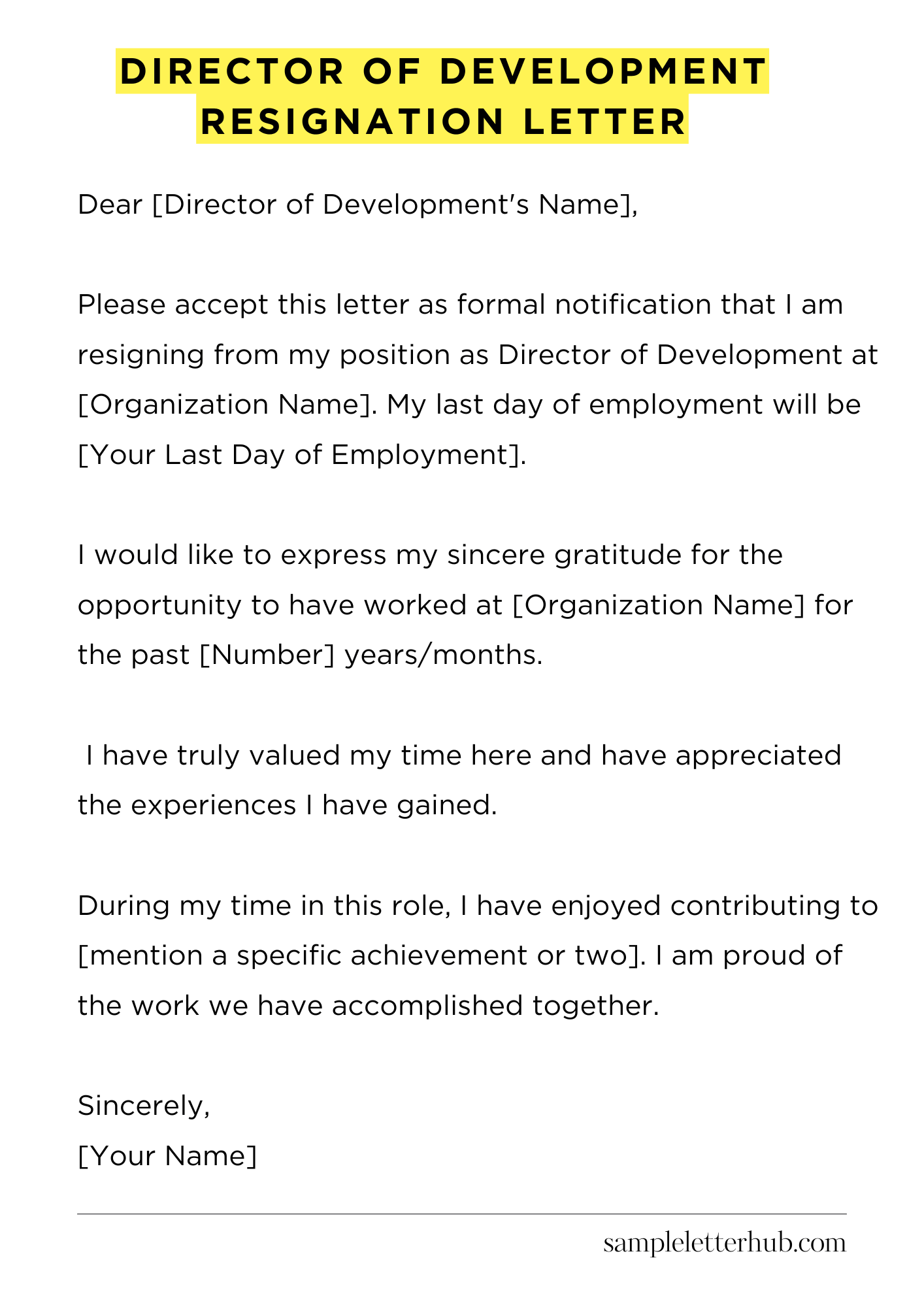
Dear [Director of Development’s Name],
Please accept this letter as formal notification that I am resigning from my position as Director of Development at [Organization Name]. My last day of employment will be [Your Last Day of Employment].
I would like to express my sincere gratitude for the opportunity to have worked at [Organization Name] for the past [Number] years/months. I have truly valued my time here and have appreciated the experiences I have gained.
During my time in this role, I have enjoyed contributing to [mention a specific achievement or two]. I am proud of the work we have accomplished together.
I am committed to ensuring a smooth transition during my departure. I am available to assist in any way possible to train my replacement or complete ongoing projects. Please let me know how I can be of assistance.
I wish you and [Organization Name] all the best for the future.
Sincerely,
[Your Name]
How to Write a Director of Development Resignation Letter
Getting Started: Your First Steps
So, you’ve made the decision. You’re ready to move on from your role as Director of Development. That’s a big step! Now, you need to craft a professional resignation letter. This is a crucial document that will define your departure. The goal? To leave on a good note. Your reputation matters, after all.
Consider it a handshake, a final communication, and a formal record of your exit. First, gather some key information. What’s your official last day? Review your employment contract, if you have one. Often, these specify the required notice period. This is important to note and stick to. Next, take a deep breath. You’ve got this!
The Essential Elements: What to Include
Your resignation letter needs to be clear and concise. A disorganized letter can reflect poorly on you. Start with a formal salutation, using the recipient’s name (ideally your supervisor or the CEO). Next comes the core of your message. State your intention to resign and the effective date of your departure.
Be specific. It should be easily understood. Then, briefly, express your gratitude for the opportunity. Mention any positive experiences or skills gained during your tenure. Keep it sincere. It is generally not the time to air grievances; that’s best handled in a separate conversation, if needed.
Keep the tone positive and professional. Finally, offer assistance with the transition. This is crucial for maintaining a positive relationship. Be willing to help train your replacement or complete any ongoing projects.
Crafting the Right Tone: Professionalism is Key
The tone of your letter is critical. It should be professional, courteous, and respectful. Avoid any negative language, complaints, or criticisms, even if you had a negative experience. You’re aiming for a positive and professional exit. Maintain a neutral and appreciative tone.
Use clear and direct language. Avoid any jargon or overly complex sentences. Be precise. Proofread your letter carefully for any grammar or spelling errors. Errors make it seem sloppy, which is never a good idea. Consider running it through a grammar checker. Get a second pair of eyes to review it, as well, if possible.
Sample Template: A Useful Framework
Here’s a basic template to get you started:
[Your Name]
[Your Address]
[Your Phone Number]
[Your Email Address]
[Date]
[Recipient Name]
[Recipient Title]
[Company Name]
[Company Address]
Dear [Recipient Name],
Please accept this letter as formal notification that I am resigning from my position as Director of Development at [Company Name], effective [Your Last Day of Employment].
I am grateful for the opportunities I’ve had during my time here. [Optional: Briefly mention a positive experience or skill gained].
I am committed to ensuring a smooth transition. I am happy to assist in any way possible to help train my replacement.
Thank you again for the experience. I wish you and [Company Name] all the best in the future.
Sincerely,
[Your Signature]
[Your Typed Name]
Remember to customize this template to your specific situation!
Final Checks and Follow-Up: The Last Steps
Before sending your resignation letter, give it one final read-through. Does it accurately reflect your intentions? Are all the details correct? Have you remembered to include your contact information? After submitting your letter (usually in physical and digital forms), be prepared for a response.
Your supervisor might want to discuss your departure. Remain professional and cooperative. Be willing to answer any questions. Finally, remember to gather all important documents, such as your final paycheck, benefits information, and any personal belongings. Ensure you understand the terms of your departure.
Follow these steps and you’ll leave your role professionally, with your reputation intact.
FAQs about Director Of Development resignation letter
How should a Director of Development begin their resignation letter?
A Director of Development should begin their resignation letter professionally, stating their intention to resign clearly. They should include the specific job title (Director of Development), the organization’s name, and the effective date of their resignation.
It’s generally a good practice to express gratitude for the opportunity to have worked at the organization and briefly mention the positive aspects of their experience, if any.
What key elements should be included in a Director of Development’s resignation letter?
The key elements include a clear statement of resignation (including title and effective date), a concise reason for leaving (optional, but can be beneficial to offer a brief explanation), a note of appreciation for the opportunity, and an offer to assist with the transition.
It’s also crucial to provide contact information (optional, but often a professional courtesy) and to maintain a polite and respectful tone throughout the letter.
Is it necessary for a Director of Development to provide a reason for resigning in the letter?
Providing a reason for resigning is optional. While not strictly required, offering a brief, professional explanation can be helpful. Reasons can include pursuing another opportunity, personal reasons, or a desire for a career change.
Keep the reason concise and avoid negative or overly critical language. If you choose not to provide a reason, a simple statement like “for personal reasons” is sufficient.
How much notice should a Director of Development give when resigning?
The standard notice period for a Director of Development is typically two to four weeks. However, the specific notice period should be outlined in the employment contract or company policy. It is crucial to adhere to the agreed-upon notice period to maintain professionalism and allow for a smooth transition. Always review your employment agreement to clarify the required notice.
Should a Director of Development offer assistance during the transition period in their resignation letter?
Yes, offering assistance during the transition period is highly recommended. This demonstrates professionalism and a commitment to ensuring a smooth handover of responsibilities. You can offer to train your replacement, document key processes, or be available for consultation. Specifying your willingness to assist, and any limits to that assistance, can be written as part of your letter.
Related:
Resignation letter due to rude boss
Resignation letter moving to another state
Resignation letter due to illness of family member
Resignation letter due to study