

A Boilermaker resignation letter is a formal document. Its purpose is to officially inform an employer of your intent to leave your job. It’s a crucial step in the employment process. The letter confirms your departure date. It also provides a record of your resignation.
Crafting the perfect resignation letter can seem tricky. Don’t worry, we’re here to help. This article provides various templates. We also have examples and samples. Use them to write your own letter.
These examples cover different situations. Find the best fit for your needs. We’ve made it easy for you. You can adapt them to your specific circumstances. Get ready to put pen to paper (or fingers to keyboard)!
Boilermaker Resignation Letter
Below is a sample of a Boilermaker Resignation Letter:
[Your Name]
[Your Address]
[Your Phone Number]
[Your Email Address]
[Date]
[Employer’s Name]
[Company Name]
[Company Address]
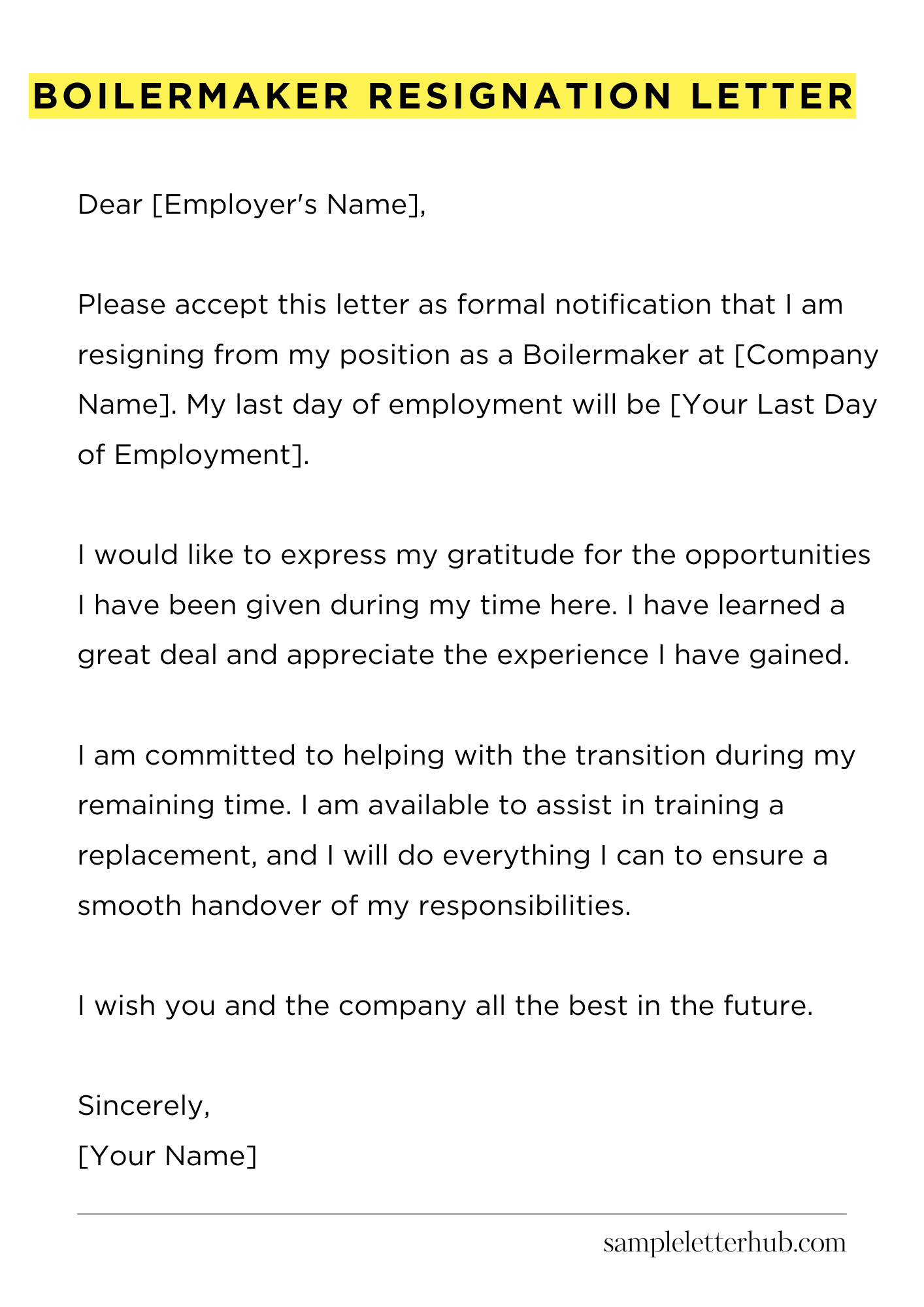
Dear [Employer’s Name],
Please accept this letter as formal notification that I am resigning from my position as a Boilermaker at [Company Name]. My last day of employment will be [Your Last Day of Employment].
I would like to express my gratitude for the opportunities I have been given during my time here. I have learned a great deal and appreciate the experience I have gained.
I am committed to helping with the transition during my remaining time. I am available to assist in training a replacement, and I will do everything I can to ensure a smooth handover of my responsibilities.
I wish you and the company all the best in the future.
Sincerely,
[Your Name]
How to Write a Boilermaker Resignation Letter
1. Grasp the Basics: Why a Resignation Letter Matters
Leaving a job as a Boilermaker? You’ll need more than just a handshake and a “see ya!” A formal resignation letter is absolutely essential. This letter is your official notice to your employer of your intention to leave.
Think of it as a crucial step in maintaining a professional relationship. It documents your departure date and serves as a record. Without it, things can get messy. This document protects both you and your employer, clarifying everything clearly.
2. Essential Elements: What to Include
Your Boilermaker resignation letter requires specific information to be effective. First, clearly state your intention to resign. This seems obvious, but get straight to the point. Next, explicitly state your final day of employment. This is critical for payroll and final paperwork. Then, express your gratitude for the opportunity.
Even if the job wasn’t perfect, a brief acknowledgment of what you gained shows professionalism. Finally, keep it brief and professional. Don’t go into detail about why you’re leaving in a long rant. Keep it simple and focused.
3. Crafting the Perfect Letter: A Practical Guide
Formatting is key! Start with your contact information, the date, and your employer’s information. Next comes the salutation: “Dear [Boss’s Name]”. In the body, state your intention, final date, and express your thanks. Consider adding a sentence about assisting with the transition.
For example, “I am happy to assist in training a replacement during my final two weeks.” Proofread! Check for any typos or grammatical errors. Before you submit, keep a copy for your records. Consider sending a hard copy and an email, to be safe.
4. Addressing Common Concerns: What to Avoid
Several pitfalls can ruin a resignation letter. Avoid negativity or complaints. This isn’t the place to air grievances. Steer clear of being overly emotional. Stick to facts and a professional tone. Do not provide excessive detail about your new job. This information is irrelevant and may come across as boastful.
Don’t burn bridges. Even if you’re not happy, maintaining a positive relationship can prove valuable in the future. Remember, it’s a professional document, not a personal rant.
5. Examples & Templates: Get Started Today!
Finding a template online can speed up the process. Search for “Boilermaker Resignation Letter Template.” Customize the template with your information. Fill in your name, the date, your final day, and your boss’s name.
Remember, use a professional font like Times New Roman or Arial. Keep the letter concise and focused. Double-check everything, then hit send! A well-written letter reflects professionalism and helps you leave your job on good terms.
FAQs about Boilermaker Resignation Letter
What is the purpose of a Boilermaker resignation letter?
The primary purpose of a Boilermaker resignation letter is to formally notify your employer of your intention to leave your position. It serves as an official record of your departure, enabling a smooth transition and helping to avoid potential misunderstandings regarding your last day of employment.
What key elements should a Boilermaker resignation letter include?
A well-crafted Boilermaker resignation letter should include your full name, the date, a clear statement of your intent to resign, the effective date of your resignation (your last day of work), and a brief, professional expression of gratitude to your employer. It can also include an offer to assist with the transition, if you are willing and able to do so.
How should I address my Boilermaker resignation letter?
Address your letter to the appropriate person, usually your direct supervisor, project manager, or the HR department. If you are unsure, check the company’s organizational chart or consult with a trusted colleague. Ensure you spell the recipient’s name correctly to demonstrate professionalism.
Can I simply tell my employer that I’m resigning, or is a formal letter essential?
While you may initially inform your employer verbally, a formal written resignation letter is generally considered essential. It provides a documented record of your resignation, which can be critical for HR processes, payroll, and references. It also helps to avoid any future disputes regarding your departure.
Are there any specific considerations for Boilermakers in their resignation letters?
While the basic structure is the same, Boilermakers should consider mentioning any ongoing projects or tasks they are involved in and offer to provide a handover. You might also want to briefly mention any specific skills or certifications relevant to your role. Remember to remain professional and avoid negativity, even if you are leaving due to dissatisfaction.
Related:
Resignation letter due to rude boss
Resignation letter moving to another state
Resignation letter due to illness of family member
Resignation letter due to study