

A Senior Brand Manager resignation letter is a formal document. It announces your departure from your current role. It officially informs your employer of your decision. It also outlines the end date of your employment.
Writing a resignation letter can be tricky. You need to be professional and clear. We’re here to help make it easier. We will share several templates. You can use these as examples. They will guide you through the process.
Inside, you’ll find different sample letters. They suit various situations. Feel free to adapt these templates. Customize them to fit your specific circumstances. Get ready to craft your perfect resignation letter.
Senior Brand Manager Resignation Letter
Below is a sample of a Senior Brand Manager Resignation Letter:
[Your Name]
[Your Address]
[Your Phone Number]
[Your Email Address]
[Date]
[Hiring Manager Name] (If known, otherwise use title)
[Hiring Manager Title]
[Company Name]
[Company Address]
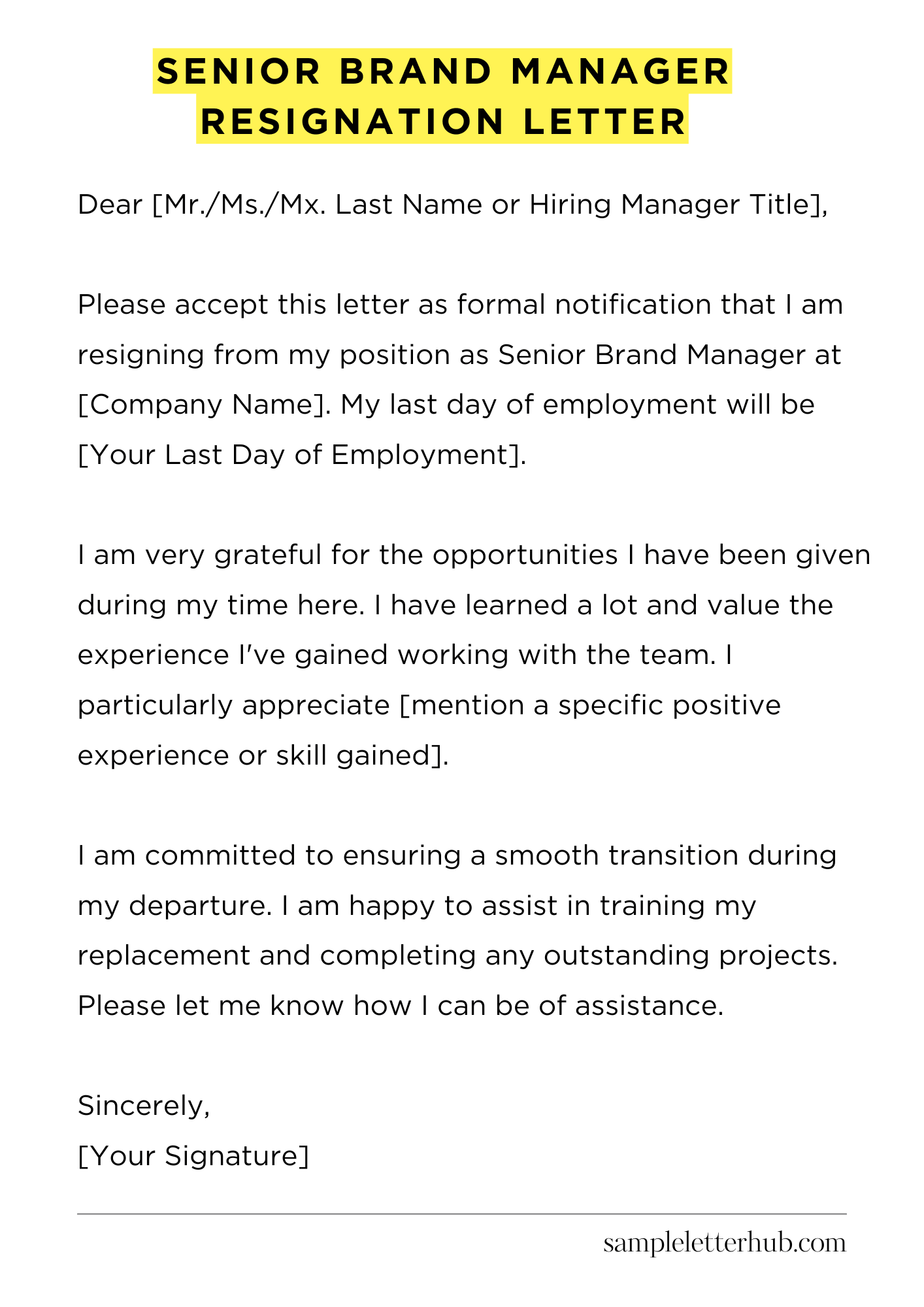
Dear [Mr./Ms./Mx. Last Name or Hiring Manager Title],
Please accept this letter as formal notification that I am resigning from my position as Senior Brand Manager at [Company Name]. My last day of employment will be [Your Last Day of Employment].
I am very grateful for the opportunities I have been given during my time here. I have learned a lot and value the experience I’ve gained working with the team. I particularly appreciate [mention a specific positive experience or skill gained].
I am committed to ensuring a smooth transition during my departure. I am happy to assist in training my replacement and completing any outstanding projects. Please let me know how I can be of assistance.
I wish you and [Company Name] all the best in the future.
Sincerely,
[Your Signature]
How to Write a Senior Brand Manager Resignation Letter
So, you’re moving on. That’s fantastic! Deciding to leave a Senior Brand Manager role is a big step, and you’ll want to handle it professionally. A well-crafted resignation letter is crucial. It’s your final statement and a lasting impression. Let’s make it a good one, shall we?
1. Keep it Short and Sweet (and Professional!)
First things first: brevity is your friend. Don’t feel the need to write a novel. A single page, ideally, is perfect. Start with a clear and direct statement of your resignation. State your intent plainly, and include the effective date of your departure. This is non-negotiable, and it should be front and center.
Keep the tone formal but avoid being overly stuffy. Think business-like and respectful. Avoid any emotional language, regardless of your personal feelings. Nobody wants to be involved in a soap opera.
2. Express Gratitude and Positive Sentiment
Now is the time for graciousness. Acknowledge your time at the company, especially if you enjoyed it. Briefly express your gratitude for the opportunities you’ve been given. Mention any positive experiences or contributions you made. This shows you’re not just ditching the place but valuing the experience.
For instance: “I am grateful for the experience and the opportunity to lead the brand marketing team…” or “I’ve learned valuable skills during my tenure.” This helps maintain a positive image. This can assist you in obtaining a good reference. It is important to remember, there is no need to be fake. Just stick to the facts and maintain a professional posture.
3. Clearly Outline Your Responsibilities and Assistance
Be proactive in helping with the transition. Offer your assistance in a smooth handover. Mention your willingness to help train your replacement, if possible. Provide a list of ongoing projects or tasks you can help with before your departure. This demonstrates your commitment to the company, even as you move on.
For example: “I am committed to ensuring a smooth transition and am available to assist in training my replacement and outlining the current projects.” This also underscores your professionalism. It will be helpful to management and your colleagues.
4. Avoid Negativity and Personal Opinions
This is not the place to air grievances. Keep any negative opinions or criticisms to yourself. Even if you have legitimate issues, now is not the time to bring them up. It’s important to remember that this letter will likely become part of your permanent record. Focus on the positives and maintain a professional demeanor.
Talking poorly about your colleagues, management or the company is a very bad idea. It just makes you look bad. Resist the temptation. Be the bigger person, always.
5. Review, Revise, and Proofread!
Before you send it, carefully review the letter. Proofread it multiple times to catch any typos or grammatical errors. Have a trusted friend or colleague read it over, too, if possible.
A polished letter shows you care about your professional image. Make sure the tone is consistent, and the message is clear. Ensure all the relevant information is included. Double-check the date and recipient. Finally, save a copy for your records. Good luck with your next endeavor!
FAQs about Senior Brand Manager Resignation Letter
What is the appropriate notice period for a Senior Brand Manager resignation?
The standard notice period for a Senior Brand Manager resignation typically aligns with the employment contract and local labor laws. Common practice is to provide at least four weeks’ notice, but this can extend to six or eight weeks depending on seniority, company policy, and the specifics of the employment agreement.
Consulting the employment contract is the best way to determine the correct notice period.
What key elements should be included in a Senior Brand Manager’s resignation letter?
A comprehensive resignation letter from a Senior Brand Manager should include: a clear statement of resignation, the effective last day of employment (calculated based on the notice period), a brief expression of gratitude for the opportunity, and a willingness to assist with the transition of responsibilities.
It is also wise to maintain a professional tone, and consider adding a specific sentence like “I am committed to ensuring a smooth handover of my duties.”
Should a Senior Brand Manager provide a reason for resigning in the letter?
While not mandatory, providing a brief, professional reason for resigning is often considered good practice. This can be as simple as stating “to pursue other opportunities” or “to focus on personal development.” Detailed explanations are typically reserved for an exit interview, if one is offered. It’s crucial to maintain a positive and professional tone, regardless of the reasons for leaving.
How should a Senior Brand Manager handle the transition of responsibilities?
A Senior Brand Manager should actively facilitate a smooth transition. This includes preparing documentation outlining ongoing projects, strategies, and key contacts.
They should also be available to train a replacement or assist colleagues in taking over their duties. Offering to be available for a limited time after departure to answer questions can be considered professional. The transition process is crucial for leaving a positive lasting impression.
What is the proper format for delivering a Senior Brand Manager’s resignation letter?
A Senior Brand Manager should typically deliver their resignation letter in writing, addressed to their direct supervisor and/or the Human Resources department. Sending it via email, with a physical copy delivered if company policy dictates, is standard. Ensure the letter is well-formatted, using a professional font and layout, to maintain a professional image.
Related:
Resignation letter due to rude boss
Resignation letter moving to another state
Resignation letter due to illness of family member
Resignation letter due to study