

A business executive resignation letter is a formal document. It announces a high-level employee’s departure from a company. Its main purpose is to officially inform the employer of the resignation. It also often outlines the last day of employment.
Navigating the world of executive resignations can be tricky. We understand. That’s why we’re here to help. This article provides you with a collection of sample letters. They cover various scenarios and situations.
These templates will serve as a guide. You can customize them to fit your specific needs. They are designed to make writing your own letter easier. Consider these samples your starting point for a smooth transition.
Business Executive Resignation Letter
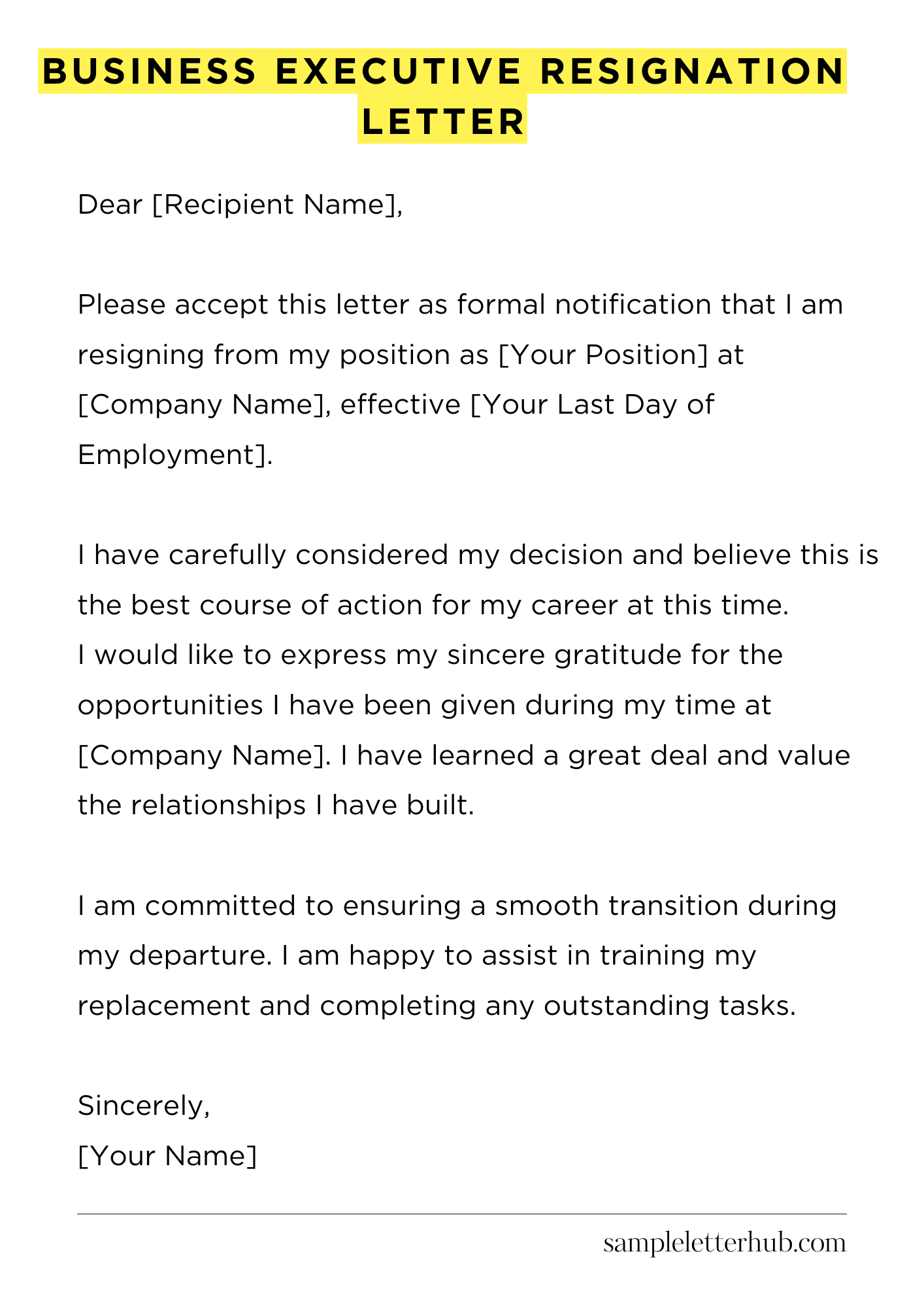
Below is a sample of a Business Executive Resignation Letter:
[Your Name]
[Your Address]
[Your Phone Number]
[Your Email Address]
[Date]
[Recipient Name]
[Recipient Title]
[Company Name]
[Company Address]
Dear [Recipient Name],
Please accept this letter as formal notification that I am resigning from my position as [Your Position] at [Company Name], effective [Your Last Day of Employment].
I have carefully considered my decision and believe this is the best course of action for my career at this time.
I would like to express my sincere gratitude for the opportunities I have been given during my time at [Company Name]. I have learned a great deal and value the relationships I have built.
I am committed to ensuring a smooth transition during my departure. I am happy to assist in training my replacement and completing any outstanding tasks. Please let me know how I can be of assistance.
I wish you and [Company Name] all the best in the future.
Sincerely,
[Your Name]
How to Write a Business Executive Resignation Letter
1. Preparation is Key: Before You Put Pen to Paper
Resigning from an executive position is a significant step. It’s not something to be taken lightly. Before even thinking about crafting your letter, take some time for internal reflection. What are your primary reasons for leaving? Are they related to career advancement, personal fulfillment, or something else entirely?
Consider the timing. Think about your existing commitments and the needs of the company. It’s crucial to ensure you’re leaving on the right foot, making the transition as smooth as possible for all parties involved.
Prepare for the conversations that will follow the letter. It’s important to handle any potential counteroffers with careful consideration and forethought.
2. Crafting the Core: The Essentials of Your Letter
Your resignation letter needs to be clear, concise, and professional. Start with a direct statement of your intent to resign, including your official last day of employment. This is non-negotiable.
Then, briefly acknowledge your time with the company. Express gratitude for the opportunities you’ve been given, even if your departure stems from negative circumstances.
While you don’t need to go into exhaustive detail about your reasons, a brief, professional explanation can be appropriate. Remember to adhere to best practices for professional business writing.
This includes using a formal tone, correct grammar, and a professional format. Keep it concise.
3. Navigating Sensitive Terrain: Addressing Concerns and Avoiding Pitfalls
Executive resignation letters sometimes require a more delicate touch. If you’re leaving due to internal disagreements or ethical concerns, consider your options carefully.
While you have the right to express your reasons, think about the potential consequences. It’s often best to keep the tone positive and professional, focusing on your future endeavors. Avoid making accusations or burning bridges. Focus on the positive aspects of your employment.
Remember that the letter will likely be read by multiple people, including legal counsel. Keep it simple; keep it professional.
4. The Details Matter: Formatting, Delivery, and Next Steps
Formatting your letter correctly is crucial. Use a standard business letter format. This includes your contact information, the date, the recipient’s information, and a professional closing (e.g., “Sincerely,”). Proofread your letter meticulously before sending it. Errors can undermine your credibility.
Consider the delivery method. Hand-delivery or certified mail are often preferred for executive resignations, confirming receipt. After delivering your letter, prepare to discuss your transition plan with your supervisor. Your goal is to leave on positive terms. That can only be a good thing.
5. Beyond the Letter: Planning Your Departure
The resignation letter is only the first step. Prepare for the process of transitioning your responsibilities. Offer your assistance in training your replacement and completing any ongoing projects. This demonstrates professionalism and a commitment to the company’s success, even after your departure. Stay positive and helpful throughout the transition.
Your actions during the notice period will have a lasting impact on your reputation. It will also influence how you are remembered. Think about the legacy you wish to leave behind.
FAQs about Business Executive Resignation Letter
What is the primary purpose of a business executive resignation letter?
The primary purpose of a business executive resignation letter is to formally notify the employer of the executive’s intent to leave their position. It serves as a legal document, providing a written record of the resignation, the effective date, and often, a brief explanation or acknowledgment of the departure.
It also helps to establish a clear timeline for the transition process and can impact how the executive is perceived professionally.
What key elements should be included in a business executive resignation letter?
A business executive resignation letter should include the following key elements: a clear and concise statement of resignation, the effective date of the resignation, a brief and professional expression of gratitude for the opportunity to have worked at the company, and the name of the position.
Mentioning a desire to assist with the transition, if applicable, is also advisable. Including contact information for future communication is also a good practice.
How much notice should a business executive give when resigning?
The amount of notice a business executive should give varies based on the employment contract, company policy, and industry standards. However, it’s generally recommended that executives provide at least four weeks’ notice, and often more, especially for senior-level positions.
Reviewing the employment agreement is crucial to understand the required notice period. Giving ample notice demonstrates professionalism and allows for a smoother transition.
What should a business executive avoid including in their resignation letter?
A business executive should avoid including any negative or critical comments about the company, colleagues, or reasons for leaving. It’s best to keep the tone positive and professional. Avoid detailing the reasons for leaving excessively, or mentioning the executive’s plans for their future.
This letter is not the place to air grievances; instead, keep it formal and focused on the resignation itself.
Should a business executive offer assistance with the transition process in their resignation letter?
Offering assistance with the transition process is often a good idea for business executives. It shows professionalism, respect for the company, and a willingness to facilitate a smooth handover of responsibilities. If the executive is able and willing, they can offer to train their replacement, provide documentation, or assist with any ongoing projects.
This can reflect well on their reputation and improve their chances of receiving a favorable reference.
Related:
Resignation letter due to rude boss
Resignation letter moving to another state
Resignation letter due to illness of family member
Resignation letter due to study