

So, you’re an Insurance Advisor ready to move on? A resignation letter is your official goodbye. It’s a formal document. Its purpose? To inform your employer you’re leaving. It also states your last day of employment.
Writing this letter can feel tricky. Don’t worry. We’ve got you covered. We’ll share helpful letter templates. These will make the process easier. You can adapt them to your specific situation.
Need something simple? Or perhaps a bit more detailed? Find the perfect starting point here. Use these examples. Craft your own polished and professional resignation letter.
Insurance Advisor Resignation Letter
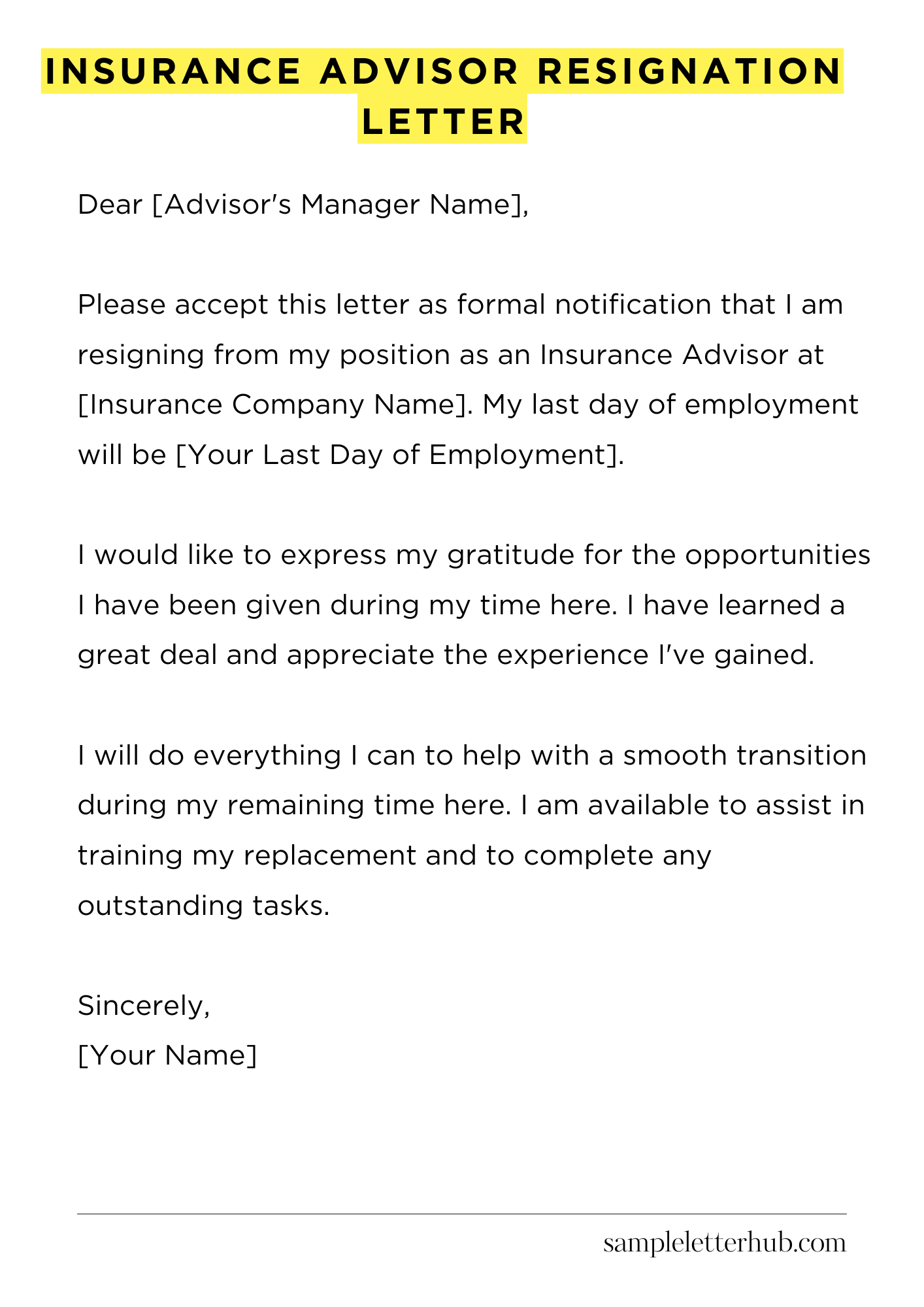
Below is a sample of a Insurance Advisor Resignation Letter:
[Your Name]
[Your Address]
[Your Phone Number]
[Your Email Address]
[Date]
[Advisor’s Manager Name]
[Advisor’s Manager Title]
[Insurance Company Name]
[Company Address]
Dear [Advisor’s Manager Name],
Please accept this letter as formal notification that I am resigning from my position as an Insurance Advisor at [Insurance Company Name]. My last day of employment will be [Your Last Day of Employment].
I would like to express my gratitude for the opportunities I have been given during my time here. I have learned a great deal and appreciate the experience I’ve gained.
I will do everything I can to help with a smooth transition during my remaining time here. I am available to assist in training my replacement and to complete any outstanding tasks.
Thank you again for the experience. I wish you and the company all the best in the future.
Sincerely,
[Your Name]
How to Write an Insurance Advisor Resignation Letter
Leaving a job can be tricky. It requires professionalism and planning, especially when it comes to formal correspondence. Resigning from your role as an Insurance Advisor is no different. You need a well-crafted resignation letter. It should be clear, concise, and leave a positive lasting impression. Follow these simple steps, and you’ll be well on your way to a smooth transition.
1. Keep it Simple: The Core Elements
Your resignation letter’s purpose is straightforward: to officially inform your employer of your departure. Start with your full name, the date, and your manager’s name and title. Next, state your intention to resign. Specify your last day of employment. This is crucial for avoiding any misunderstandings. Keep this section direct and to the point.
For example: “Please accept this letter as formal notification that I am resigning from my position as Insurance Advisor, effective [Your Last Day of Employment].”
2. Show Gratitude and Professionalism
Even if the job wasn’t perfect, express gratitude. Acknowledge the opportunities you were given and any positive experiences you had. This adds a touch of class and maintains a professional tone. This is also important to maintain good relationships for future reference. Avoid negativity or complaints in your letter; this is not the time to air grievances.
Consider a sentence like this: “I am grateful for the opportunities I’ve had during my time here and for the experience I have gained.”
3. Address Outstanding Matters (Optional but Recommended)
If appropriate, you can offer assistance with the handover of your responsibilities. Offer to help train a replacement or complete ongoing projects. This demonstrates your commitment to a smooth transition. This is not always necessary, but it certainly helps. Ensure all important clients are appropriately reassigned.
You might write: “I am happy to assist in any way possible during the transition period and will make sure all my current projects are concluded and documents are handed over to my successor.”
4. Check and Re-Check: Proofreading is Key
Before you send your letter, proofread it carefully. Check for any grammatical errors or typos. Double-check the dates and the names. Make sure the tone is appropriate for your workplace.
A poorly written letter can damage your professional reputation. Ask someone else to read it over for a fresh perspective, it can be very useful to have a second set of eyes.
This attention to detail demonstrates professionalism.
5. Delivery and Follow-up
Submit your letter according to your company’s policy. Usually, this means delivering it to your manager in person. Keep a copy for your records. After you submit the letter, be prepared for a conversation with your manager. Be polite, professional, and ready to answer any questions. This completes the process, giving you peace of mind.
FAQs about Insurance Advisor resignation letter
How do I start an Insurance Advisor resignation letter?
The standard way to begin a resignation letter includes a formal salutation (e.g., “Dear [Manager’s Name]”), followed by a clear and concise statement of your intent to resign from your position as an Insurance Advisor. You should also state the effective date of your resignation in the opening paragraph.
What key information should be included in an Insurance Advisor resignation letter?
Essential information to include is the effective date of your resignation, the specific role you are resigning from (Insurance Advisor), a brief, professional statement of your decision (optional), and an expression of gratitude to your employer for the opportunity, experiences, or training. It’s also important to provide contact information (optional) for any handover.
Should I provide a reason for resigning in my Insurance Advisor letter?
Providing a reason for your resignation is optional. If you choose to, keep it brief and professional, focusing on career advancement, personal reasons, or other opportunities. Avoid negative comments about your current employer or colleagues. If you have concerns, these can be mentioned after you leave or during an exit interview.
What is the appropriate tone for an Insurance Advisor resignation letter?
The tone of your resignation letter should be professional, respectful, and courteous. Express your gratitude for the opportunity and avoid any negativity or personal complaints. This ensures you leave a positive impression, regardless of your reasons for leaving.
How should I handle the handover of my responsibilities as an Insurance Advisor?
In your resignation letter, offer your assistance in the transition process. Briefly state your willingness to cooperate with the handover of your duties. You might suggest assisting in training a replacement, providing documentation, or attending handover meetings. This demonstrates your commitment to a smooth transition and professionalism.
Related:
Resignation letter due to rude boss
Resignation letter moving to another state
Resignation letter due to illness of family member
Resignation letter due to study