

A Kindergarten Teacher resignation letter is a formal document. It is written by a Kindergarten teacher. Its purpose is to officially inform the school of their decision to leave their job. It’s a key step in ending the employment.
Feeling overwhelmed about writing it? You’re not alone. Many teachers find this process stressful. That’s why we’ve got you covered. This article will share several templates. We will provide different examples and samples.
These samples are designed to help. They make the writing process simple. You can easily adapt them to fit your specific situation. This article makes your letter writing easy.
Kindergarten Teacher Resignation Letter
Below is a sample of a Kindergarten Teacher Resignation Letter:
[Your Name]
[Your Address]
[Your Phone Number]
[Your Email Address]
[Date]
[Principal’s Name]
[School Name]
[School Address]
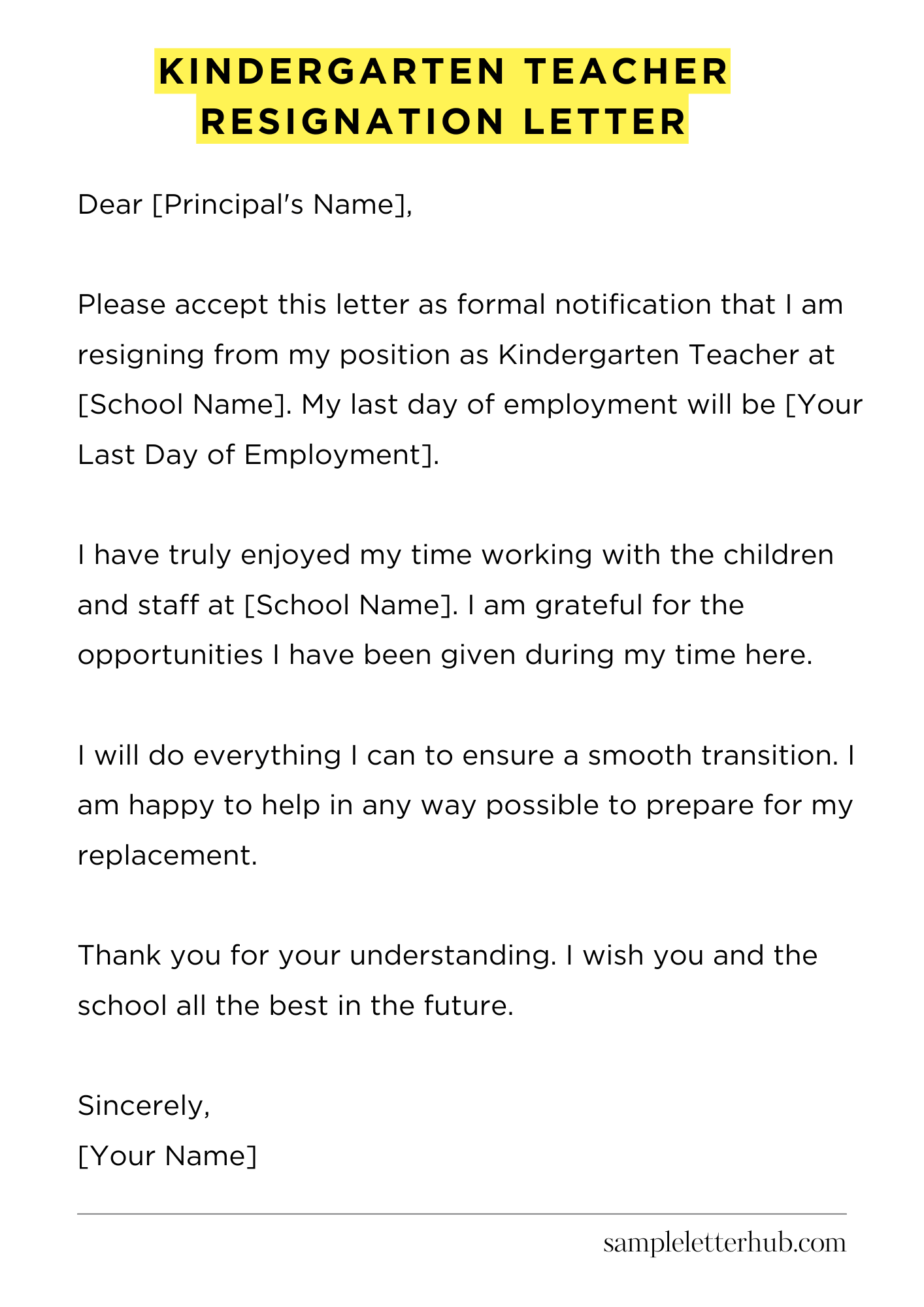
Dear [Principal’s Name],
Please accept this letter as formal notification that I am resigning from my position as Kindergarten Teacher at [School Name]. My last day of employment will be [Your Last Day of Employment].
I have truly enjoyed my time working with the children and staff at [School Name]. I am grateful for the opportunities I have been given during my time here.
I will do everything I can to ensure a smooth transition. I am happy to help in any way possible to prepare for my replacement.
Thank you for your understanding. I wish you and the school all the best in the future.
Sincerely,
[Your Name]
How to Write a Kindergarten Teacher Resignation Letter
1. Why Resign? Reasons to Consider
Leaving a job, especially one as important as teaching kindergarten, isn’t a decision taken lightly. Numerous reasons might push you to resign. Maybe you’ve found a better opportunity elsewhere, or perhaps you’re seeking a different environment for professional growth.
Could be that personal circumstances, like relocating or family needs, are at play. Whatever the underlying cause, your resignation letter needs to reflect it appropriately.
Consider your motives carefully before you put pen to paper (or fingers to keyboard!). Honesty is crucial.
2. Essential Elements: What to Include
A good resignation letter is concise and professional. It should immediately state your intent to resign from your position as a kindergarten teacher. This is step one, and the most important!
Next, you’ll need to specify your last day of employment. This gives the school ample time to find a replacement. Include a brief, positive statement of appreciation for the opportunity to have worked there.
Then, a touch of thanks for the experience goes a long way. Maybe mention a specific person, a project you enjoyed, or a memorable aspect of your tenure. It makes the letter more personable. Finally, provide your contact information, just in case they need to get in touch with you.
3. Crafting the Perfect Letter: A Step-by-Step Guide
Start with a professional salutation. “Dear [Principal’s Name]” is appropriate. Then, state your intention. For example: “Please accept this letter as formal notification that I am resigning from my position as Kindergarten Teacher at [School Name], effective [Your Last Day of Employment].”
Next, express your gratitude. Something like: “I am grateful for the opportunity to have worked at [School Name] for [Duration]. I have truly valued my time here and learned so much.” After that, keep it simple, and avoid overly detailed explanations about why you’re leaving.
Briefly state that the resignation is because of personal reasons, if it’s personal. Conclude by offering assistance with the transition. Offer to help train the new teacher. Finally, close with a professional closing, such as “Sincerely,” or “Respectfully,” followed by your full name and contact information.
4. Dos and Don’ts: Avoiding Common Pitfalls
Do maintain a professional tone throughout the letter. Keep it brief and to the point. Avoid negativity or complaining about your job or the school. This is not the time for grievances.
Avoid any gossip or negative remarks. Don’t burn bridges. Your goal is to leave a positive impression, even if you are leaving under less than ideal conditions.
Proofread carefully before sending it! Typos and grammatical errors are unprofessional. Also, be sure to send the letter on time, according to your contract, and ideally in person, or via email to the principal.
5. Sample Resignation Letter
Here’s an example to guide you:
        [Your Name]
        [Your Address]
        [Your Phone Number]
        [Your Email Address]

        [Date]

        [Principal's Name]
        [School Name]
        [School Address]

        Dear [Principal's Name],

        Please accept this letter as formal notification that I am resigning from my position as Kindergarten Teacher at [School Name], effective [Your Last Day of Employment].

        I am grateful for the opportunity to have worked at [School Name] for the past [Duration]. I have truly valued my time here.

        I am leaving due to personal reasons. I am happy to assist with the transition in any way possible.

        Sincerely,
        [Your Name]
FAQs about Kindergarten Teacher resignation letter
How do I start my kindergarten teacher resignation letter?
Begin your letter with a clear and concise statement of your intent to resign. Include your name, the date, and the recipient’s name (typically the principal or school administrator).
State your resignation formally, mentioning the specific date your resignation will be effective. For example: “Please accept this letter as formal notification that I am resigning from my position as Kindergarten Teacher at [School Name], effective [Date].”
What essential information should I include in my resignation letter?
Besides the basic details, you should state your position, the school, and the effective date of your resignation. It’s also customary to express gratitude for the opportunity to work at the school.
While not mandatory, briefly stating your reason for leaving can be helpful, though it’s acceptable to keep it brief and professional. Some teachers include a willingness to assist with the transition. It is essential to include all of this.
Should I provide a reason for resigning in my letter?
Providing a reason is optional. If you choose to, keep it brief and professional. Common reasons include accepting another position, pursuing further education, or personal reasons. Avoid negativity and focus on the future. You can simply state that you are pursuing a new opportunity or that the decision is based on personal circumstances. You are not required to provide a reason at all.
How should I express gratitude in my resignation letter?
Expressing gratitude is an important aspect of a professional resignation letter. Thank the school and administration for the opportunity to work there. You can mention specific positive experiences or the professional growth you’ve experienced.
A simple statement such as, “I am grateful for the opportunity to have worked at [School Name] and for the experiences I’ve gained” is often sufficient. Consider mentioning something unique, if there’s any.
How can I ensure a smooth transition when resigning?
To ensure a smooth transition, offer to assist with the handover process. This might include preparing lesson plans, providing resources for the substitute teacher, or training a replacement. Be available to answer questions and offer support. Maintain a positive and professional demeanor until your last day. Your cooperation will leave a positive lasting impression.
Related:
Resignation letter due to rude boss
Resignation letter moving to another state
Resignation letter due to illness of family member
Resignation letter due to study