

A Stage Manager resignation letter is a formal document. It announces your departure from a stage management position. Its main purpose is to officially inform your employer of your intention to leave.
Crafting the perfect resignation letter can be tricky. We’ve got you covered. We’ll share several templates and examples. These samples will help you. They’ll guide you through writing your own letter.
Need a simple template? Looking for something more specific? We have options. Find the perfect starting point for your letter. Make your resignation process smooth.
Stage Manager Resignation Letter
Below is a sample of a Stage Manager Resignation Letter:
[Your Name]
[Your Address]
[Your Phone Number]
[Your Email Address]
[Date]
[Recipient Name]
[Recipient Title]
[Theater/Company Name]
[Theater/Company Address]
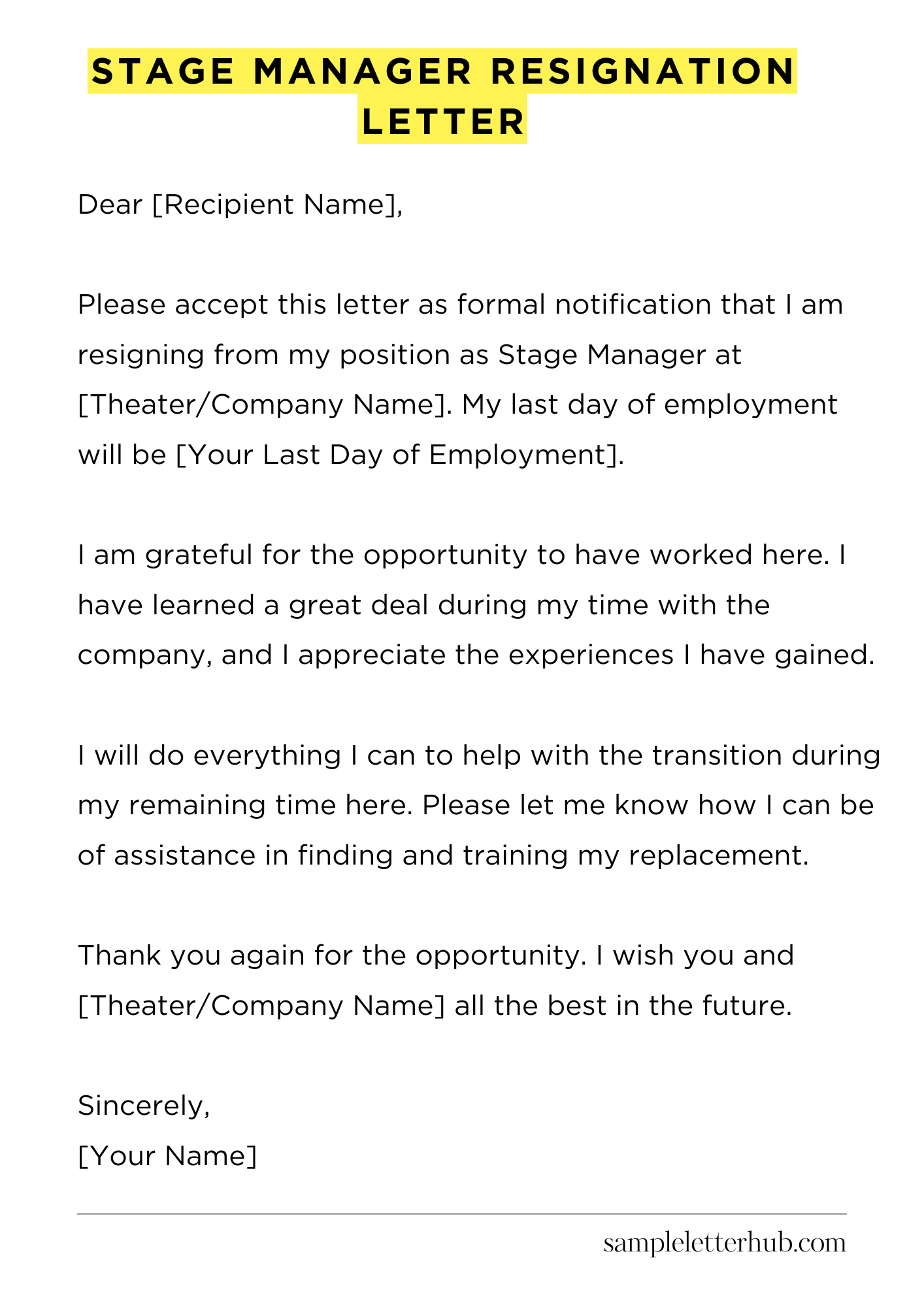
Dear [Recipient Name],
Please accept this letter as formal notification that I am resigning from my position as Stage Manager at [Theater/Company Name]. My last day of employment will be [Your Last Day of Employment].
I am grateful for the opportunity to have worked here. I have learned a great deal during my time with the company, and I appreciate the experiences I have gained.
I will do everything I can to help with the transition during my remaining time here. Please let me know how I can be of assistance in finding and training my replacement.
Thank you again for the opportunity. I wish you and [Theater/Company Name] all the best in the future.
Sincerely,
[Your Name]
How to Write a Stage Manager Resignation Letter
So, you’re moving on from the world of calling cues, wrangling actors, and managing the chaos backstage? Congratulations! Deciding to resign from a stage management position is a big step, and you’ll want to handle it professionally. A well-crafted resignation letter is your key to leaving a positive impression and ensuring a smooth transition.
1. Keep it Concise and Clear
Your letter doesn’t need to be a novel. It should get straight to the point. State your intention to resign, and specify your last day of employment. This is the most crucial part. You’ll want to avoid any ambiguity, as well.
Here’s a basic template: “Please accept this letter as formal notification that I am resigning from my position as Stage Manager at [Theatre/Company Name]. My last day of employment will be [Date].” That’s it! Keep it short, sweet, and to the point. It will go a long way.
2. Express Your Gratitude (and Be Sincere)
Even if the job wasn’t perfect, expressing gratitude is important. Acknowledge the opportunities you’ve been given, the things you’ve learned, and the relationships you’ve built. This shows professionalism and leaves a good impression.
Consider adding a sentence like: “I am grateful for the opportunities I’ve had during my time here, and I have truly appreciated working with the dedicated team at [Theatre/Company Name].” It is a good gesture.
3. Offer Assistance with the Transition
Show your commitment to a smooth handover. Offer to help with the transition to your replacement. This is not only a professional courtesy, but it also reflects well on you. Are you available for training?
Include a sentence or two about assisting. Something like: “I am happy to assist in any way possible during the transition period to ensure a seamless handover of my responsibilities.” It shows you care about the company.
4. Maintain a Positive Tone
Regardless of your personal feelings, keep the tone of your letter positive and professional. Avoid negativity or complaints. This letter is a reflection of you. It’s the last impression you’ll leave with your employer.
Remember, the theatre world is a small one. Burning bridges is never a good idea! Be graceful.
5. Proofread and Proofread Again!
This seems obvious, but it’s essential. Before you send your letter, thoroughly proofread it for any spelling or grammatical errors. Errors can undermine your professionalism and make you look careless.
Ask a friend to read it over, too. A fresh pair of eyes can often catch mistakes you missed. Make sure you use the right names and dates. A little care goes a long way!
FAQs about Stage Manager Resignation Letter
What is the typical format for a Stage Manager resignation letter?
A typical Stage Manager resignation letter should include a clear and concise statement of resignation, the effective date of departure, a brief expression of gratitude for the opportunity, and any necessary information for a smooth transition.
The format is usually a formal business letter, including your contact information, the recipient’s contact information, a salutation, the body of the letter, a closing, and your signature.
What key information must be included in a Stage Manager resignation letter?
The key information includes the formal notice of resignation, the last day of employment (the effective date), a note of appreciation for the experience, and any details about the handover process or assistance you can offer to ensure a smooth transition. Consider including contact information where you can be reached after your departure, if you’re willing to be contacted.
How much notice should a Stage Manager give when resigning?
The amount of notice a Stage Manager should give varies, but it’s generally best practice to provide as much notice as possible. Two weeks’ notice is a common standard in many industries, and it is usually sufficient to begin the transition. In some larger organizations and complex productions, a longer notice period might be expected, as specified in your contract.
Should I provide a reason for resigning in my letter?
You are not usually required to provide a detailed reason for your resignation in the letter. A brief statement such as “for personal reasons” or “to pursue other opportunities” is often sufficient. If you choose to provide a reason, keep it professional and avoid any negative comments about the employer or colleagues.
How should I handle the transition process in my resignation letter?
In your letter, it’s beneficial to offer your assistance in the transition process. This can include offering to train your replacement, compile documentation, or answer questions.
Be specific about what you’re willing to do to ensure the continued success of the project or organization after your departure. State what you are willing to do like training. Mention the period for it to complete smoothly and provide contact if needed.
Related:
Resignation letter due to rude boss
Resignation letter moving to another state
Resignation letter due to illness of family member
Resignation letter due to study