

An HR Supervisor resignation letter formally announces your departure. It communicates your intention to leave the company. This letter is a professional courtesy. It outlines your last day of employment.
Writing a resignation letter can feel tricky. You want to be professional and clear. The goal is a smooth transition. Don’t worry, we’re here to help.
We’ll provide several letter examples. Each suits different situations. Find the perfect fit for your needs. Use these templates to craft your own letter. This will make the process simple.
Hr Supervisor Resignation Letter
Below is a sample of a Hr Supervisor Resignation Letter:
[Your Name]
[Your Address]
[Your Phone Number]
[Your Email Address]
[Date]
[HR Supervisor Name]
[HR Department]
[Company Name]
[Company Address]
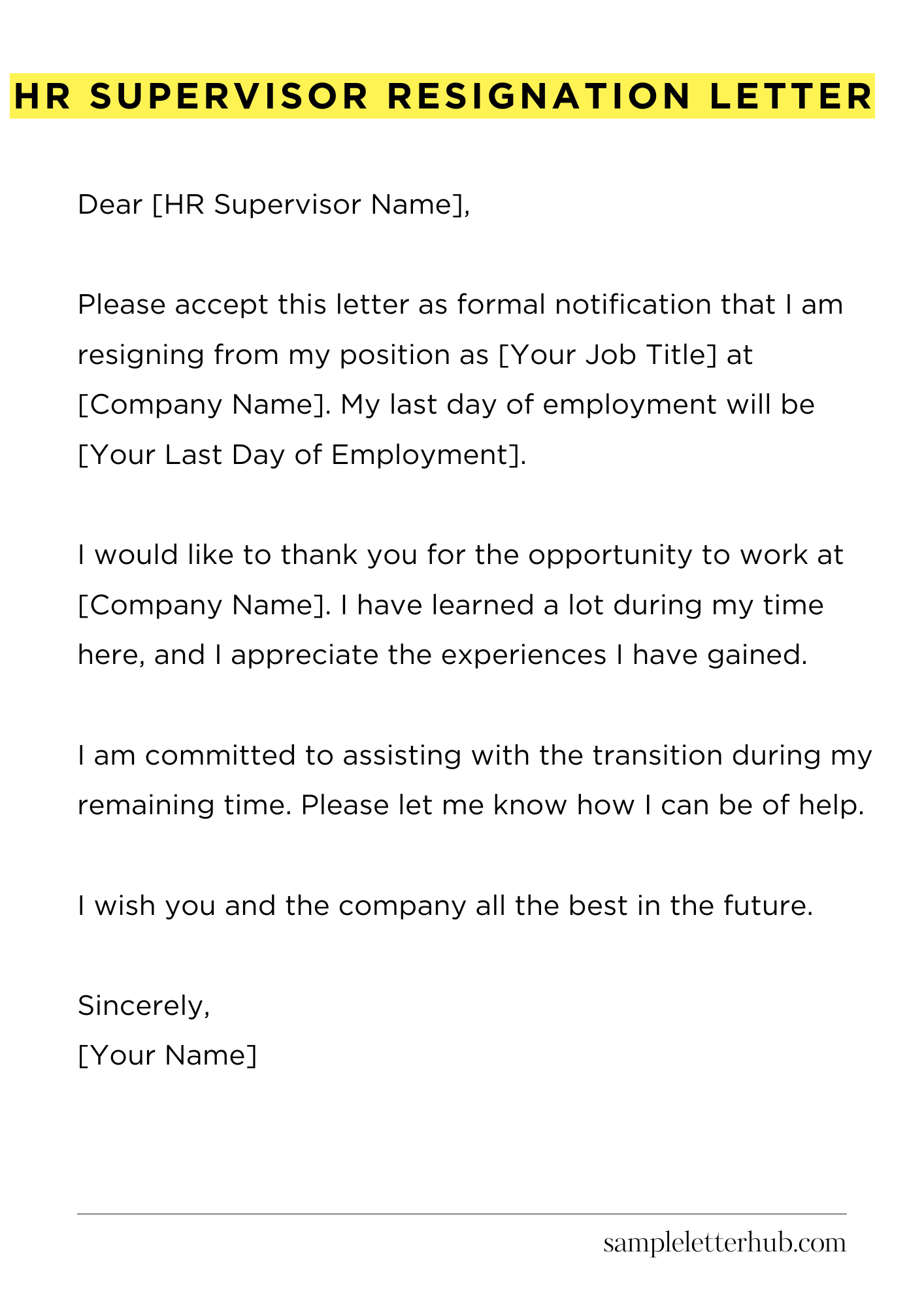
Dear [HR Supervisor Name],
Please accept this letter as formal notification that I am resigning from my position as [Your Job Title] at [Company Name]. My last day of employment will be [Your Last Day of Employment].
I would like to thank you for the opportunity to work at [Company Name]. I have learned a lot during my time here, and I appreciate the experiences I have gained.
I am committed to assisting with the transition during my remaining time. Please let me know how I can be of help.
I wish you and the company all the best in the future.
Sincerely,
[Your Name]
How to Write an HR Supervisor Resignation Letter
Resigning from a job is a big step. And when it comes to a role as important as an HR Supervisor, it needs to be handled with professionalism and grace.
Think of your resignation letter as the final impression you’ll make on your employer. It should be clear, concise, and respectful. Here’s a breakdown of how to craft a resignation letter that leaves a positive mark.
1. Start with the Basics: Your Contact Information and the Date
First things first! Begin your letter with your contact information. This is simple. Include your full name, address, phone number, and email address. At the very top, in the left or right corner, include the current date. This sets the stage. It keeps things organized, and makes sure everyone knows who you are and when you’re resigning.
2. The Formal Salutation: Addressing Your Boss
Now, let’s talk about the greeting. A proper salutation is essential. Always address your letter to your direct supervisor or the appropriate person in HR. Use a formal greeting like “Dear [Manager’s Name],” This shows respect. Avoid casual greetings, as professionalism is key. This is a very common approach to maintain a polite tone.
3. Clearly State Your Intent: The Core of Your Letter
This is where you make it official. State your intent to resign from your position as HR Supervisor. Be direct and unambiguous. Specify your last day of employment. This is crucial for planning.
For instance, you could write: “Please accept this letter as formal notification that I am resigning from my position as HR Supervisor, effective [Your Last Day of Employment].” Keep it straightforward and easy to understand.
4. Express Gratitude and Offer Assistance: Be Professional
Even if you’re leaving, show appreciation. A brief expression of gratitude for the opportunities you’ve been given can go a long way. Mention any positive experiences or skills you’ve gained during your time at the company. Consider offering assistance during the transition period.
For example: “I am grateful for the opportunities I have been provided during my time at [Company Name]. I am willing to assist in the handover process to ensure a smooth transition.” This shows you are a team player. They might even ask you to take on a more senior role if you are leaving because you need to grow.
5. Closing and Signature: Finalizing Your Letter
Wrap up your letter with a professional closing, such as “Sincerely,” or “Respectfully,” followed by your full name. Make sure you sign your name above your typed name. This is a crucial element that provides a final, personal touch. Make a copy for yourself before submitting it.
Once the letter is complete, deliver it to your supervisor. Be prepared for a conversation, too. Keep in mind that a well-written resignation letter can leave a positive, lasting impression. You want to make sure you do it right. Good luck!
FAQs about HR Supervisor Resignation Letter
What is the primary purpose of an HR Supervisor resignation letter?
The primary purpose of an HR Supervisor resignation letter is to formally notify the employer of the employee’s intent to leave the company. It serves as an official record of the resignation, the effective date of departure, and, often, a brief statement of gratitude or reason for leaving.
What key elements should be included in an HR Supervisor resignation letter?
Essential elements include a clear and concise statement of resignation, the effective date of departure, a professional and respectful tone, and a formal closing. It’s also advisable to include a brief statement of gratitude for the opportunity and, optionally, an offer to assist with the transition. Contact information is important.
How much notice should an HR Supervisor provide in their resignation letter?
The amount of notice required typically depends on company policy and any employment contract. Standard practice is often two weeks, but HR Supervisors may be expected to provide a longer notice period, potentially a month or more, especially if they have significant responsibilities or are involved in ongoing projects.
Always consult your employment contract and company guidelines.
Should an HR Supervisor explain the reasons for their resignation in the letter?
While not mandatory, briefly stating the reason for leaving can be helpful. It allows the company to understand the circumstances, potentially identify areas for improvement, and maintain a positive relationship.
The level of detail depends on individual comfort and the specific situation. General statements like “pursuing other opportunities” or “seeking career advancement” are often sufficient.
Can an HR Supervisor’s resignation letter be used as a reference?
Yes, a well-written resignation letter can sometimes be used as a reference. However, the employer’s response to reference requests will likely depend on the circumstances of the resignation and the company’s policy. The letter itself can demonstrate professionalism and good standing, especially if it includes positive statements and offers assistance with the transition.
Related:
Resignation letter due to rude boss
Resignation letter moving to another state
Resignation letter due to illness of family member
Resignation letter due to study