

So, you’re a Scientific Officer looking to move on? A resignation letter is your official goodbye. It formally announces your departure from your role. It is a vital document. It initiates the process of your leaving.
Crafting the perfect letter can feel daunting. No worries! We’ve got you covered. We’ve compiled a collection of templates. These examples offer different scenarios. They cater to various circumstances.
Need a quick and easy starting point? Or maybe you want to customize something specific? We will share some samples for your use. These will help you compose your own letter. Writing a resignation has never been easier.
Scientific Officer Resignation Letter
Below is a sample of a Scientific Officer Resignation Letter:
[Your Name]
[Your Address]
[Your Phone Number]
[Your Email Address]
[Date]
[Hiring Manager Name] (If known, otherwise use title)
[Hiring Manager Title]
[Company Name]
[Company Address]
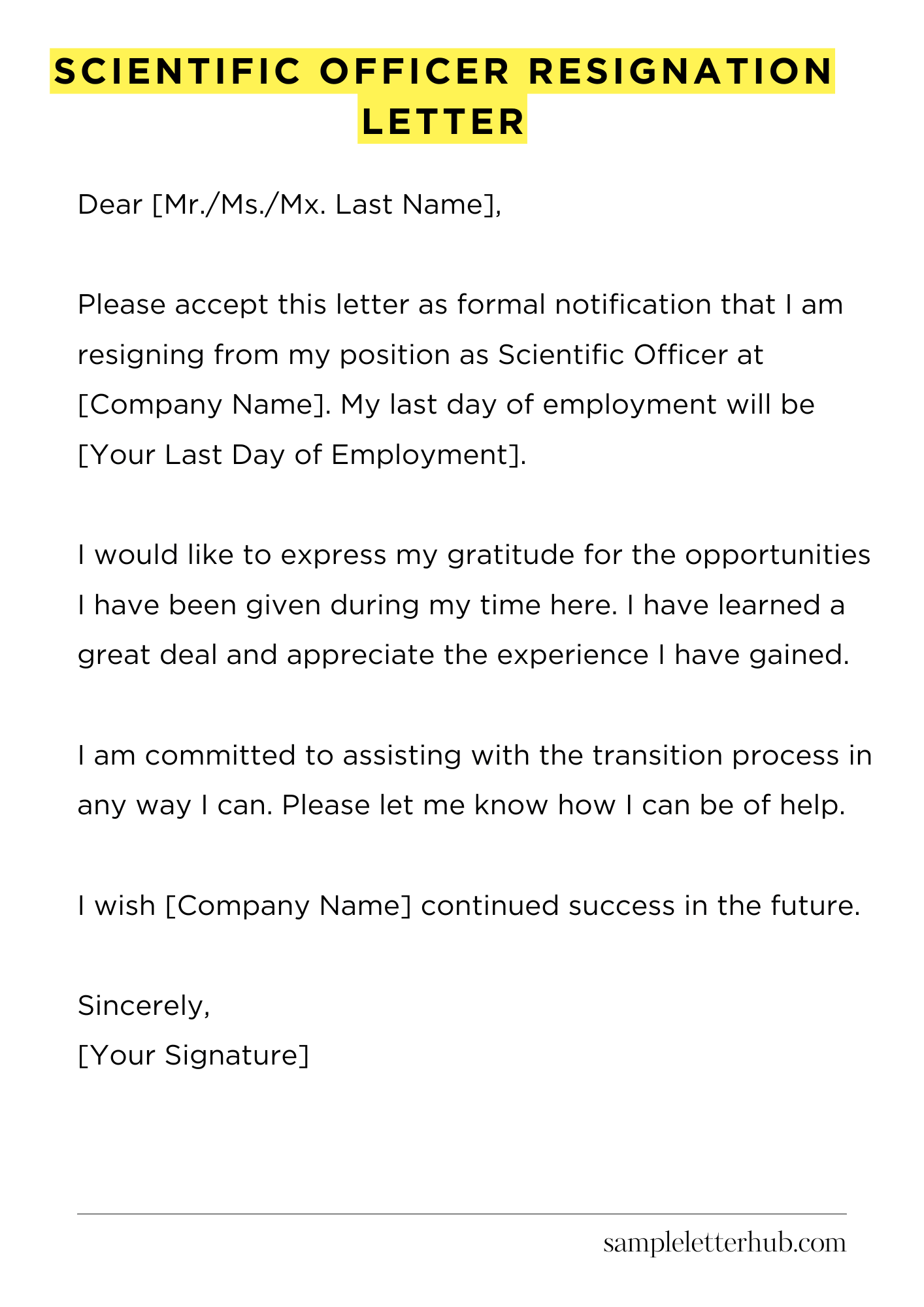
Dear [Mr./Ms./Mx. Last Name],
Please accept this letter as formal notification that I am resigning from my position as Scientific Officer at [Company Name]. My last day of employment will be [Your Last Day of Employment].
I would like to express my gratitude for the opportunities I have been given during my time here. I have learned a great deal and appreciate the experience I have gained.
I am committed to assisting with the transition process in any way I can. Please let me know how I can be of help.
I wish [Company Name] continued success in the future.
Sincerely,
[Your Signature]
How to Write a Scientific Officer Resignation Letter
So, you’re ready to move on. You’ve made a big decision and now you need to put it in writing: a resignation letter. This is a crucial document. You want to leave a positive impression, even when you’re exiting the scene. For Scientific Officers, this is especially important because their professional reputation is key. Let’s get you started on crafting a great resignation letter.
1. Keep it Short and Sweet (But Complete)
Your resignation letter isn’t a novel. It’s a formal communication. Think brevity. Keep it concise. This letter should be direct, to the point. It doesn’t need to be overly elaborate. The goal is to clearly state your intention to resign and the effective date. Always. Make sure all the necessary details are present.
Here’s what you **MUST** include:
- Your intention to resign. This is the headline, literally.
- The date of your resignation. Be clear about the exact date you will be leaving.
- A professional closing. Such as “Sincerely” or “Respectfully”.
Optional but advisable: Mention the title of your role.
2. The Tone Matters: Professionalism is Key
Think of this as a final performance. Make it a good one! You want to maintain a professional tone throughout. Avoid any negativity. Even if you’ve had a bad experience, now is not the time to air grievances. Keep the language polite and respectful. Steer clear of slang. Your goal is to leave on good terms, preserving future opportunities.
Here’s a good example: “I am writing to formally resign from my position as Scientific Officer, effective [Date].” It’s clear, direct, and doesn’t leave room for misinterpretation.
3. Express Gratitude (A Touch of Class)
While you don’t need to gush, showing some appreciation can go a long way. Briefly acknowledging the opportunities you’ve had or what you’ve learned can be a smart move. It demonstrates maturity and leaves a positive impression. It also subtly reinforces your professional demeanor. Remember, it can open doors in the future.
Consider this sentence: “I am grateful for the opportunities I have been given during my time here and for the experience I’ve gained.” A simple sentence like this will suffice.
4. Offer to Help with the Transition (Show Initiative)
This is where you go above and beyond. Offering assistance with the transition shows that you’re committed to a smooth handover. This demonstrates a strong work ethic. It also minimizes any potential disruption to the workplace. Offer your assistance in training your replacement or completing any pending tasks.
Add a sentence like this: “I am happy to assist in training my replacement and ensure a smooth handover of my responsibilities.”
5. Proofread, Proofread, Proofread! (Perfection Matters)
Before you send it, proofread! Proofread again. The last thing you want is for a typo or grammatical error to undermine your professionalism. Double-check the date, your name, and the recipient’s name. A clean, error-free letter reflects attention to detail – a quality often essential for Scientific Officers.
Ask a colleague or friend to review it as a fresh pair of eyes often catches things you might miss. It is always helpful.
FAQs about Scientific Officer resignation letter
How much notice should I give in my resignation letter?
The standard notice period for a Scientific Officer resignation is usually determined by your employment contract or company policy. This is typically between two weeks and one month. Review your employment agreement to ascertain the required notice period. Adhering to this timeframe is crucial to maintain a professional standing.
What key information should be included in my resignation letter?
Your resignation letter should include a clear statement of your intention to resign, the effective date of your resignation, and a brief expression of gratitude for the opportunity to work at the organization.
It’s often beneficial to state your role and department to avoid any confusion. Consider adding a sentence thanking your colleagues and mentioning a handover plan, if applicable. Keep the tone professional.
Should I provide a reason for my resignation in the letter?
While you are not obligated to provide a reason for your resignation, it can be advantageous to briefly state the reason. If you’re leaving for a better opportunity, you can mention this in a neutral way. If you have any serious grievances, it’s generally best to address them separately through HR. This allows you to maintain a professional image and enables a smooth transition.
Can I request a reference in my resignation letter?
Yes, it’s appropriate to request a reference in your resignation letter, if you wish. You can include a simple sentence expressing your interest in a reference and thanking the employer for considering providing it. Keep in mind that the provision of a reference is at the employer’s discretion. Ensure you have positive contributions at the company.
How should I handle the handover of my responsibilities?
Your resignation letter may mention your willingness to assist with the handover process. This includes providing a detailed plan, documenting ongoing projects, and training your replacement. It is professional and facilitates a smooth transition. Coordinate with your manager to arrange the handover and ensure all crucial tasks are properly transferred before your departure.
Related:
Resignation letter due to rude boss
Resignation letter moving to another state
Resignation letter due to illness of family member
Resignation letter due to study