

A “Mortgage Underwriter resignation letter” is a formal document. It is written by a mortgage underwriter. Its purpose is to officially announce their departure from a company. This letter informs the employer of the underwriter’s resignation.
Are you a mortgage underwriter planning to move on? Writing a resignation letter can feel tricky. We’re here to help! We will share templates and examples. These samples will guide you.
Our goal is to make it easy. We’ll provide different letter examples. This allows you to customize your own letter. Find a style that fits your situation perfectly.
Mortgage Underwriter Resignation Letter
Below is a sample of a Mortgage Underwriter Resignation Letter:
[Your Name]
[Your Address]
[Your Phone Number]
[Your Email Address]
[Date]
[Hiring Manager Name] (If known, otherwise use title)
[Hiring Manager Title]
[Company Name]
[Company Address]
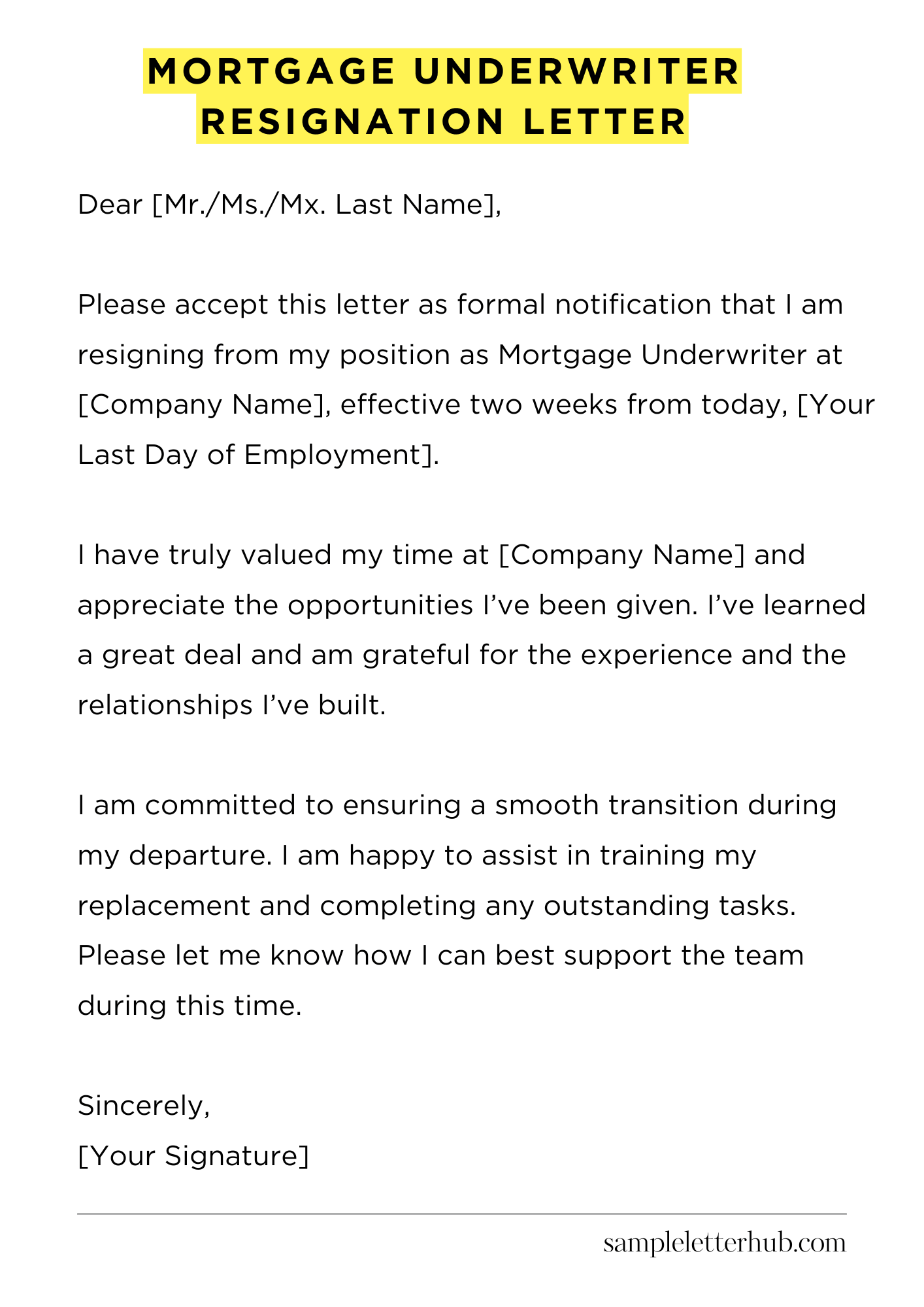
Dear [Mr./Ms./Mx. Last Name],
Please accept this letter as formal notification that I am resigning from my position as Mortgage Underwriter at [Company Name], effective two weeks from today, [Your Last Day of Employment].
I have truly valued my time at [Company Name] and appreciate the opportunities I’ve been given. I’ve learned a great deal and am grateful for the experience and the relationships I’ve built.
I am committed to ensuring a smooth transition during my departure. I am happy to assist in training my replacement and completing any outstanding tasks. Please let me know how I can best support the team during this time.
Thank you again for the opportunity to work at [Company Name]. I wish you and the company continued success in the future.
Sincerely,
[Your Signature]
How to Write a Mortgage Underwriter Resignation Letter
Resigning from any job can feel like a monumental task. Especially when dealing with the intricacies of finance! Crafting a resignation letter, particularly as a Mortgage Underwriter, is no exception. This document needs to be professional, clear, and concise. After all, you want to leave a positive lasting impression. Here’s a guide to help you do just that.
1. Keep it Simple: The Basic Structure
Your resignation letter doesn’t need to be overly complicated. Stick to a simple, easily understood format. Start with your name, address, and contact information. Then, include the date. Next, address your letter to the appropriate person, usually your direct supervisor or HR department. Use a professional salutation like “Dear [Manager’s Name]”.
The core of the letter should include a clear statement of your resignation. Explicitly state you’re resigning from your position as a Mortgage Underwriter. Mention your last day of employment. This is crucial for HR and payroll purposes. Finally, close with a professional closing like “Sincerely” or “Respectfully” and your typed name.
2. The Body of Your Letter: Key Information
The body of your letter is where you communicate your intentions. Begin by clearly stating your resignation. For instance, “Please accept this letter as formal notification that I am resigning from my position as Mortgage Underwriter at [Company Name].”
Next, state your last day of employment. This is non-negotiable and provides your employer with sufficient notice. “My last day of employment will be [Date].”
You may, optionally, include a brief, positive statement. Expressing gratitude is always a good idea. A short sentence acknowledging your experience can be very helpful. “I appreciate the opportunities I’ve been given during my time here” or “I am grateful for the experience I’ve gained”. Don’t feel obligated to overshare. Keep it brief.
3. Reasons for Resigning: To Share or Not to Share?
Do you need to provide a reason for leaving? Not necessarily! While you are not obligated to explain why you are leaving, you could briefly include one. If you are comfortable sharing your reasons, keep it concise and positive. Maybe it is for a new job or to pursue different opportunities, but never bad mouth anyone or company.
Examples: “I have accepted a new position that aligns with my long-term career goals.” Or, “I am pursuing a new opportunity.” Keeping it neutral avoids unnecessary complications.
If you prefer not to disclose your reasons, that’s perfectly acceptable. Focus on the positive aspects of your departure. A simple “Thank you for the opportunity” can suffice.
4. Proofread, Proofread, Proofread: Accuracy Matters!
Before you send your letter, make sure you proofread it! Ensure there are no spelling errors, grammatical mistakes, or typos. This reflects professionalism and attention to detail. This is very important. This is your exit from the company, so you want to leave an amazing impression.
Read the letter aloud to yourself. Ask a friend or colleague to review it as well. A fresh pair of eyes can often catch errors that you might miss. Consider printing a copy and reviewing it on paper.
Double-check the date, company name, and the name of the person you’re addressing the letter to. Accuracy is essential!
5. Delivery and Follow-Up: The Final Steps
Once you’ve finalized your letter, decide how you will deliver it. Most companies accept a printed copy. Hand-delivering your letter in person to your supervisor is generally considered the most professional approach. If that is not possible, email is often acceptable.
After submitting your letter, be prepared for a response. Your supervisor may want to discuss your resignation. Be prepared to answer any questions calmly and professionally. Stick to the points you raised in the letter. Cooperate with any requests to facilitate a smooth transition. Be professional until the very end!
FAQs about Mortgage Underwriter Resignation Letter
What is the most important information to include in a mortgage underwriter resignation letter?
The most crucial components of a mortgage underwriter resignation letter include: a clear and concise statement of your intent to resign, the effective date of your resignation, a brief expression of gratitude to the employer (optional but recommended), and any necessary information regarding the handover of your current responsibilities and ongoing projects.
Be sure to follow company policy.
How far in advance should a mortgage underwriter submit their resignation letter?
The standard practice is to provide at least two weeks’ notice. However, this may vary depending on your employment contract, company policy, and the specific role. Always review your employment agreement to ascertain the required notice period. Providing more than the minimum notice period is often appreciated and can positively impact your professional reputation.
Should a mortgage underwriter explain the reason for leaving in the resignation letter?
While not mandatory, it is generally acceptable to briefly state the reason for leaving. You could opt for a general statement such as “to pursue other opportunities” or “for personal reasons.”
Avoid including any negative comments about your current employer or colleagues. If you have a particularly good relationship with your supervisor or HR, you may choose to provide a more specific, but still professional, explanation if you wish.
What should a mortgage underwriter do after submitting their resignation letter?
After submitting the letter, it’s vital to cooperate with your employer during the transition period. This includes assisting with the handover of your duties, training your replacement (if applicable), and completing any outstanding tasks. Be prepared to answer questions and provide necessary documentation.
Maintaining a professional and helpful attitude during this time is crucial. Ensure you understand and comply with any exit procedures.
Can a mortgage underwriter use a template for their resignation letter?
Yes, templates can be a helpful starting point. Numerous templates are available online. However, it is essential to customize the template to fit your specific situation and the requirements of your company.
Tailor the content to reflect your individual circumstances, including your job title, the date, and the specific effective date of your resignation. Proofread the letter carefully before submitting it to ensure accuracy.
Related:
Resignation letter due to rude boss
Resignation letter moving to another state
Resignation letter due to illness of family member
Resignation letter due to study