

A psychotherapist resignation letter is a formal document. It informs an employer about the therapist’s decision to leave their job. The letter officially ends the employment relationship. It also facilitates a smooth transition for both the therapist and the practice.
Crafting the perfect resignation letter can feel daunting. But don’t worry. We’ve got you covered. This article offers helpful templates. You’ll find a variety of examples. They’re designed to make writing your letter simple.
You’ll discover different letter formats. Each suits varying situations. Choose the one that best fits your needs. Use them as inspiration or a starting point. Let’s make this process easier for you.
Psychotherapist Resignation Letter
Below is a sample of a Psychotherapist Resignation Letter:
[Your Name]
[Your Address]
[Your Phone Number]
[Your Email Address]
[Date]
[Recipient Name]
[Recipient Title]
[Clinic/Organization Name]
[Clinic/Organization Address]
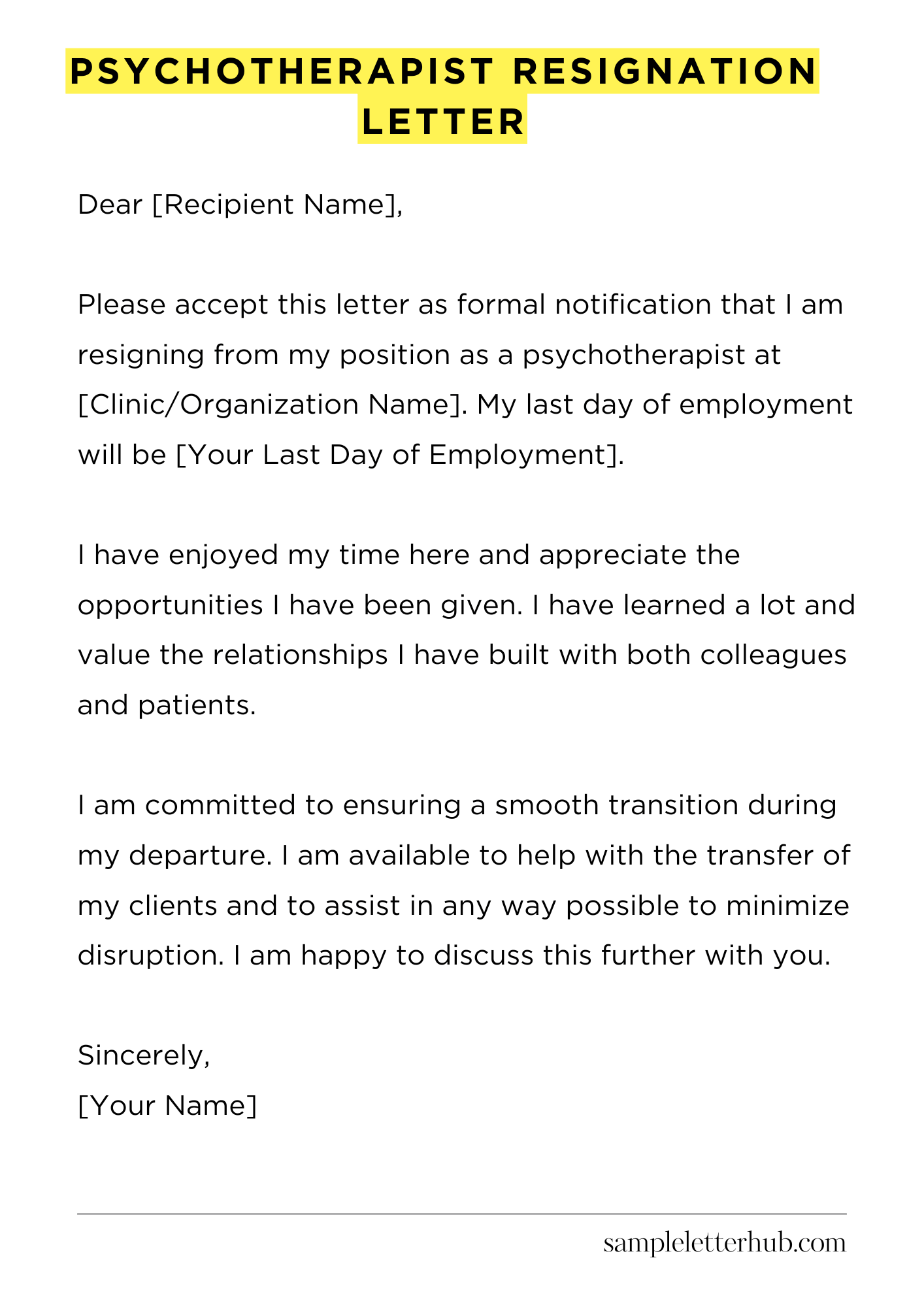
Dear [Recipient Name],
Please accept this letter as formal notification that I am resigning from my position as a psychotherapist at [Clinic/Organization Name]. My last day of employment will be [Your Last Day of Employment].
I have enjoyed my time here and appreciate the opportunities I have been given. I have learned a lot and value the relationships I have built with both colleagues and patients.
I am committed to ensuring a smooth transition during my departure. I am available to help with the transfer of my clients and to assist in any way possible to minimize disruption. I am happy to discuss this further with you.
Thank you for the experience. I wish you and [Clinic/Organization Name] all the best in the future.
Sincerely,
[Your Name]
How to Write a Psychotherapist Resignation Letter
1. Why Resign? Understanding the Context
Resigning from a position as a psychotherapist is a significant decision. You’ve likely spent a considerable amount of time and effort building your practice, and helping your clients. There are many reasons why a therapist might choose to move on.
These can range from personal reasons, like needing a change of pace or relocating, to professional ones, such as seeking better opportunities or experiencing burnout. It’s crucial to be clear on your motivations before you begin to write your resignation letter. That clarity will make the process easier and clearer.
Knowing your ‘why’ will guide the tone and content of your letter, allowing you to approach the task with a more informed perspective. Consider your individual circumstances very carefully, to ensure everything you write is aligned with your goals.
2. Essential Components: What to Include
Your resignation letter for a psychotherapist role, like any professional resignation, needs several key components. Start with a clear and concise statement of your intention to resign. This should include your official resignation date. Avoid any ambiguity. State your date of departure plainly and in a well-formatted way.
Next, express your gratitude for the opportunity to work there. Acknowledge any support you’ve received, and any positive experiences. Consider mentioning any specific skills you’ve gained or contributions you’ve made. This shows professionalism and respect. Finally, be sure to offer assistance with the transition process.
This may involve helping to transfer client records, or assisting with the hand-off to your replacement. A well-crafted letter should create a good impression.
3. Maintaining Professionalism: Tone and Language
Professionalism is paramount. Use a formal tone and avoid overly emotional language. Keep your language clear, concise, and respectful. Steer clear of any negative comments about your employer, colleagues, or clients.
Even if you’ve had negative experiences, it’s best to keep those to yourself. Focus instead on the positive aspects of your employment, and your future goals. Proofread your letter carefully for any grammatical errors or typos.
This helps to maintain your credibility. Remember, you want to leave a positive lasting impression. Your letter is a reflection of your professional identity.
4. Addressing Client Confidentiality and Transition
Client confidentiality is of utmost importance in the field of psychotherapy. You need to address how your clients will be transitioned to other therapists. State your willingness to collaborate with the practice to ensure a smooth transition for your clients. Suggest a plan for managing client records and any ongoing therapy sessions.
It is the ethical responsibility to handle this appropriately. Outline your involvement in notifying clients of your departure. Provide information about how clients can continue receiving care. This is a critical step in preserving patient care and maintaining ethical standards.
Make certain you follow any specific guidelines from your employer regarding client transition policies. Consult your supervising therapist or relevant professionals if you’re uncertain about any aspects of these requirements.
5. Sample Letter and Customization
Here’s a basic template for a psychotherapist resignation letter. Remember to personalize it to fit your specific circumstances.
[Your Name]
[Your Address]
[Your Phone Number]
[Your Email Address]
[Date]
[Employer’s Name]
[Employer’s Title]
[Practice Name]
[Practice Address]
Dear [Employer’s Name],
Please accept this letter as formal notification that I am resigning from my position as psychotherapist at [Practice Name]. My last day of employment will be [Your Last Day of Employment].
I am grateful for the opportunities I have been given during my time here. I want to express my gratitude for my time here, and wish you all the best. I am happy to help ensure the transition of my clients to another therapist. Please let me know how I can help in the process of transferring my client’s records and any further details.
Thank you again for the opportunity to work here. I wish you and [Practice Name] all the best in the future.
Sincerely,
[Your Signature]
[Your Typed Name]
Use this template as a guide. Customize it by adding specifics about your experiences, and your plans. Tailor the language to reflect your relationship with your employer. Most importantly, ensure it communicates your intentions professionally and respectfully. Your resignation letter is a crucial part of the process, and this template provides a great start. Good luck!
FAQs about Psychotherapist resignation letter
Why is a formal resignation letter necessary for a psychotherapist?
A formal resignation letter serves multiple crucial purposes. Firstly, it provides a written record of your intent to leave your position, protecting both you and your employer. This establishes a clear date of departure, avoiding any ambiguity. Secondly, it initiates the formal process of your departure, which helps with the transfer of clients and administrative tasks.
Thirdly, it demonstrates professionalism and respect for your employer and colleagues, facilitating a positive departure and the potential for future professional relationships.
What essential information should be included in a psychotherapist resignation letter?
A comprehensive resignation letter should include: your full name and the date; a clear statement of your intent to resign from your position; the specific date of your last day of employment (typically allowing for a reasonable notice period, such as two to four weeks); a concise acknowledgment of your appreciation for the opportunity.
What is the appropriate notice period for a psychotherapist’s resignation?
The standard notice period for a psychotherapist typically ranges from two to four weeks. However, the exact duration should be stipulated in your employment contract or any applicable regulations. If there are any specifics, consult your contract.
Consider the importance of the continuity of care for your clients when determining your notice period, allowing sufficient time for client notification, referral, and transition. Longer notice periods are usually preferable if you have a significant caseload or are in a leadership position.
How should a psychotherapist address client transition in a resignation letter?
In your resignation letter, you can briefly acknowledge your commitment to facilitating a smooth transition for your clients. While not requiring extensive detail, it’s beneficial to mention your intention to work with the practice or organization to ensure their care continues uninterrupted.
This can include offering to assist with referrals to other therapists, providing necessary documentation, and adhering to ethical guidelines regarding client confidentiality and the handling of clinical records. Specify the methods you will use to help your clients.
What are the key ethical considerations when writing and submitting a resignation letter as a psychotherapist?
Ethical considerations are paramount. You must adhere to all confidentiality requirements related to client information, which are maintained even after your departure. Avoid including any client-specific details in your letter. Professionalism is crucial; maintain a respectful tone and refrain from making negative comments about the employer or colleagues.
Finally, ensure that your actions align with your professional licensing board’s standards and code of ethics. Provide appropriate, ethical, and helpful support to help your clients.
Related:
Resignation letter due to rude boss
Resignation letter moving to another state
Resignation letter due to illness of family member
Resignation letter due to study