

A legal trainee resignation letter is a formal document. It informs your employer of your intention to leave. It signals the end of your training period. This letter is a crucial step in concluding your legal training.
Feeling overwhelmed about writing it? Don’t worry, we’ve got you covered. We’ll explore various templates and examples. These examples will help you draft your own resignation letter. They cater to different situations.
Whether you’re moving on to a new opportunity or taking a different path, we provide options. Consider these samples as your starting point. Make use of the samples to create your perfect letter.
Legal Trainee Resignation Letter
Below is a sample of a Legal Trainee Resignation Letter:
[Your Name]
[Your Address]
[Your Phone Number]
[Your Email Address]
[Date]
[Name of Supervisor]
[Supervisor’s Title]
[Law Firm Name]
[Law Firm Address]
Dear [Mr./Ms./Mx. Last Name of Supervisor],
Please accept this letter as formal notification that I am resigning from my position as a Legal Trainee at [Law Firm Name]. My last day of employment will be [Your Last Day of Employment].
Thank you for the opportunity to learn and grow during my time here. I have gained valuable experience and knowledge that I will carry with me throughout my career. I appreciate the guidance and support I have received from you and the entire team.
I am committed to completing my current tasks and assisting with the smooth transition of my responsibilities before my departure. Please let me know if there is anything I can do to help during this process.
I wish you and [Law Firm Name] continued success in the future.
Sincerely,
[Your Signature]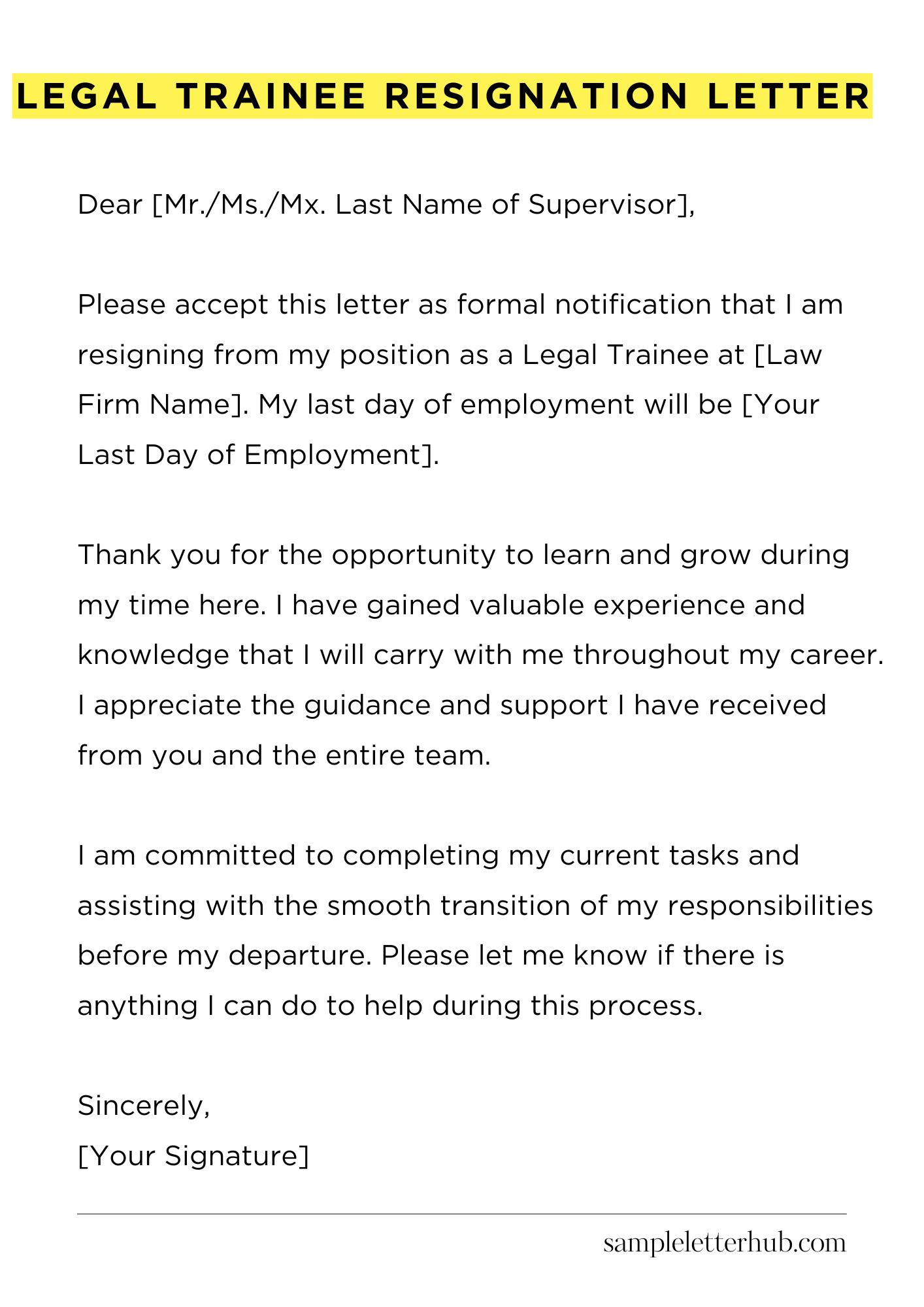
How to Write a Legal Trainee Resignation Letter
So, you’ve made the decision. You’re ready to move on from your legal trainee position. That’s great! Now you have to write a resignation letter. This is a critical step, but don’t worry, it’s manageable. This letter is more than just a formality; it is important.
1. Format is Key: Keep it Professional
First impressions matter, even when you’re leaving. Your letter should look clean and professional. Stick to a standard business letter format. Start with your contact information (name, address, phone number, and email) and the date.
Next, include the recipient’s contact information (your supervisor’s name and title, the law firm’s name, and address). Keep it concise and clear. Use a professional font like Times New Roman or Arial and a font size of 12.
2. The Core Message: State Your Intent Clearly
This is the most important part! State your intention to resign clearly and directly. Don’t beat around the bush. Use straightforward language. Start with a clear statement of resignation.
For example, “Please accept this letter as formal notification that I am resigning from my position as a Legal Trainee at [Law Firm Name], effective [Your Last Day of Employment].” This leaves no room for misunderstanding.
3. Express Gratitude (and a Little Diplomacy!)
Show some appreciation. Even if you haven’t enjoyed every minute, expressing gratitude is good practice. A few well-chosen words can go a long way. Thank your employer for the opportunity to learn and grow.
Mention any specific experiences or individuals you found particularly helpful. This is a chance to leave on a positive note. Remember to be sincere. Something like, “I am grateful for the opportunities I have been given during my time here and for the support I have received from my colleagues.”
4. Handle the Details: Notice Period and Handover
Know your obligations. Your employment contract will likely specify a notice period. Adhere to this. State the date of your last day of employment accurately. Also, mention your willingness to assist with the handover process.
This is the professional thing to do. Offer to help with the transition. Include something like, “I am committed to ensuring a smooth transition during my remaining time and am happy to assist in training my replacement or completing any outstanding tasks.”
5. Review and Revise: Proofread Carefully!
Before you hit send, read your letter. Proofread it carefully. Check for any grammatical errors, spelling mistakes, and typos. Make sure the tone is appropriate, and the message is clear. Ensure you are sending it to the right person.
Get a second pair of eyes to review it. Consider asking a friend or mentor to read it over. A polished letter reflects well on you. It shows professionalism and attention to detail. You want to leave a good impression, even as you move on!
FAQs about Legal Trainee resignation letter
Understanding the nuances of a legal trainee resignation letter is crucial for a smooth transition. Here are some of the most common questions regarding this topic, along with their answers.
What is the primary purpose of a Legal Trainee resignation letter?
The primary purpose of a legal trainee resignation letter is to formally notify the employer (law firm, legal department, etc.) of the trainee’s intent to leave their position. It serves as an official record of the resignation, ensuring both the trainee and the employer have documented proof of the termination of employment.
It also provides an opportunity to express gratitude, state the reason for leaving (if desired), and outline any remaining responsibilities or handover plans.
What key information should be included in a Legal Trainee resignation letter?
A well-crafted legal trainee resignation letter typically includes: the date of the letter, the trainee’s name and contact information, the employer’s name and address, a clear statement of resignation (including the effective date), a brief expression of gratitude for the opportunity, the reason for leaving (optional), any handover plans or outstanding tasks, and the trainee’s signature.
It’s also advisable to check the employment contract for any specific requirements regarding resignation letters.
How much notice should a Legal Trainee provide when resigning?
The required notice period for a legal trainee resignation is typically outlined in the employment contract or local labor laws. Common notice periods range from two weeks to one month. It is important to carefully review the contract to understand the specific obligations.
Providing the appropriate notice period ensures a professional departure and allows the employer sufficient time to find a replacement and manage the transition effectively.
Is it necessary to state the reason for resigning in the letter?
While not mandatory, it is often considered polite and professional to briefly state the reason for resigning. The reason can be as simple as “pursuing other opportunities” or “to further my legal education.”
However, the level of detail is at the trainee’s discretion. If the trainee is leaving due to dissatisfaction or grievances, they can choose to address it with their supervisor or HR separately, but it’s often best to keep the resignation letter concise and focused on the fact of leaving.
Should a Legal Trainee offer assistance with the handover process in the resignation letter?
Offering assistance with the handover process is generally a good practice. It demonstrates professionalism and a commitment to ensuring a smooth transition for the employer.
This could involve offering to train a replacement, completing outstanding tasks, or providing any relevant documentation. Clearly stating willingness to assist in the letter is a gesture that is often appreciated and can leave a positive impression.
Related:
Resignation letter due to rude boss
Resignation letter moving to another state
Resignation letter due to illness of family member
Resignation letter due to study