

So, you’re ready to move on from your customer service role? A customer service resignation letter is your official notice to your employer. It’s a formal document. Its purpose is to communicate your departure. It also states your last day of employment.
Writing this letter doesn’t have to be a headache. We’ve got you covered. This article offers helpful templates. We’ll also share sample letters. These examples will make the writing process easier. Crafting your resignation letter should be simple.
From simple formats to detailed examples, we have something for everyone. Whether you are aiming for brief or comprehensive, you can find the right example. Ready to bid farewell gracefully? Let’s get started.
Costumer Service Resignation Letter
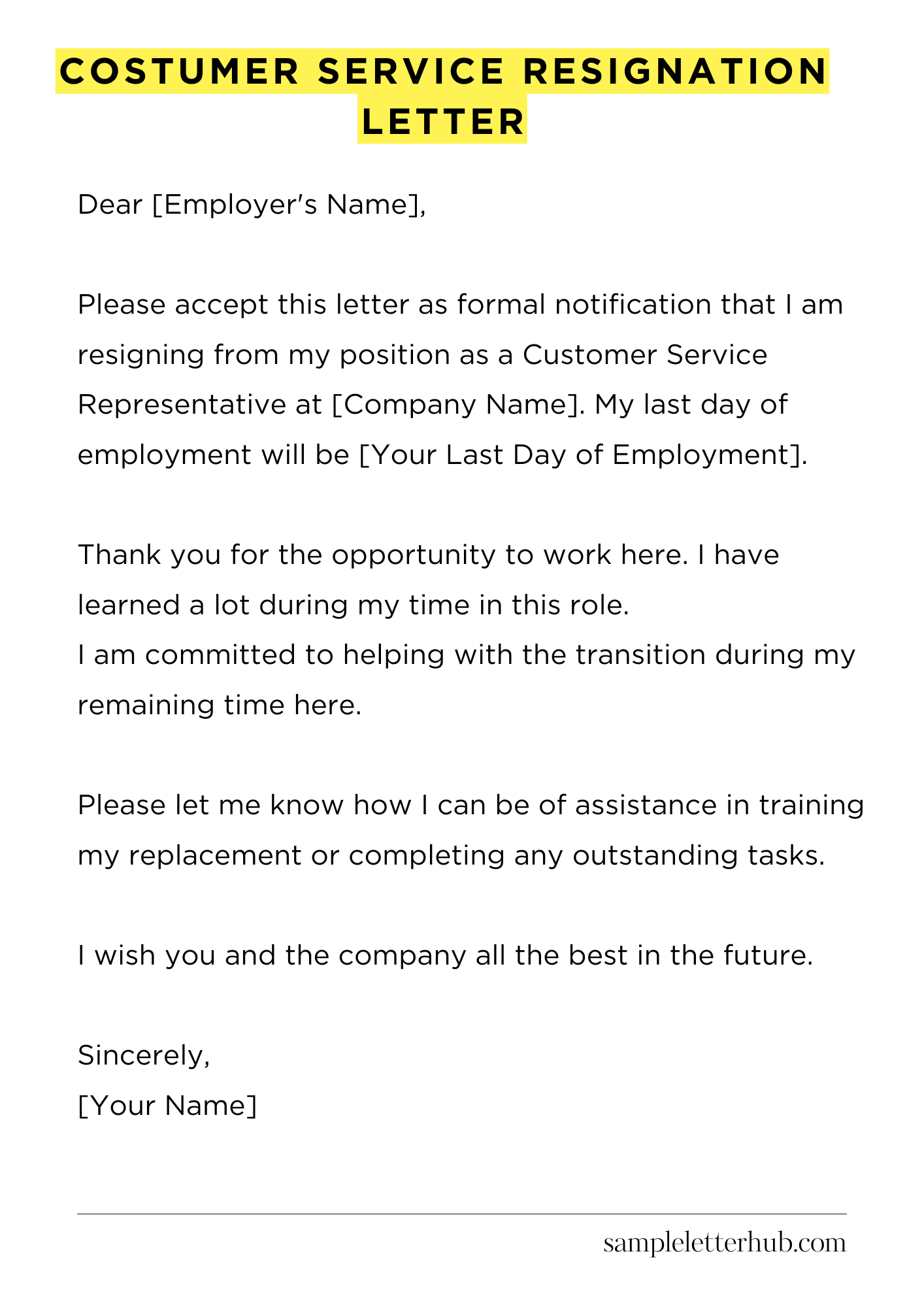
Below is a sample of a Costumer Service Resignation Letter:
[Your Name]
[Your Address]
[Your Phone Number]
[Your Email Address]
[Date]
[Employer’s Name]
[Company Name]
[Company Address]
Dear [Employer’s Name],
Please accept this letter as formal notification that I am resigning from my position as a Customer Service Representative at [Company Name]. My last day of employment will be [Your Last Day of Employment].
Thank you for the opportunity to work here. I have learned a lot during my time in this role.
I am committed to helping with the transition during my remaining time here. Please let me know how I can be of assistance in training my replacement or completing any outstanding tasks.
I wish you and the company all the best in the future.
Sincerely,
[Your Name]
How to Write a Customer Service Resignation Letter
So, you’re ready to move on. That’s good! You’ve decided to resign from your customer service role, and you need to craft a resignation letter. This is an important step; it’s your chance to end your employment professionally and leave a good impression. Let’s make sure you get it right. Here’s a guide to help you do just that.
1. Formatting Your Letter: Making a Good First Impression
First things first: the format. A well-formatted letter is a sign of respect and attention to detail. Always use a professional business letter format. This is crucial. Start with your contact information (your name, address, phone number, and email address) at the top, usually on the left-hand side.
Skip a line or two, and then add the date. Next, include your supervisor’s name and title, and the company’s address. Keep it simple and clear.
Use a standard font like Times New Roman or Arial, size 12. Stick to a single space. Make sure the letter is easy to read. A messy, poorly formatted letter can reflect badly on you, no matter what you write. Think of it as a preview of your work ethic.
2. The Core Content: What to Say (and Not Say)
Now for the substance. Your resignation letter needs to be concise and to the point. Start with a clear statement of your intention to resign. State your position and your last day of employment.
This is the absolute minimum requirement. For example: “Please accept this letter as formal notification that I am resigning from my position as Customer Service Representative, effective [Your Last Day of Employment].”
Keep your tone positive and professional. Avoid negativity, even if you had a less-than-ideal experience. It’s not the time to air grievances. If you want to thank your employer for the opportunity, that’s fine, but don’t feel obligated. Next, offer to assist with the transition. This is a common courtesy and can leave a positive lasting impression.
If you are willing to help train your replacement or complete any ongoing tasks, say so. This shows responsibility and willingness to help.
Finally, end the letter with a professional closing, such as “Sincerely,” or “Respectfully,” followed by your typed name. Sign the letter by hand if possible, above your typed name. You want to make it look personal, even though you are sending out an official letter.
3. Key Elements: What to Include and Why
Several elements are non-negotiable in your letter. First, and most importantly, is your clear statement of resignation, along with the date of your departure. Next, consider a brief thank you to your employer. It’s a nice touch and shows gratitude. Then, offer your assistance with the transition. The reason is this highlights your professionalism and can ease the hand-off process.
Also, make sure the language is professional. Avoid slang, jargon, or overly casual language. Proofread your letter carefully for any errors in grammar or spelling before sending it. Finally, keep a copy for your records.
4. The Importance of Professionalism: Leaving a Positive Legacy
Your resignation letter is more than just a formality; it’s a representation of you. It’s your last official communication as an employee. A well-written letter can enhance your reputation and potentially open doors in the future.
In the professional world, you never know when you might cross paths with former colleagues or employers again. So, make sure your final communication reflects the kind of person you want to be known as.
A positive letter shows that you are responsible, respectful, and able to handle difficult situations gracefully. It can also make it easier for your former employer to provide a positive reference in the future.
5. Putting it all Together: The Final Checklist
Let’s make sure you’ve got everything covered. Before you hit send, use this final checklist:
- Format: Is it a professional business letter format?
- Clarity: Is your intention to resign and last day of employment clear?
- Tone: Is your tone positive and professional?
- Content: Did you include an offer to help with the transition?
- Accuracy: Have you proofread for any errors in grammar or spelling?
- Copies: Did you keep a copy of the letter for your records?
- Delivery: Are you sending the letter to the correct person?
By following these steps, you can create a customer service resignation letter that is professional, respectful, and leaves a positive lasting impression. Good luck with your future endeavors!
FAQs about Customer Service Resignation Letters
How do I write a customer service resignation letter?
A customer service resignation letter typically includes these key elements:
- A clear statement of your intention to resign.
- Your last day of employment.
- A brief expression of gratitude for the opportunity.
- (Optional) A brief and neutral reason for leaving.
- Your contact information.
Keep it professional and concise. Avoid negative comments about the company or colleagues.
What should I include in my customer service resignation letter?
Besides the basics outlined above, consider including these points:
- Your full name and employee identification number (if applicable).
- Your direct supervisor’s name.
- A sincere expression of thanks for the experience and the skills you’ve gained.
- An offer to assist with the transition of your duties (if you are willing and able).
- A professional closing.
What are some common mistakes to avoid in a customer service resignation letter?
Common pitfalls include:
- Being overly emotional or negative.
- Including personal grievances or complaints.
- Giving too much detail about your reasons for leaving.
- Burning bridges with the company.
- Not providing enough notice (typically two weeks, but check your employment contract).
Maintaining a professional tone throughout the letter is crucial.
How much notice should I give when resigning from a customer service role?
The standard practice is to provide at least two weeks’ notice. However, this can vary based on your employment contract, company policy, and local labor laws. Always review your employment agreement to determine the required notice period. If you are unsure, err on the side of caution and give two weeks’ notice.
Can I use a template for my customer service resignation letter?
Yes, using a template can be a good starting point. Many templates are available online. However, customize the template to fit your specific situation and personalize it to reflect your role and experience. Make sure to proofread the letter carefully before submitting it.
Related:
Resignation letter due to rude boss
Resignation letter moving to another state
Resignation letter due to illness of family member
Resignation letter due to study