

A Business Unit Manager resignation letter is a formal document. It informs your employer of your intention to leave your position. The letter also states your last day of employment. It’s a crucial step in ending your employment professionally.
Crafting the perfect resignation letter can be tricky. We’ve got you covered. This article offers several templates. We’ll give you examples of different scenarios. You can customize them to fit your specific needs.
These samples simplify the process. They save you time and effort. Whether you’re moving on or retiring, these letters will help. Write your resignation with confidence and ease.
Business Unit Manager Resignation Letter
Below is a sample of a Business Unit Manager Resignation Letter:
[Your Name]
[Your Address]
[Your Phone Number]
[Your Email Address]
[Date]
[Hiring Manager Name] (If known, otherwise use title)
[Hiring Manager Title]
[Company Name]
[Company Address]
Dear [Mr./Ms./Mx. Last Name],
Please accept this letter as formal notification that I am resigning from my position as Business Unit Manager at [Company Name], effective [Your Last Day of Employment].
I have enjoyed my time at [Company Name] and appreciate the opportunities I have been given. I am grateful for the experience and knowledge I have gained during my employment.
I am committed to ensuring a smooth transition during my departure. I am happy to assist in training my replacement and completing any necessary handover tasks. Please let me know how I can best support the company during this period.
I wish you and [Company Name] all the best for the future.
Sincerely,
[Your Signature]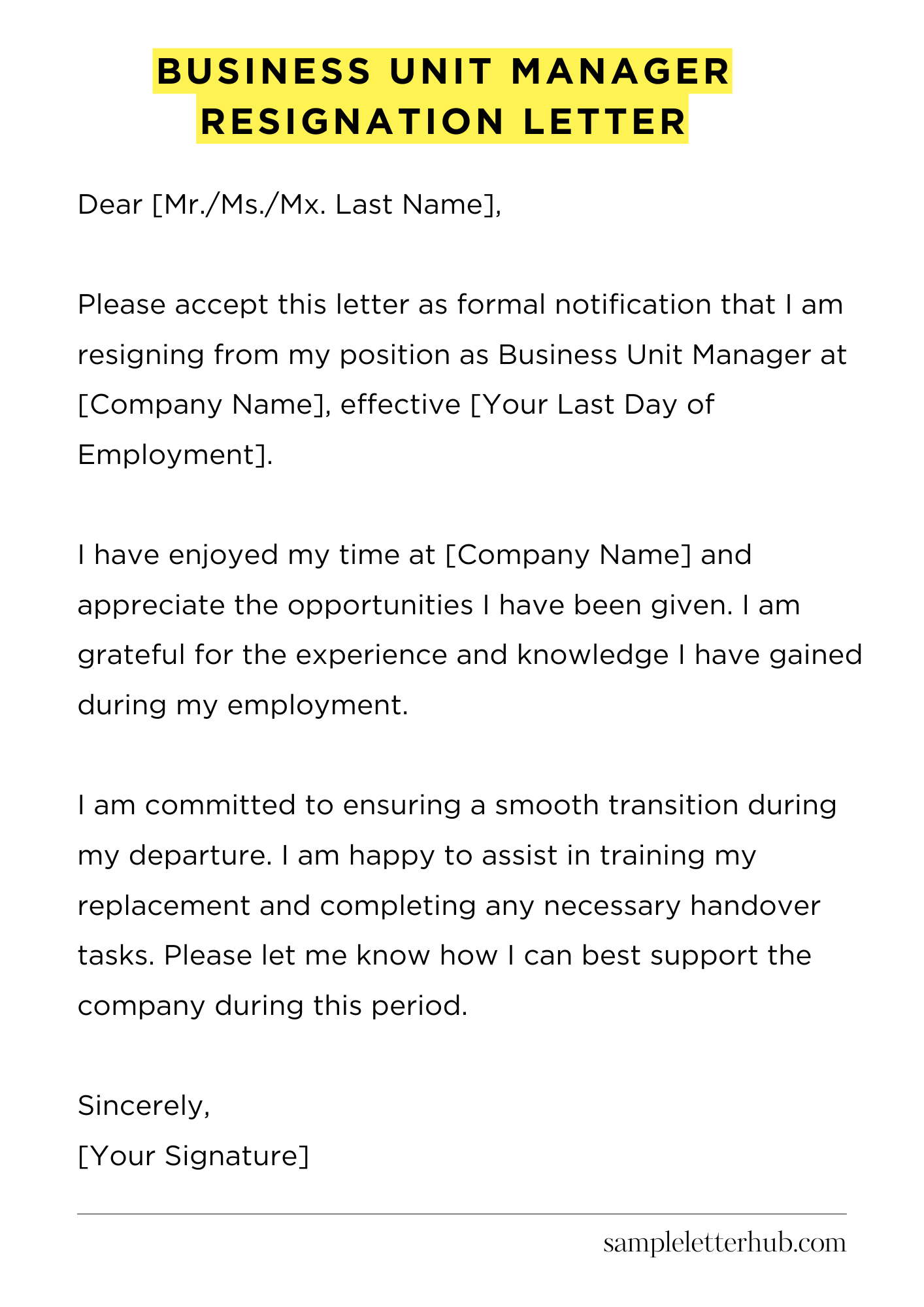
How to Write a Business Unit Manager Resignation Letter
1. The Core Components: What You Absolutely Need
Resigning from a Business Unit Manager position is a significant step. You need a well-crafted resignation letter to ensure a smooth transition. This letter, first and foremost, must be professional. It should also be clear. Begin with your formal notice. Clearly state your intention to resign from your role. Include the effective date of your resignation.
This is the last day you will be employed. Then, briefly, and I mean briefly, express your gratitude for the opportunity. You don’t want to get into a huge amount of detail here. Also, include your contact information for any follow-up.
2. Maintaining Professionalism: Tone and Style
Professionalism is key in a resignation letter. Avoid negativity and complaints, even if you have legitimate grievances. Keep the tone respectful and positive. The language should be clear and concise. Do not use slang or overly casual language. Focus on the facts. The letter is a formality, not a venting session.
Think of your future career. Maintain a positive impression, as this letter will become part of your permanent record. Proofread thoroughly! Spelling and grammar errors reflect poorly on you. This is essential, no matter how good you are at your job.
3. Key Elements: Specifics to Consider
While brevity is vital, include certain specifics. Your job title should be accurately stated. Also, the date you’re writing this letter is important, as is the name of your company. Address the letter to your direct supervisor or the appropriate HR representative. You might offer assistance with the transition.
It can be a very gracious gesture. Think about offering help to train your replacement. Specify the number of days of notice you are giving, typically two weeks. Make sure to keep the letter within one page. You don’t want to overwhelm the reader.
4. Tailoring Your Letter: Examples and Customization
You can find plenty of templates online, but personalize your letter. It should reflect your specific situation. Modify it to match your experiences at the company. For example, mention any significant projects you were involved in. Also, add a sentence about what you learned. This makes it more personalized.
You can also modify the expressions of gratitude to match your interactions with the company. Be authentic and sincere. Remember, it should sound like your own voice. Avoid generic phrasing.
5. After Submission: Final Steps and Future Considerations
After you submit your letter, follow up with your supervisor. This may involve a face-to-face meeting. This is a chance to discuss your departure. Be prepared for any questions they might have.
Keep all communication professional and courteous. Also, remember to collect any relevant documents. Make sure you return all company property. Finally, ensure all your final pay and benefits details are taken care of before you leave. This helps ensure a smooth transition. Keep a copy of your resignation letter for your personal records.
FAQs about Business Unit Manager Resignation Letter
What is the primary purpose of a Business Unit Manager’s resignation letter?
The primary purpose of a Business Unit Manager’s resignation letter is to formally notify their employer of their intent to leave their position. It serves as an official record of the resignation, the effective date, and often includes expressions of gratitude or any handover plans.
What key elements should be included in a Business Unit Manager’s resignation letter?
Essential elements include a clear statement of resignation, the effective date of the resignation, the position held (Business Unit Manager), and often a brief statement of gratitude or thanks to the company or specific individuals. It is also customary to offer assistance with the transition period, if applicable.
Should a Business Unit Manager explain the reasons for their resignation in the letter?
While not strictly required, a Business Unit Manager can briefly state their reason for leaving. This can be as simple as “pursuing other opportunities” or “to focus on personal commitments”. It is generally recommended to keep the reasons concise and avoid negative comments about the company or colleagues.
How much notice should a Business Unit Manager provide when resigning?
The amount of notice required typically depends on the employment contract or company policy. A common timeframe is two weeks, but it may be longer for managerial roles. Review your employment agreement or consult with your HR department to determine the appropriate notice period.
What are some best practices for a Business Unit Manager when submitting their resignation letter?
Best practices include submitting the letter in writing (typically electronically), providing the letter to the appropriate person (usually the direct supervisor or HR), and retaining a copy for personal records.
Maintain a professional and courteous tone throughout the letter, and be prepared to assist with the handover process. Also, it’s advisable to be prepared to answer any questions about the resignation.
Related:
Resignation letter due to rude boss
Resignation letter moving to another state
Resignation letter due to illness of family member
Resignation letter due to study