

A Tax Analyst resignation letter is a formal document. Its main purpose is to notify an employer of your intent to leave your job. It clearly states your last day of employment. This letter is crucial for a smooth departure.
Crafting the perfect resignation letter can be tricky. We’re here to help. This article provides helpful templates and examples. Use these samples as your guide. They will simplify your writing process.
We understand the importance of making a good impression. Our examples cover different scenarios. Whether you’re moving on or retiring, we’ve got you covered. These samples are here to make your resignation process easier.
Tax Analyst Resignation Letter
Below is a sample of a Tax Analyst Resignation Letter:
[Your Name]
[Your Address]
[Your Phone Number]
[Your Email Address]
[Date]
[Hiring Manager Name] (If known, otherwise use title)
[Hiring Manager Title]
[Company Name]
[Company Address]
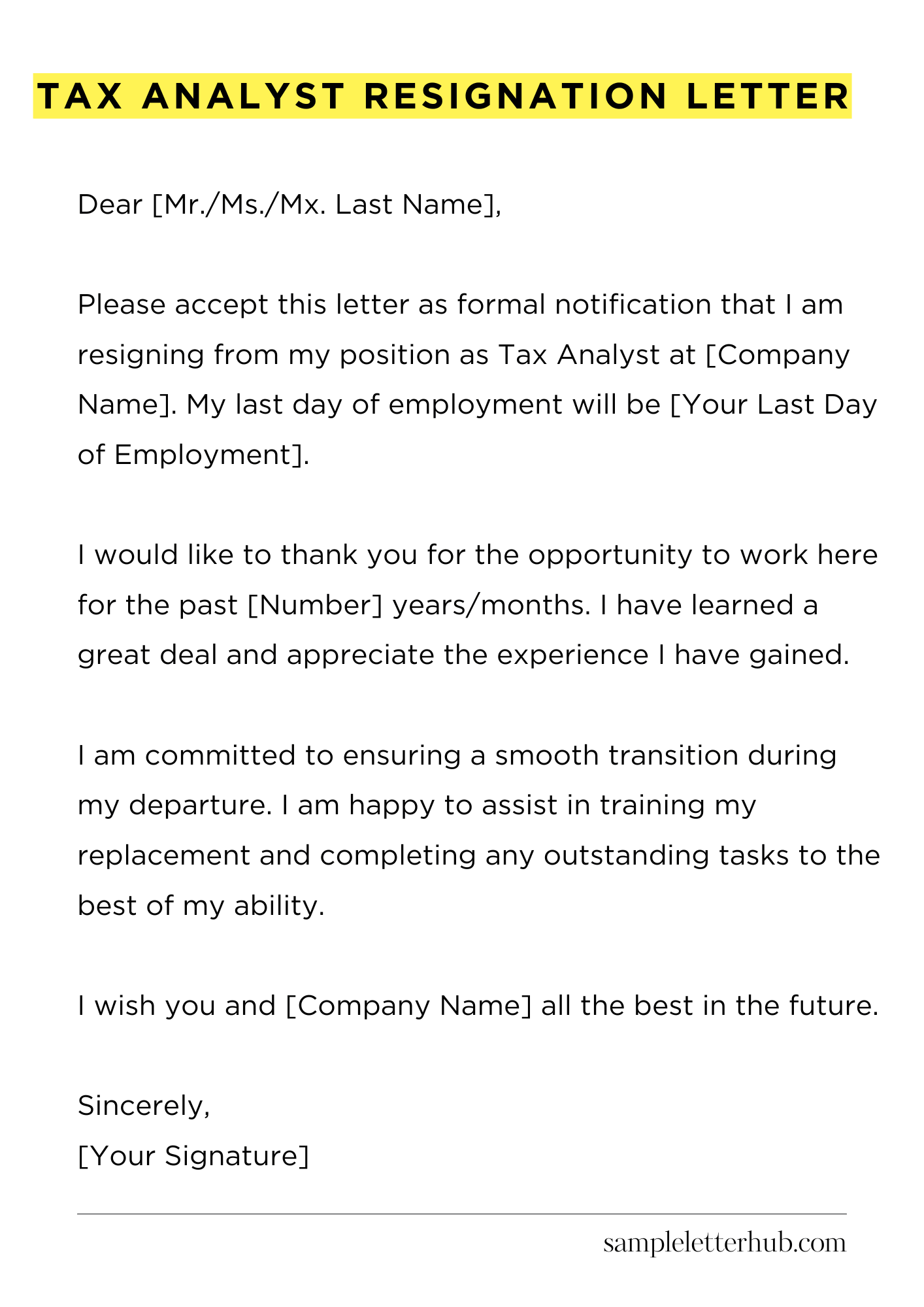
Dear [Mr./Ms./Mx. Last Name],
Please accept this letter as formal notification that I am resigning from my position as Tax Analyst at [Company Name]. My last day of employment will be [Your Last Day of Employment].
I would like to thank you for the opportunity to work here for the past [Number] years/months. I have learned a great deal and appreciate the experience I have gained.
I am committed to ensuring a smooth transition during my departure. I am happy to assist in training my replacement and completing any outstanding tasks to the best of my ability.
I wish you and [Company Name] all the best in the future.
Sincerely,
[Your Signature]
How to Write a Tax Analyst Resignation Letter
So, you’re ready to move on. You’ve made a decision. You’re leaving your role as a Tax Analyst, and now it’s time to write that all-important resignation letter. Don’t worry; it doesn’t have to be a daunting task.
With a little planning and attention to detail, you can craft a professional and respectful letter that leaves a positive lasting impression. This is a crucial step in your career journey. Here’s how to do it right.
1. Keep it Concise and Clear
First things first: brevity is key. A resignation letter should be straightforward and to the point. No need for lengthy explanations or elaborate stories. Your main goal is to inform your employer of your decision and your last day of employment. Start with a direct statement of your intent to resign from your position as Tax Analyst.
State the effective date of your resignation clearly. This is essential for HR and payroll purposes. Make sure it’s correct. Also, stick to the facts. Avoid overly emotional language, even if you’re unhappy. Simple and professional is always the best approach.
2. Express Gratitude and Professionalism
Even if your time at the company wasn’t perfect, it’s vital to maintain a professional tone. Expressing gratitude is a great idea. Thank your employer for the opportunity to work there. You can mention any specific experiences or skills you gained while working as a Tax Analyst.
This shows respect for the company and demonstrates that you value the experience. It leaves a positive note. Remember that you may need a reference from this company in the future. Keep the door open for possible future opportunities. A gracious exit can be beneficial.
3. Provide Necessary Information
There are some practical things to include in your resignation letter. It is useful to offer assistance with the transition. Offer to help train your replacement, if possible.
This is not always a requirement, but it shows your commitment and professionalism. Include your contact information. This makes it easy for the company to reach you if needed during the transition period. Include your personal email, just in case.
4. Format and Tone for Success
Your letter should be well-formatted. Use a professional business letter format. Include the date, the recipient’s name and title, and your name. Proofread carefully.
Check for any grammatical errors or typos before sending. Ensure your tone is polite and respectful throughout the letter. Avoid any negative comments about your current role or the company. Maintain a positive attitude. This will help maintain a good professional relationship. It’s also important to sign your name and provide a typed name below the signature.
5. Review and Submit Strategically
Before sending your resignation letter, take a final look. Read it carefully to ensure everything is correct. Make sure you’ve included all the necessary information. Once you’re satisfied, submit the letter to your supervisor or HR department. Adhere to your company’s policy for submitting resignations. In most cases, it is via email or physical delivery.
Ensure you keep a copy for your records. Remember, your resignation letter is a formal document. It is a part of your professional record. By following these steps, you can write a Tax Analyst resignation letter that reflects well on you. Now you can move forward with confidence!
FAQs about Tax Analyst resignation letter
How do I start a Tax Analyst resignation letter?
Begin your resignation letter professionally. Start with a clear and concise statement of your intent to resign, including your name, the date, and the recipient’s name and title. State your last day of employment. For example: “Please accept this letter as formal notification that I am resigning from my position as Tax Analyst at [Company Name], effective [Your Last Day of Employment].”
What should I include in the body of a Tax Analyst resignation letter?
In the body of your letter, briefly express your gratitude for the opportunities and experiences you’ve gained during your employment. Mention any specific skills or knowledge you’ve developed. You might also want to briefly explain your reason for leaving, but this is optional.
Keep it brief and positive, focusing on the future and not on any negative aspects of your current role. Offer to assist with the transition of your duties and provide your contact information for any follow-up questions.
What is the proper format for a Tax Analyst resignation letter?
The format should be professional. Use a standard business letter format. Start with your contact information (name, address, phone number, email) at the top, followed by the date, and then the recipient’s information (name, title, company, address). Use a formal salutation (e.g., “Dear Mr./Ms. [Last Name]”).
The body of the letter should be clear, concise, and professional. Close with a professional closing (e.g., “Sincerely,” or “Respectfully,”) and your typed name.
What information regarding benefits should I mention in my resignation letter?
Your resignation letter doesn’t need to specify benefits information. Mentioning specific benefits in your letter isn’t necessary. However, it’s wise to request information regarding final paychecks, accrued vacation time, and COBRA or other benefits continuation. This can often be addressed separately in a conversation with HR or a manager after submitting your letter.
How should I end my Tax Analyst resignation letter?
End your letter with a professional closing and your typed name. A simple “Sincerely,” or “Respectfully,” followed by your typed name is standard. It is wise to thank the employer for the opportunity, and then offer your assistance during the transition period.
If you have contact information that you want to share with the company to communicate after you leave, you can add it at the bottom.
Related:
Resignation letter due to rude boss
Resignation letter moving to another state
Resignation letter due to illness of family member
Resignation letter due to study