

A Chief Operations Officer (COO) resignation letter is a formal document. It announces a COO’s decision to leave a company. The letter officially ends their employment. It also provides key details about the departure.
Crafting this letter can seem daunting. This article simplifies the process. We provide various templates and examples. They cover different scenarios. These samples make writing your resignation easier.
Need help expressing yourself clearly? Our examples offer a solid starting point. Customize them to fit your specific situation. We’ve got you covered.
Chief Operations Officer Resignation Letter
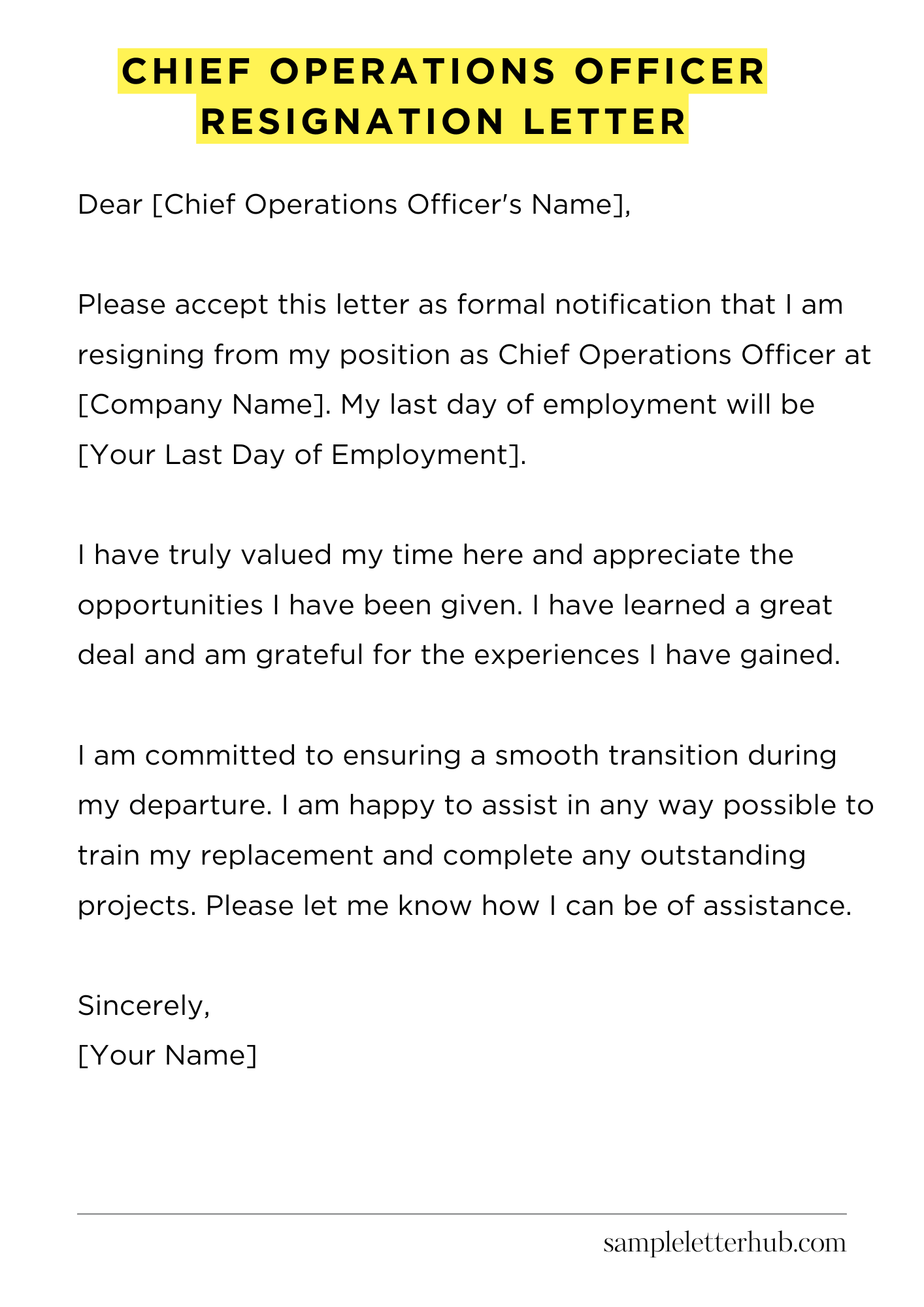
Below is a sample of a Chief Operations Officer Resignation Letter:
[Your Name]
[Your Address]
[Your Phone Number]
[Your Email Address]
[Date]
[Chief Operations Officer’s Name]
[Company Name]
[Company Address]
Dear [Chief Operations Officer’s Name],
Please accept this letter as formal notification that I am resigning from my position as Chief Operations Officer at [Company Name]. My last day of employment will be [Your Last Day of Employment].
I have truly valued my time here and appreciate the opportunities I have been given. I have learned a great deal and am grateful for the experiences I have gained.
I am committed to ensuring a smooth transition during my departure. I am happy to assist in any way possible to train my replacement and complete any outstanding projects. Please let me know how I can be of assistance.
I wish you and [Company Name] all the best in the future.
Sincerely,
[Your Name]
How to Write a Chief Operations Officer Resignation Letter
1. Preparation is Key: Before You Start
Before you even begin typing, take a deep breath. Resigning from a high-level position like Chief Operations Officer is a big deal. Consider all your options, and make sure this is truly the path you want to take. First, understand your company’s policy regarding resignations. Every company has its own rules.
This includes the required notice period and any specific procedures you must follow. This information will guide your letter’s content and structure. Next, think about why you are leaving. Are you seeking new opportunities? Maybe you are going through other challenges.
Clearly identify your reasons, but always maintain a professional tone, even if you are feeling very emotional. Finally, gather all necessary information like your official job title, start date, and your manager’s name and contact information.
2. Structure and Format: Building a Solid Foundation
Your resignation letter should follow a standard business letter format. Start with your contact information (name, address, phone number, and email address), followed by the date. Then, include the recipient’s information: the name of the recipient, their title, and the company’s address.
The next part is the salutation. Use a formal greeting, such as “Dear [Manager’s Name]”. The body of the letter needs to be clear, concise, and professional. State your intention to resign unequivocally. Here, you should include the date of your last day of employment.
Use a polite and positive tone, even if you are leaving under less-than-ideal circumstances. Also, keep the letter short. Lengthy explanations are usually not necessary. Finally, close with a professional closing like “Sincerely” or “Respectfully”.
3. Content Breakdown: What to Say and How to Say It
The core of your letter is the content. Begin with a clear statement of your resignation. For instance, “Please accept this letter as formal notification that I am resigning from my position as Chief Operations Officer at [Company Name], effective [Your Last Day of Employment].”
After the formal announcement, you might briefly thank the company for the opportunity. You can mention specific accomplishments, but do not dwell on them. If appropriate, offer to assist with the transition. This shows your commitment to a smooth handover.
Finally, keep it brief! Avoid excessive detail about why you are leaving. Remember, it’s a professional document. Your personal feelings are best discussed in person, if at all.
4. Proofreading and Review: The Final Polish
Before you hit the “send” button, proofread your letter meticulously. Spelling and grammar errors can undermine your professionalism. Read it several times, and consider reading it aloud to catch any awkward phrasing. If possible, have a trusted colleague or friend review the letter for you.
A fresh pair of eyes can often spot mistakes you might have missed. Ensure the tone is appropriate for a formal business document. It should be respectful, positive, and avoid any negative or critical language. Double-check all dates, names, and titles for accuracy. Making sure all the details are correct is important.
5. Delivery and Follow-Up: Making the Transition Seamless
Once you are happy with the final draft, determine the best method of delivery. Often, your company will have a preferred process. Usually, the letter will be delivered to your immediate supervisor. Make a copy for your records. After you submit the letter, prepare for a conversation with your supervisor.
They will likely want to discuss your resignation. Be prepared to answer questions and provide further details if needed. Lastly, be prepared to start the transition process.
Cooperate with your company’s efforts to ensure a smooth handover of your responsibilities. Maintain a positive and professional attitude throughout the transition period. This will leave a positive final impression, even as you embark on your next chapter.
FAQs about Chief Operations Officer resignation letter
What is the primary purpose of a Chief Operations Officer (COO) resignation letter?
The primary purpose of a COO resignation letter is to formally notify the employer of the intent to leave the position. It serves as an official record of the resignation, providing details such as the effective date of departure and may also include reasons for leaving and expressions of gratitude or well wishes.
What key elements should be included in a COO resignation letter?
A comprehensive COO resignation letter should include: a formal statement of resignation, the effective date of resignation, a brief and professional reason for leaving (optional but often included), expressions of gratitude for the opportunity (optional but recommended), acknowledgment of any ongoing projects or responsibilities.
How much notice should a COO provide when resigning?
The amount of notice a COO should provide typically depends on the employment contract, company policy, and industry standards. However, a minimum of four weeks’ notice is generally considered professional. In more senior roles or companies, providing longer notice, such as one to three months, is often considered appropriate to allow for a smooth transition of duties.
Should a COO explain the reason for leaving in the resignation letter?
While not mandatory, including a brief and professional reason for leaving can be beneficial. It helps provide context and can be helpful for the employer’s record.
The reason should be kept concise and positive, focusing on personal or professional growth, a new opportunity, or other relevant factors. Avoid overly detailed explanations or negative commentary about the company or colleagues.
What steps should a COO take after submitting the resignation letter?
After submitting the resignation letter, the COO should: discuss the resignation with the supervisor or board members, collaborate on a transition plan, assist with the handover of responsibilities and knowledge, adhere to any non-disclosure or confidentiality agreements, and maintain a professional demeanor throughout the remaining employment period.
It is also important to return company property and comply with exit procedures.
Related:
Resignation letter due to rude boss
Resignation letter moving to another state
Resignation letter due to illness of family member
Resignation letter due to study